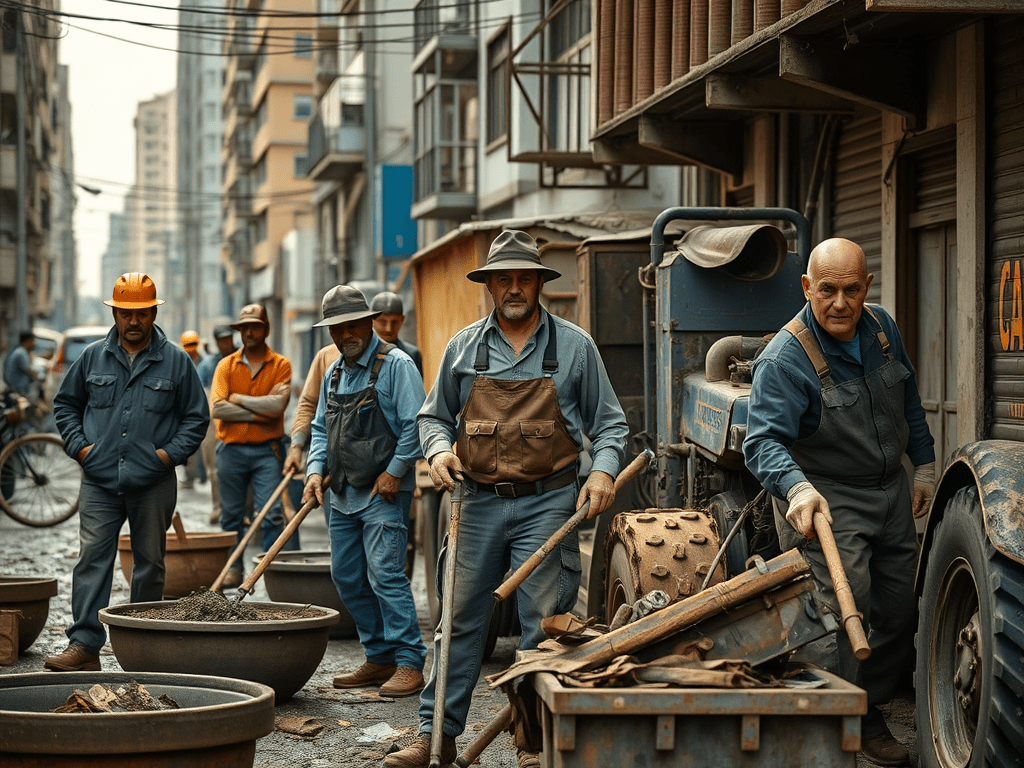
“Society works because a quiet few get up early, get dirty, and keep going while everyone else complains on WiFi.”
❖ The Invisible Backbone
Let’s get one thing straight: society isn’t held up by think tanks, reality stars, or HR managers who host workshops on eye contact. It’s held up by the 10% who make the world actually work—the farmers, the mechanics, the truckers, the sewage engineers, the people who don’t have time to go viral because they’re busy holding civilization together with their bare hands (and maybe a spanner).
They don’t trend. They don’t campaign. They don’t sit on panels. But try going a week without them.
You’ll quickly discover that your door doesn’t fix itself, your fridge doesn’t stock itself, your lights don’t turn on by virtue of your political virtue, and your toilet—well, you get the picture.
❖ Who Are The 10%?
We’re not talking about billionaires or hedge fund managers here. We’re talking about the producers—the people whose daily work produces real-world outputs you depend on but rarely think about:
- Farmers – grow your food.
- Fishermen – catch your dinner.
- Loggers and miners – extract the materials for your buildings, gadgets, and electricity.
- Oil and gas workers – keep you warm and moving.
- Truckers and train operators – bring everything from everywhere.
- Power grid engineers – make sure your Netflix works.
- Sewage and sanitation workers – keep disease at bay.
- Road crews and civil engineers – connect your world.
- Factory workers – build the tools that build everything else.
- Mechanics, welders, linemen – fix what breaks.
That’s your 10%. And without them, the other 90% would be reduced to cave-dwelling philosophers arguing about consent over campfire embers.
❖ Why They’re Ignored
These people don’t fit into politics’ obsession with visibility, votes, or virtuality. They don’t have time for optics—they’re busy operating cranes or digging trenches. The working class used to be represented by unions and movements. Now? They get sneered at by career politicians who think “plumbing” is what you call a data leak.
Governments, media, and academics tend to live in cities, attend conferences, and spend their time speaking to people like them. So naturally, the priorities shift toward the loud, the polished, and the tweetable—not the valuable.
Even worse, many policies are actively hostile to these groups:
- Fuel taxes that hit rural and transport workers hardest.
- Environmental mandates written by people who think steak comes from a biodegradable cardboard box.
- Education systems that funnel everyone into abstract theory while practical trades die out.
❖ The Real Government Failure
Every government claims to “build back better” or “deliver for working people,” but here’s what they actually deliver:
- Bloated bureaucracies that produce paperwork, not food.
- Endless subsidies for failing institutions that produce credentials, not skills.
- Media campaigns about “equity” while the grid crumbles and the bins overflow.
The truth is, governments rarely invest in resilience—because resilience isn’t sexy. There’s no ribbon-cutting ceremony when you insulate a water pipe or fix a diesel pump. But let either of those break, and society unravels faster than a university student in exam week.
The NHS, education, and the arts are held sacred. But the trucker delivering the hospital’s oxygen tanks? The gas worker keeping the school heated? The farmer producing the lunch served in Parliament?
They get taxed, ignored, and occasionally blamed for not being “green” enough.
❖ What Happens When They Stop?
Want a glimpse of collapse? Try these:
- The UK fuel crisis, when a shortage of tanker drivers emptied the pumps.
- The COVID supply chain crunch, when a few shipping bottlenecks meant supermarkets went bare.
- Power cuts in advanced economies because no one invested in infrastructure—just rhetoric.
It only takes a few missing links in the physical chain before the digital world goes dark.
❖ A Lesson From Rome (They Never Learn)
In late Rome, the farmers and engineers—the ones who kept roads open and food moving—were taxed, conscripted, and overburdened. The empire started worshipping administrators, orators, and paper-pushers. The doers fled. The system decayed. Barbarians didn’t end Rome—rot did.
Sound familiar?
❖ So What Do We Do?
We flip the priorities.
If I were king, I’d institute a National Carriers Charter:
- Tax Credits for Real-World Work
– Farmers, builders, grid workers, and transporters get priority deductions. You grow food? You get dignity. Simple. - Practical Trades Scholarships
– Enough with everyone doing media studies. Bring back funded apprenticeships. Let fixing a boiler be more respectable than managing a TikTok account. - The Producer Index
– Forget GDP. Let’s measure the health of the nation by the strength of its producer class. How well are the builders, fixers, and haulers doing? That’s your real national score. - First Line Consultation
– Any new law or tax? Must pass a basic test: how does this affect the 10% who actually keep the country alive? - Dignity by Design
– Show the value. Celebrate them in schoolbooks, media, and speeches. A welder isn’t a fallback job. It’s a foundation.
❖ Final Thought
Civilization doesn’t survive because of ideas. It survives because someone keeps the lights on, the food coming, and the waste moving. Ignore those people long enough, and one day—maybe during your next avocado toast—the machine will stop.
And there’ll be no one left to fix it.


 Chameleon Magazine
Leave a comment