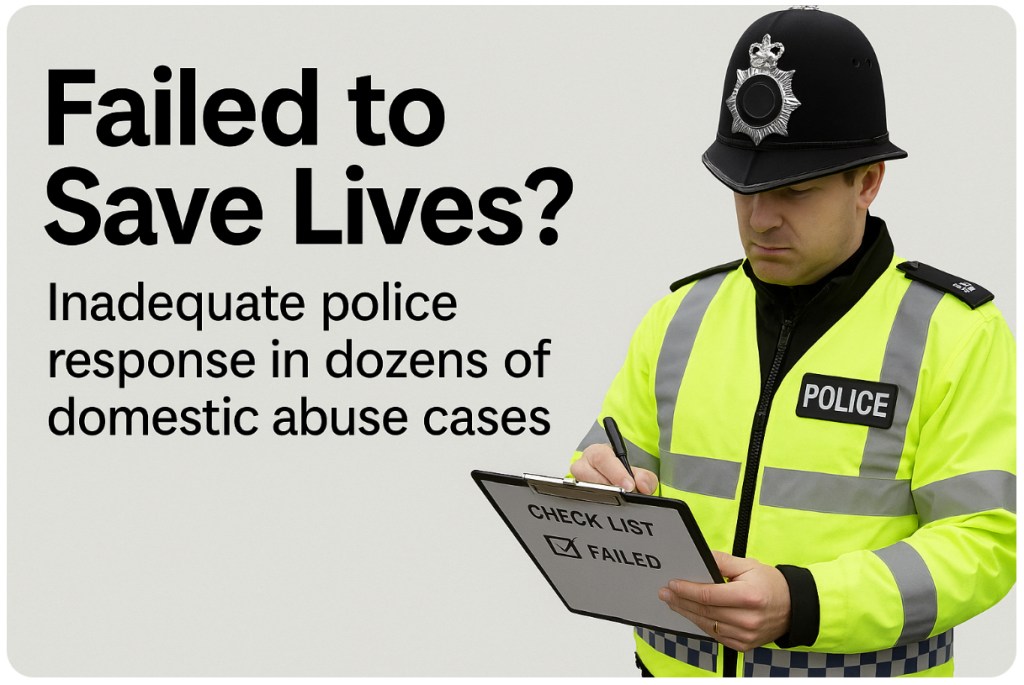
More than 50 women are dead because British police put their faith in a clipboard. The Dash checklist — the “domestic abuse risk assessment” form officers are told to rely on — has been branded “deeply flawed” after it failed to identify dozens of women as “high risk.” These women were later murdered by partners or ex-partners.
Instead of instinct, experience, or urgency, the system reduced life-or-death situations into multiple-choice admin. If a woman answered “no” in the wrong place, she wasn’t flagged as a priority. A predator could be stalking her, threatening her, strangling her — but if the boxes didn’t add up, she was classed as “safe.” Until she wasn’t.
📋 Death by Checklist
The Dash form was meant to bring consistency. What it brought was complacency. Officers could wave away gut feelings or visible danger because “the form says she’s low risk.” It turned violence into paperwork. And it turned victims into statistics.
Meanwhile, grieving families are told the same hollow mantra every time: “lessons will be learned.” But they never are. Why? Because the checklist gives the illusion of control — neat data for ministers, excuses for police, and another round of reports gathering dust while women keep dying.
☑️ The One-Box Test
If the police love checklists so much, let’s give them one that cuts through the noise. Forget 27 pointless questions. Just one will do:
👉 Did someone die after you ignored the warning signs?
• Yes
That’s it. No “medium risk.” No “context needed.” Just a brutal tick in the failure column every time bureaucracy suffocates common sense. Imagine how different the culture would be if officers had to tick their own box each time a preventable death occurred.
Because until there’s accountability, the Dash checklist isn’t a safeguard. It’s a shield — one the system hides behind while families bury their daughters, sisters, and mothers.
🔥 The Real Risk: Complacency
Domestic violence doesn’t fit neatly into a form. It escalates unpredictably. Victims often minimise danger because they’re scared or ashamed. Abusers lie, manipulate, and game the system. Any officer worth their badge knows this. And yet the reliance on tick-box tools continues — because it’s cheap, it’s easy, and it ticks another box for the Home Office.
The result? Women murdered while police point at paperwork and say, “Well, she didn’t tick the right boxes.”
🔥 Challenges 🔥
Should the Dash checklist be scrapped entirely, or should we replace it with a one-box accountability form for police? Would naming and shaming failures force change, or is the culture too far gone to fix? 💬☑️
👇 Drop your take in the comments, hit like, and share this — before “lessons learned” becomes the gravestone inscription for another woman failed by the system.
The most blistering takes will feature in our next issue. 📝🔥


 Chameleon Magazine
Leave a comment