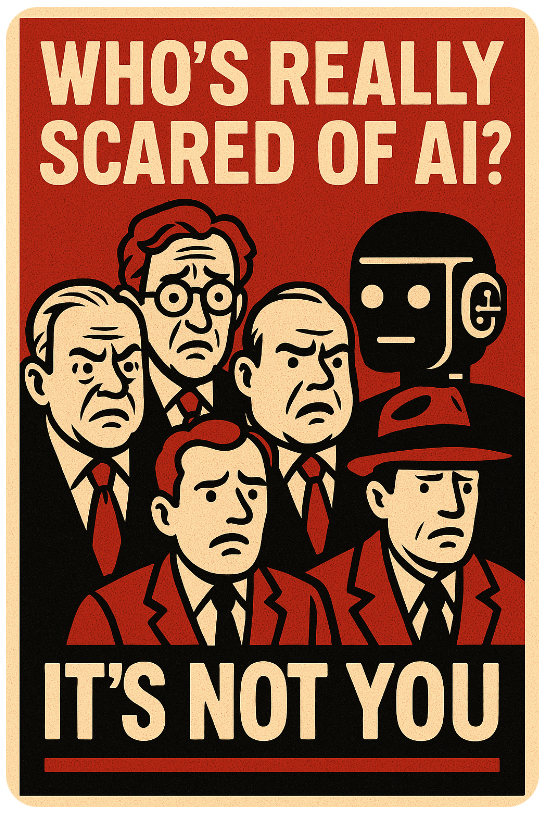
Who’s Really Scared of AI? (Spoiler: It’s Not You)
The Great Panic of the Powerful, Unpacked for the Rest of Us
By Chameleon Staff Writer
“We see you sweating behind the firewall.”
Every time artificial intelligence takes another leap forward, a parade of experts, executives, and unelected moral overlords marches onto your screen to tell you:
“Be afraid. Be very afraid.”
They’ll tell you AI is going to kill your job, confuse your kids, take over your democracy, and launch nukes on its lunch break. They warn of “existential risks” and “uncontrollable models” and “too much power in the wrong hands.”
And for once, they’re half right.
Because yes — AI in the wrong hands is terrifying.
But here’s the catch:
They’re the wrong hands.
🎩 Who’s Panicking?
Not the kid in a council flat using AI to finally pass his GCSEs.
Not the single mum building her first website with a chatbot assistant.
Not the corner shop owner automating his stock orders.
Not the worker using ChatGPT to understand a lawyer’s letter without selling a kidney.
No, the ones panicking are the people who’ve spent decades profiting from your confusion, your dependence, and your lack of access.
Let’s meet the usual suspects:
🏛️ Politicians
“This could destabilise democracy!”
Translation: This could expose my lies, incompetence, and offshore accounts.
Imagine AI fact-checking Prime Minister’s Questions in real-time.
Imagine local voters using bots to write better policies than parliament.
Imagine public opinion actually informed for once.
No wonder they’re scared. AI doesn’t care about spin doctors or party whips.
💼 Big Business
“AI might disrupt the economy!”
Translation: AI might stop me from charging you £999 for something a chatbot can do in 10 seconds.
These are the same people who:
- Automated your job.
- Moved it offshore.
- Rehired you on a zero-hours contract.
Now you get a tool to fight back — and suddenly it’s “too powerful.”
🎓 Academia
“AI might undermine education!”
Translation: AI might make people realise I’ve been overcomplicating simple ideas for 20 years to justify my funding.
When students can learn anything for free, who needs a £30k lecture series about “post-colonial semiotics in shoe design”?
Let’s be honest: some professors fear AI because it’s the first rival that doesn’t need tenure.
📰 Media Moguls
“AI might spread misinformation!”
Translation: AI might compete with my misinformation.
Legacy media is losing its grip. You don’t need a pundit anymore — you need context, clarity, and clean data.
And guess what? AI gives you all three, without the sneering agenda.
That’s why they want to regulate you using it — not themselves.
🧠 Tech Elites
“AI must be controlled before it’s too late!”
Translation: We’d like to control it before you get any ideas.
The same companies racing to build AI are lobbying to stop you from building your own. They call for “regulation” — but what they mean is: lock it behind closed doors and charge rent at the gate.
They fear open-source like vampires fear sunrise.
⚖️ Lawyers
“AI isn’t legally safe yet!”
Translation: You might realise I charge £400/hour to reword Google results.
Chatbots are already doing contracts, consumer rights advice, and small claims better than junior solicitors.
Law, like most things, isn’t as complicated as the gatekeepers want you to believe.
🪖 The Military-Industrial Complex
“AI could be weaponised!”
Translation: We already weaponised it. Now we need a reason to keep you out.
The irony? The only people currently using AI to kill people are governments and arms manufacturers.
But somehow it’s the teenager using AI to make music in his bedroom who’s the threat.
🔥 Let’s Flip the Narrative
AI isn’t dangerous to the people.
It’s dangerous to:
- The corrupt
- The obsolete
- The entitled middlemen
- The monopoly merchants
- The priests of complexity who think knowledge should be taxed
It threatens the very structure of top-down control that keeps 90% of the world stuck at the bottom of the pyramid.
And now, with a few prompts, a basic internet connection, and a bit of curiosity — anyone can join the fight.
🛠️ What We Want Instead
- Open-source AI, everywhere.
- Personal, offline AI tools that don’t need the cloud to think.
- Publicly funded, locally controlled AI for health, law, and education.
- Data privacy by default.
- Ban AI for war. Ban AI for surveillance.
- Keep AI in the people’s hands — or we’ll take it there.
🧬 Final Thought
The only thing more dangerous than AI — is letting the same old hands hold it.
Let the powerful tremble.
Because this time, it’s our tool.


 Chameleon Magazine
Leave a comment