It’s easy to laugh at people waving Union Jacks. But if you think sneering at flags is a clever takedown of power, you’ve already lost the plot.
The Statement – from a disgruntled lefty!
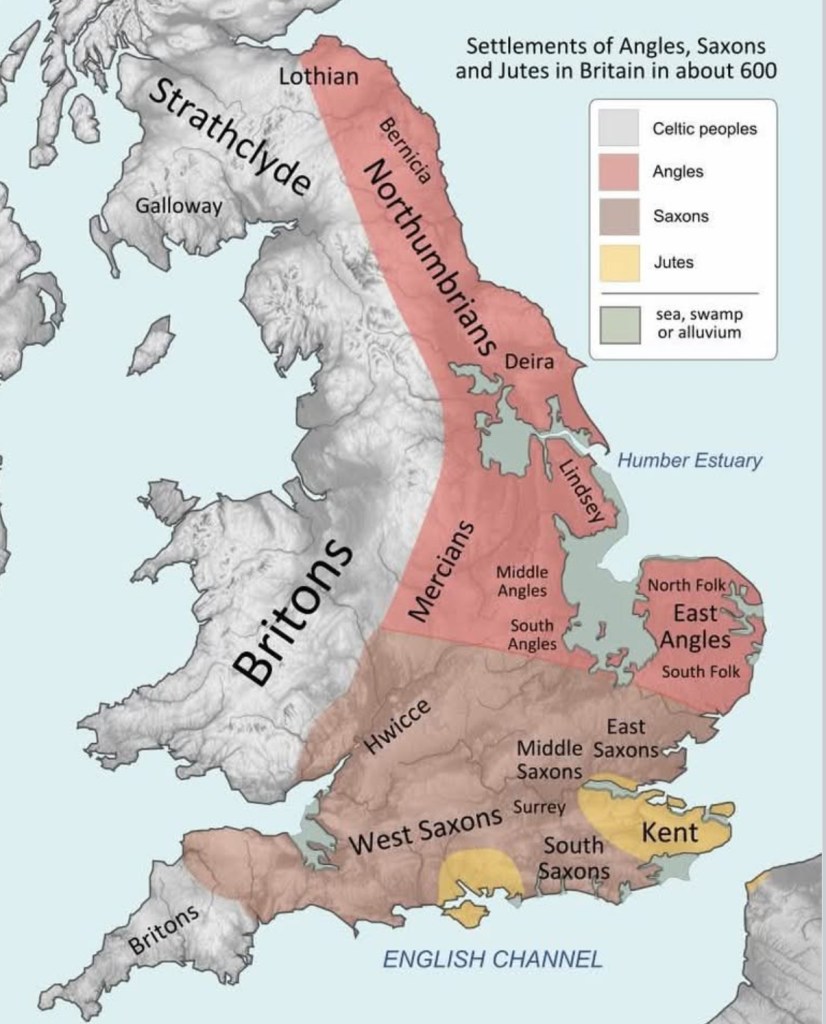
“This is a map pre-dating the creation of England… the grey is the native peoples’ geography. They were displaced by the Germanic tribes that later unified and became England. After that, the Saxons were defeated by the Norman culture. We are now living in a country ruled by a foreign aristocratic class — they own most of the land and don’t share wealth. You can’t grow veg and we are mostly all crammed into cities and towns and told there isn’t enough room or money to support humans who are fleeing war-torn areas that the very same rulers deliberately propagate by selling weapons. So keep painting those flags guys.”
Why This Argument Falls Apart
At first glance, this feels powerful — a sweeping attack on elites, history, and hypocrisy. But once you scratch the surface, the whole thing collapses under its own contradictions. Here’s why:
1. History as a Trump Card (That Doesn’t Work)
Yes, England was shaped by waves of conquest: Britons, Saxons, Normans. That’s not news — it’s Year 7 history. But saying “we’re ruled by foreigners, therefore today’s national identity is fake” is meaningless. By that logic, no culture on Earth is real. Italy? Roman, Gothic, Norman. France? Celtic, Frankish, Roman. Everywhere is built on waves of migration.
If you take this to its logical conclusion, nobody has a home. That’s not an argument — that’s nihilism.
2. The Aristocracy Scapegoat
Yes, a tiny elite own obscene amounts of land. But claiming “you can’t grow veg” because the aristocrats won’t let you is just silly. People grow veg in gardens, allotments, community plots — the problem isn’t medieval dukes fencing off cabbage patches, it’s housing policy, planning rules, and modern capitalism. Waving the word “Norman” around like it explains everything is lazy history cosplay.
3. The Refugee Contradiction
The statement says: “we’re crammed into cities, no room for refugees” — while also admitting the elite profit from wars that create refugees. That’s the real hypocrisy! But the anger ends up pointed downwards, at desperate families, not upwards at the arms-dealers and warmongers. You can’t condemn the causes and then sneer at the victims. Pick a side.
4. Flags Aren’t the Problem
The sarcastic “keep painting those flags guys” totally misses the point. People don’t wave flags because they love aristocrats or arms sales — they wave flags because they want identity, belonging, and respect. Mocking the flag doesn’t dismantle elite power. It just alienates the very people you claim to care about.
5. No Blueprint, Just Rage
And the biggest flaw: there’s no vision of what comes after. If flags are stupid, if nations are fake, if land is stolen and elites are corrupt — fine. But then what? What replaces them? Shared values? New systems of ownership? A different kind of democracy? Without offering an alternative, all this amounts to is: “Everything you care about is stupid, and I’m smarter than you.” That’s not persuasion — that’s provocation.
The Real Issue
There are real injustices — grotesque land inequality, arms sales, refugees trapped in limbo, communities starved of housing. But if you want to convince people, you can’t just sneer at their flags and mutter “foreign aristocrats.” That doesn’t challenge power — it just deepens the divide between you and the very people you need on side.
The Hard Truth
It’s easy to rage against history, flags, and other people’s beliefs. It’s much harder to imagine what should replace them. A country is more than land deeds and battle scars — it’s the stories people share, the values they defend, and the futures they’re willing to build together.
So if you want to tear down someone’s flag, at least be ready to offer them something better to hold in their hands. Otherwise, you’re not fighting injustice — you’re just picking a fight. And in the end, change that only serves your own beliefs isn’t liberation. It’s just another form of control.
👉 Final Word: The challenge isn’t to make people give up their symbols. The challenge is to ask: What can we build together that’s stronger than symbols? If you can’t answer that, maybe the problem isn’t with the flag-wavers — maybe it’s with you.


 Chameleon Magazine
Leave a comment