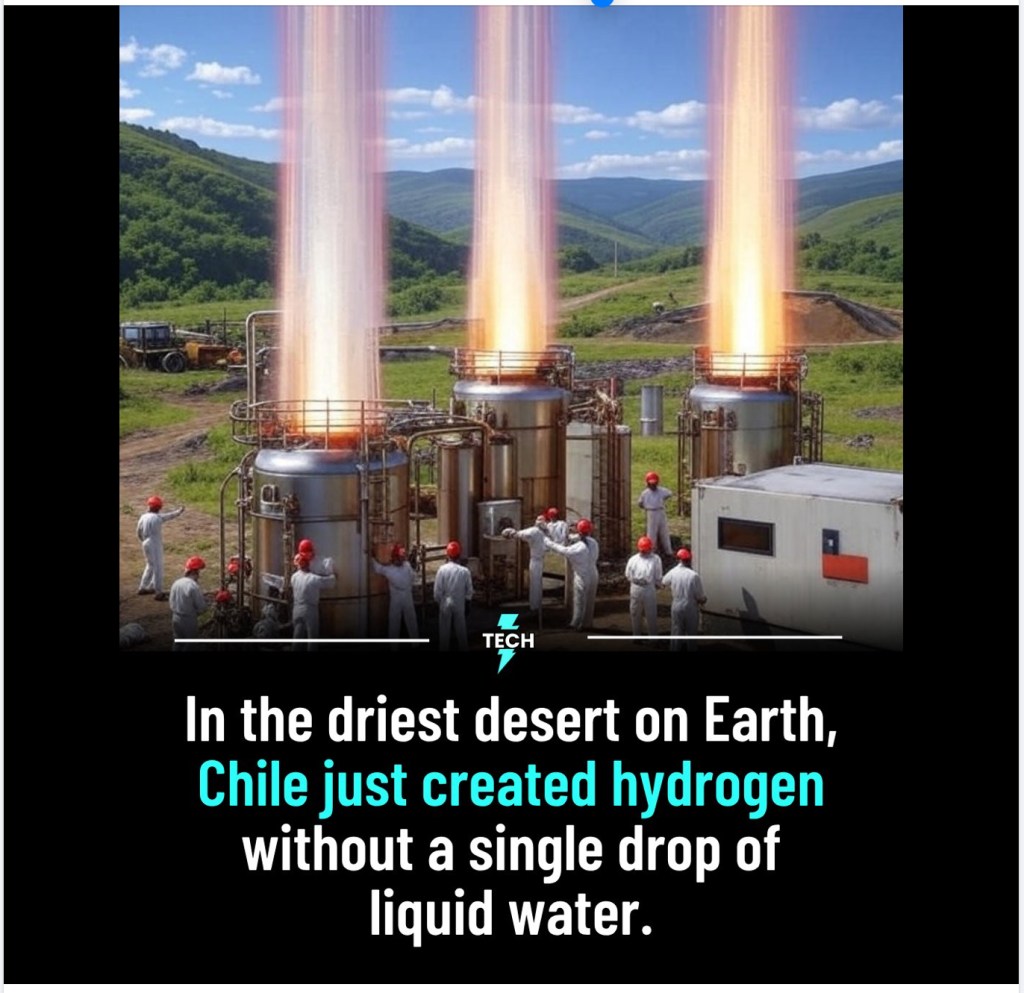
☀️💨⚗️In the unforgiving heat of the Atacama Desert, Chile has just pulled off a move that looks less like energy policy and more like science fiction. Forget dams, pipelines, or power plants—this is sunlight, thin desert air, and a splash of German engineering fused into the world’s first solar-to-hydrogen refinery. They’re calling it the H2Atacama Project, but let’s be real—it’s desert alchemy.
🔥 Hydrogen Without Water? Believe It
Traditional hydrogen production guzzles water like a hungover rugby team. But what happens when your desert has less water than a martini glass at a nun’s convention? You improvise. Instead of wasting gallons of drinkable water, Chile’s thermocatalytic solar reactors just pull vapour straight from the air. Then—bam!—high-concentration sunlight slams through solid-state chambers, splitting molecules into pure hydrogen.
No grid. No dams. No guilt. Just a refinery that churns out 120 kilos of hydrogen per day, in a desert where even cacti need counselling. Plans are already underway to multiply that output tenfold.
And the kicker? This isn’t just a Chilean stunt. Modular units mean the same tech could be dropped into mining camps, desert military bases, or island nations that couldn’t dream of clean fuel access until now. It’s green hydrogen that thrives where even weeds give up.
Forget “Saudi Arabia of solar.” Chile just leapfrogged straight into “lab of the future.”
🔥 Challenges 🔥
If hydrogen can be born from air and sunlight in the driest desert on Earth, what excuse do oil and gas giants have left? Could this kill fossil fuels faster than we think—or will big energy lobbyists smother it before it scales? Drop your take in the blog comments. 💬
👇 Comment, like, and share—could Chile’s desert sorcery be the true game-changer?
The sharpest and boldest takes will make it into the next issue of the magazine. 📝⚡


 Chameleon Magazine
Leave a comment