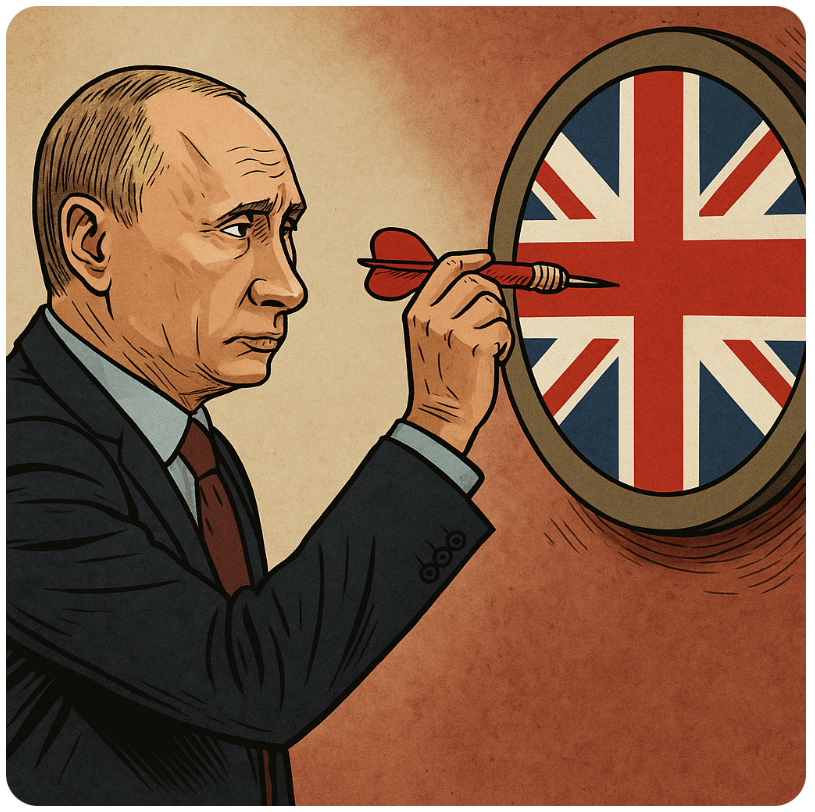
🎯🇷🇺🇬🇧Vladimir Putin doesn’t even need to launch missiles at London anymore—he just takes potshots at British outposts abroad for sport. Case in point: the attack on the British Council building in Kyiv. And the response from the so-called “special relationship” across the pond? A shrug. No sanctions, no slap on the wrist, not even a strongly worded Hallmark card from Washington.
🏚️ Britain: The Easy Punching Bag
Britain today isn’t a mighty fortress—it’s a damp tent flapping in the wind. Bankrupt, weakened, politically confused, and run by leaders more interested in PR stunts than power. Putin knows it, the White House knows it, and apparently, the British public is the last to admit it.
The Kremlin’s logic is simple: why bother with NATO’s heavyweights when you can humiliate the featherweight wobbling at the edge of the ring? Britain has become the geopolitical equivalent of a training dummy—perfect for Putin’s “message sending” without triggering any real consequences.
🦅 America’s Cold Shoulder
And where’s Uncle Sam in all this? Busy elsewhere. Ukraine aid, Gaza fires, China tension—plenty of global crises to juggle. So when Putin smacks down a little British institution abroad, Washington yawns. The “special relationship” is starting to look less like Churchill-Roosevelt and more like a bad situationship: one side giving everything, the other barely returning texts.
For Putin, that’s the jackpot. Every time the West looks away, every time Britain takes a hit without backup, the Kremlin gets bolder. Britain becomes weaker. And the world gets a little more dangerous.
🔥 Challenges 🔥
Has Britain become a sitting duck for Putin? Should America back its ally harder—or is the UK just no longer worth the trouble? And if Britain is this fragile, what does that say about the rest of Europe’s security? 💬
👇 Comment, like, share—your voice matters more than the silence from Washington.
The sharpest takes will be featured in the next issue of the magazine. 📝⚡


 Chameleon Magazine
Leave a comment