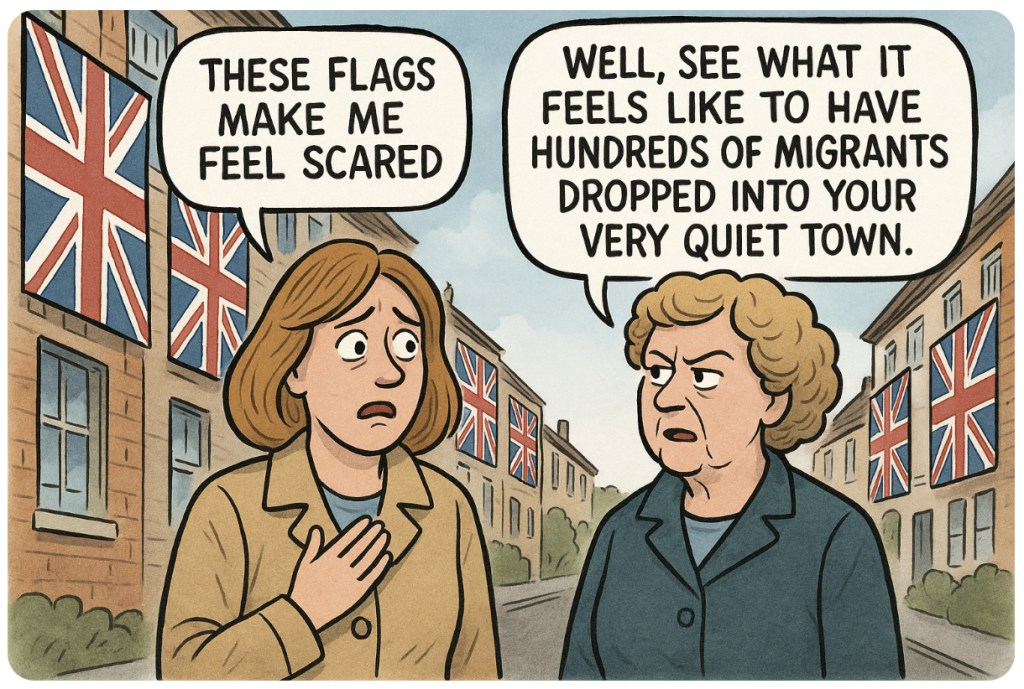
Flags, Fears, and Forgotten Voices
Walk down any British street these days and you’ll hear the whispers: some are spooked by a Union Jack fluttering in the breeze, others by the sound of coaches pulling up at the edge of town. Both fears are real to the people holding them, but only one seems to get airtime.
The Flag Fear
For a certain crowd, flags have become a trigger. Too much bunting on the lampposts and it’s suddenly a march toward authoritarianism. A banner in the window, and it’s no longer patriotism but intimidation. The Union Jack is apparently no longer cloth on a stick but a full-blown psychological weapon.
The Town Fear
Then there are those who live in quiet villages and towns, suddenly told their community is now home to hundreds of new arrivals. No consultation, no discussion, just buses arriving under cover of night. Services already stretched buckle further, and the sense of control slips away. For these residents, it’s not the bunting that’s frightening—it’s the speed of change without anyone asking their opinion.
The Real Divide
The problem isn’t the flags, or even the migrants. The problem is that both sides are talking past each other. One lot are busy psychoanalyzing bunting while the other are staring at packed GP waiting rooms, crowded housing lists, and jobs they can’t get near. The fears are different, but both are dismissed by the other as nonsense.
What This Says About Us
Britain has always been a country of symbols—red buses, cups of tea, stiff upper lips, and yes, flags. But it has also been a country of small towns, lived-in communities, and people who feel ownership over their patch of land. Ignore one fear and mock the other, and you end up with a nation that doesn’t speak to itself anymore.
The Closing Thought
Maybe the flags and the migrants aren’t really the issue. Maybe what people fear most is being unheard. One group feels their cultural identity is being caricatured into nationalism, the other feels their way of life is being bulldozed by policy decisions made in distant offices. Neither group is crazy—but the silence between them is deafening.


 Chameleon Magazine
Leave a comment