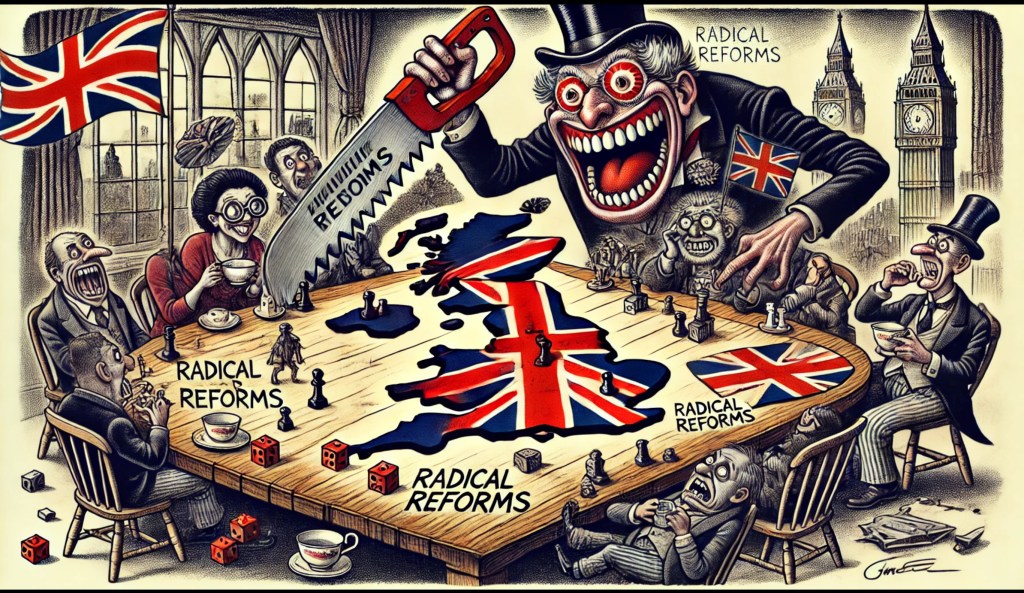
Every week it seems Britain is diagnosed with another terminal condition: morally constipated, economically anaemic, institutionally arthritic. Enter Sir Michael Ellis, clutching his bold prescription pad and scribbling down Trump-inspired “cures” like an overzealous GP on performance-enhancing coffee. His diagnosis? The state is sluggish, risk-averse, and choked by committees. His remedy? Strip away the checks, juice up the executive, and bulldoze pesky oversight in the name of efficiency. In other words: when in doubt, centralise power, then ask questions later.
🏛️ “Fixing” Britain with a Sledgehammer
The Ellis formula is dazzlingly simple: if Parliament, judges, or regulators slow things down, clip their wings. If democratic guardrails exist, treat them like speed bumps and pave them flat. Efficiency über alles. Sure, the machinery of state currently feels like a wheezing fax machine trying to send an email, but replacing it with a turbocharged “decisive” government is like saying the solution to a leaking roof is to burn the house down and pitch a tent.
Ellis insists Britain can’t afford tinkering — only radical surgery. But history whispers (or yells, depending on how many gin and tonics you’ve had): concentrated executive power rarely produces “competence.” It produces spectacular mistakes, just faster, bigger, and harder to reverse.
⚡ The Myth of “Decisive Government”
Here’s the punchline: the problem isn’t just the plumbing, it’s the plumbers. Britain’s woes often stem less from structures and more from skills. Weak leadership, underfunded public services, ministers who resign faster than milk goes off — these can’t be solved by constitutional demolition. Give an unprepared government more unchecked power, and all you’ve done is hand the toddler a sharper pair of scissors.
And if Ellis wants to mimic Trump’s America, he should take a closer look at how “decisive” government ends: lawsuits, chaos, institutions stretched to breaking point, and half the country treating each election as a battle for survival. Efficiency? More like whiplash.
🔥 Why This Could Backfire (Spectacularly)
- Public trust is already circling the drain. Strip away accountability and suddenly “fast action” looks a lot like “power grab.”
- Civil liberties don’t do well under hasty executives. Ask anyone who’s been kettled at a protest.
- Polarisation feeds on exclusion. Ignore too many voices and you don’t get legitimacy — you get backlash, populism, and the mother of all constitutional migraines.
Britain isn’t just broken because its gears grind slowly. It’s broken because people feel unheard, politicians play musical chairs with zero follow-through, and the system bleeds money into potholes and procurement disasters. None of Ellis’s turbocharged reforms fix that — they just centralise the dysfunction.
🧩 Renovation, Not Demolition
Britain does need reform. But not a Trump-flavoured bonfire of conventions. Think renovation, not razing. Rebuild trust, invest in capability, modernise institutions without trashing the safeguards that prevent abuse. The country isn’t terminally broken — unless we panic and hand the steering wheel to whichever strongman promises shortcuts.
The choice isn’t “decline forever” or “dictatorship-lite.” There’s a middle ground. But finding it requires imagination, patience, and leadership — three resources currently scarcer than NHS dentists. 🦷
🔥 Challenges 🔥
So here’s the real question: would you trade Britain’s slow, lumbering bureaucracy for a slicker but more authoritarian system? Or would that just swap one nightmare for another? Is Ellis a visionary reformer — or just Britain’s latest snake-oil salesman? 🐍💊
👇 Spill your thoughts in the blog comments (not just Facebook — we see you lurking). Argue, roast, suggest, rant.
The sharpest takes will make it into the next magazine issue. 🎯📝


 Chameleon Magazine
Leave a comment