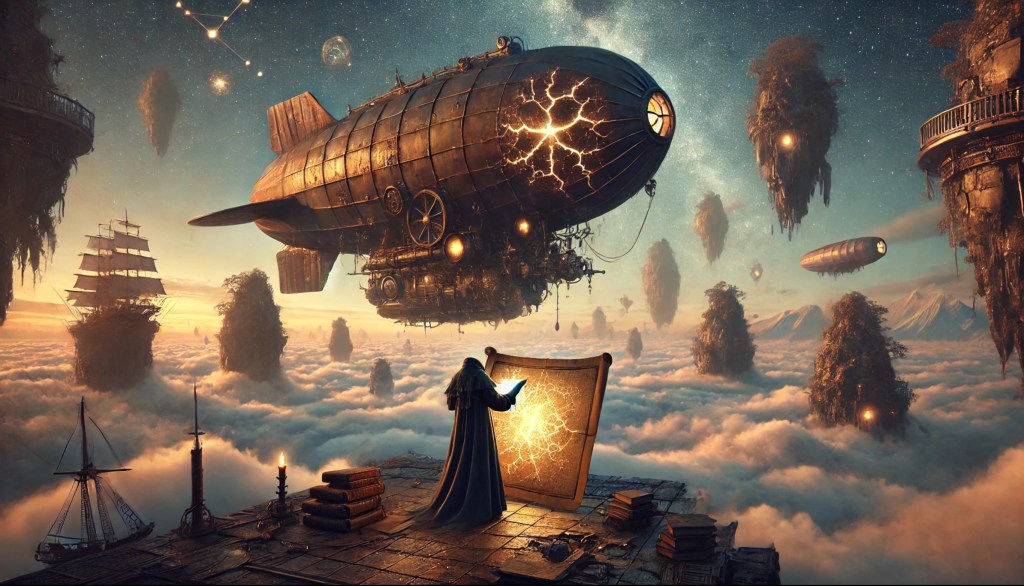
Long after the Great Tide swallowed the old continents, the survivors gathered upon a single sprawling archipelago called Terra Novus. It was said the world had once been whole—a single landmass where every voice spoke in harmony—but that was before the Fracture, when the seas rose, and humankind forgot its shared tongue.
From that scattering, the Archivist Guild was born. Their charge: to record every people, every language, every shore. They traveled with parchment and ink, charting the new nations like cartographers of human difference.
The First Archivist, known as Nara the Listener, carried a book bound in fishskin called The Atlas of Division. Into it she inscribed the genealogies of nations—not by blood, but by the spirit of invention. She wrote of the Builders of Glass, who raised cities that bent the light of dawn into colors unseen; of the Whisperers of Stone, who taught their children to read the movements of mountains; and of the Sailors of the Sky, who strung zeppelins together to form floating colonies above the storms.
Yet as she mapped, Nara began to notice something unsettling. The further the Guild traveled, the more each people spoke of their uniqueness not as a gift, but as a weapon. The Builders despised the Whisperers for their silence; the Sailors mocked those who stayed grounded. Words that once built bridges now drew borders.
One night, high above the coral city of Arvad, Nara climbed to the roof of her airship. There she unfurled the Atlas, and for the first time, saw that every line of division she had drawn—every border, every label—was shaped like a crack through the world itself. It was beautiful, and terrible.
When dawn came, she gathered the Guild.
“We set out to record the families of the world,” she said, “but perhaps we were only tracing the fractures of our own forgetting.”
The Guild members looked uneasy. “Then what should we do?” one asked.
“Keep mapping,” Nara replied, “but this time—seek the hidden roots beneath the names. For every nation divided was once a single breath.”
And so the Atlas was rewritten. It became not a record of separation, but of echoes—maps that, when held up to the light, revealed how each island mirrored another, how every tongue contained a memory of the first word ever spoken: home.
“What divides the world are not the borders we draw, but the names we forget once belonged to one another.”


 Chameleon Magazine
Leave a comment