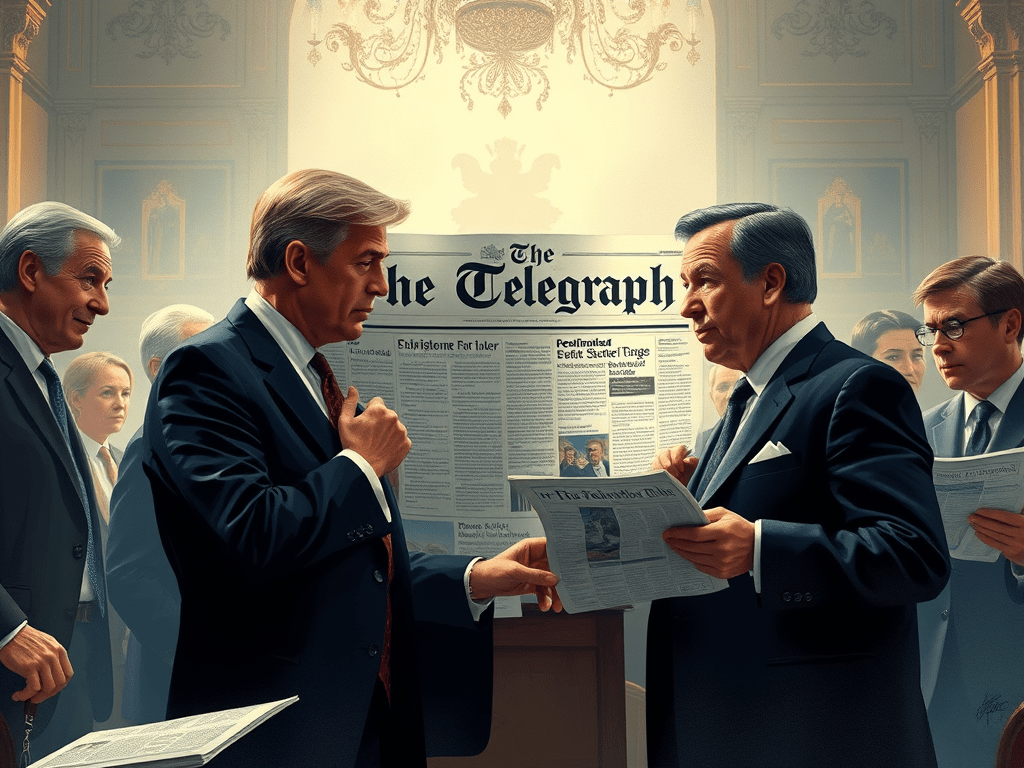
📰💼💸Welcome to the media bazaar, where centuries of journalistic tradition can now be acquired like a midlife crisis sports car — financed by a consortium of bankers, billionaires, and possibly Beijing. RedBird Capital’s £500m bid for The Telegraph has become the national equivalent of watching a family heirloom auctioned off to the highest bidder while everyone politely insists it’s “for the good of journalism.”
🕵️♂️ “Free Press” — Now With Extra Surveillance
It’s a simple story: one of Britain’s oldest newspapers, caught between the dusty ledgers of the Barclay family’s debts, might soon be owned (in part) by the UAE royal family, advised by men with business ties to China, and politely rubber-stamped by Westminster — all under the banner of “editorial independence.” What could possibly go wrong? 🤷♀️
Ministers assure us that no “foreign state will have control.” Which is comforting, except for that awkward bit where nobody can actually explain where all the money’s coming from. But don’t worry — it’s all in the hands of private equity bankers who definitely aren’t trying to buy influence, just “investing in free speech.”
Meanwhile, the House of Lords is engaged in a polite panic, whispering about “national security” while the Culture Secretary promises to “consider” an investigation. Translation: expect a sternly worded memo, followed by tea. ☕📜
And RedBird’s chairman, a man on the advisory council of China’s sovereign wealth fund, assures us there’s no Chinese money involved — a statement so specific it deserves its own lie detector test.
🧨 Challenges 🧨
Would you trust your morning newspaper if it were half-owned by a royal court and half-funded by mystery money? Should the press be a playground for geopolitics? Or should someone, somewhere, remember that journalism is supposed to serve readers — not regimes? 🧐💬
👇 Sound off in the comments — we want outrage, wit, and unfiltered British sarcasm. Don’t hold back. The sharpest takes will be featured in our next issue. 🖋🔥


 Chameleon Magazine
Leave a comment