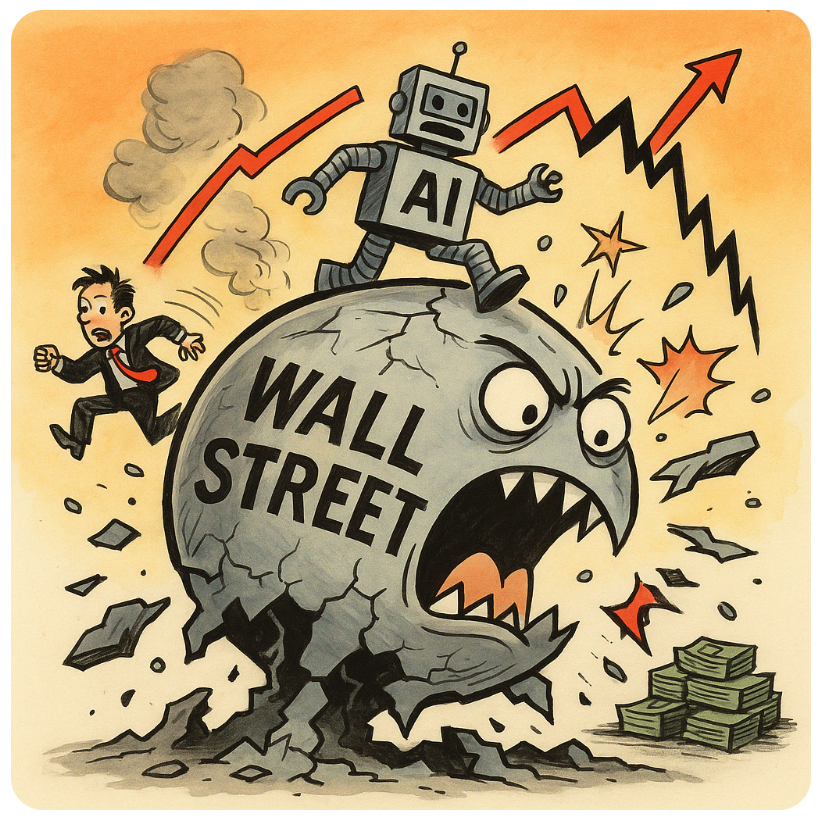
💥📉When the market starts behaving like a toddler on a sugar high, you know nap time (a.k.a. correction) isn’t far off. Stocks are soaring, analysts are shrugging, and investors are convincing themselves that the laws of gravity have been repealed. Spoiler: they haven’t. Between overinflated AI valuations, binge-borrowed margin debt, and policymakers juggling chainsaws labeled “soft landing,” the global economy feels less like a market and more like a high-wire act performed over a volcano. 🌋
🤖 Tech Euphoria or Just Another Bubble in Fancy Sneakers?
The so-called “AI revolution” has turned the stock market into a cosplay convention for future trillionaires. Everyone’s pretending to be the next OpenAI, Nvidia, or “AI-powered disruptor of literally everything.” But peel back the buzzwords and you’ll find companies with PowerPoints instead of profits.
The Buffett Indicator — that old-fashioned measure of how absurdly priced everything is — just hit around 218% in the U.S. That’s not “a bit frothy.” That’s “champagne geyser in zero gravity” levels of insane. Meanwhile, a handful of mega-cap tech titans are propping up the entire market like wobbly Atlas statues, and everyone’s acting like diversification is for cowards.
Even the IMF and the Bank of England — institutions that usually speak in the soothing tones of bureaucratic anesthesia — are now whispering “bubble” through clenched teeth. They’ve spotted the same pattern that shows up before every market implosion: euphoria, leverage, denial, and a vague belief that “AI will fix it.”
💸 Margin Debt and the Global House of Cards
Let’s talk leverage — because what’s a good financial disaster without a little borrowed hubris? Margin borrowing is up roughly 18.5% in a single quarter. That’s one of the sharpest spikes since 1998, when Titanic was still in theaters and people thought dial-up internet was cutting-edge.
History lesson: margin debt surges always end the same way — in panic-selling, bank meltdowns, and CNBC anchors using the word “plunge” every 10 minutes. But hey, at least Jamie Dimon’s giving us a heads-up. When the CEO of JPMorgan Chase says there’s a 30% chance of a serious market fall, it’s not because he’s practicing mindfulness. It’s because he’s seen the receipts. 📉
🌍 Politics, Policy, and the Global Domino Effect
Add a dash of geopolitics to the mix — trade wars, tariffs, global tensions — and you’ve got a recipe for a financial soufflé that’s about to collapse. Inflation may have cooled a little, but interest rates are still sky-high, debt levels are ballooning, and policymakers are stuck between “do nothing” and “make it worse.”
In past crashes, it was the combination of overvaluation, external shock, and policy paralysis that did the trick. Today? Check, check, and check. All we need now is a spark — maybe an earnings miss from a tech darling, a surprise rate hike, or an “oops” moment from a leveraged hedge fund — and suddenly, everyone remembers that stocks can go down.
🧠 But Maybe… It’s Just a Correction, Not the Apocalypse
Let’s be fair — a correction doesn’t always mean the sky is falling. Markets can fall 10–20% and bounce back. Some AI companies are genuinely profitable, and innovation is happening. The problem isn’t tech — it’s the cult around it. Investors aren’t buying businesses; they’re buying narratives with glossy investor decks.
Timing a crash is like predicting when your cat will knock the glass off the table: inevitable, but impossible to pin down. Could this madness continue for another six months? Absolutely. Could it unravel next week? Just as easily.
🛠️ What to Do Before the Music Stops
If you’re staring at your portfolio like it’s a ticking time bomb, here’s the move: don’t panic — prepare.
- Review your exposure. If your portfolio looks like a tech fan club, it’s time for an intervention.
- Diversify. Cash, bonds, alternatives — anything that isn’t a single point of failure.
- Hedge smartly. A bit of insurance now beats a fire sale later.
- Prioritize quality. Companies with strong balance sheets and actual cash flow survive storms.
- Have a plan. Know what you’ll do before volatility hits — not during it.
- Don’t try to time the exact top. That’s how you end up broke and bitter on Reddit.
Markets don’t reward panic — they reward preparation. So strengthen your defenses now, and when the storm comes, you’ll be the one selling umbrellas while everyone else is getting drenched. ☔💼
🧩 The 6–18 Month Window: What Could Trigger the Tumble
Here’s your likely timeline. Within the next year or so, expect volatility spikes.
Possible triggers include:
- A tech earnings miss that pops the AI bubble.
- A geopolitical event — tariffs, war, or regulation shock.
- A monetary policy misstep that reignites inflation or crushes liquidity.
- A financial accident — a debt default, a non-bank collapse, or margin calls spiraling out of control.
Think of it as a game of Jenga — we don’t know which block will topple the tower, only that it’s getting taller and wobblier.
🔥 Challenges 🔥
So, what’s your move when gravity catches up? Will you double down on “buy the dip,” or quietly shift your portfolio toward sanity? 🤔 Will you brag about diamond hands or finally admit that diversification was the adult thing to do all along?
Drop your thoughts in the blog comments — not just the social feeds where everyone suddenly becomes a macroeconomic prophet after reading one Reddit thread. 📊💬
👇 Comment, like, and share this post if you can see the cracks forming beneath the bull market’s hooves. Let’s hear your predictions, your panic plans, and your best survival tips for the next great correction.
The most insightful, hilarious, and brutally honest takes will be featured in the next issue of the magazine. 📰🔥


 Chameleon Magazine
Leave a comment