⚖️🔥Labour’s decision to rewrite the official definition of Islamophobia has cracked open a question that Britain has been nervously avoiding for years — one that lies at the tangled crossroads of race, faith, and power: why do some communities get a bespoke definition of hate, while others are told to simply “cope”?
We now live in a country with official vocabulary for Islamophobia, antisemitism, and Afrophobia — complete with parliamentary debates, hashtags, and HR training modules. But mention anti-Christian sentiment, or discrimination against white Britons, and the room fills with awkward silence and the faint hum of moral confusion. Apparently, not all hate is created equal.
The logic, we’re told, is “historical.” One group oppressed; another dominant. But history, like privilege, doesn’t grant immunity. A school pupil mocking Jesus in a classroom is “expression.” A comedian sneering at white working-class men? “Satire.” Reverse those roles, and you’ll need a PR crisis team before the punchline lands.
This isn’t a denial of real prejudice. Islamophobia, antisemitism, racism — all very real, all poisonous. But so is the growing inconsistency in how we respond to hate, depending on who is hated. The Equality Act doesn’t pick favourites; our culture does. And that selective moral outrage isn’t equality — it’s theatre.
The moment we start dividing hatred into categories, we turn empathy into a competition and pain into a brand. Each community becomes a franchise in the suffering Olympics, jostling for recognition, resources, and righteous hashtags. Hate becomes a hierarchy, not a human failure.
Britain doesn’t need another label, another definition, or another parliamentary working group on who qualifies for compassion. It needs a single, unbreakable truth: every citizen — Muslim, Christian, atheist, Hindu, Sikh, Black, white, whatever box you tick — deserves equal dignity under the same moral sky. 🌍✋
🧾 The Great Bureaucracy of Bias
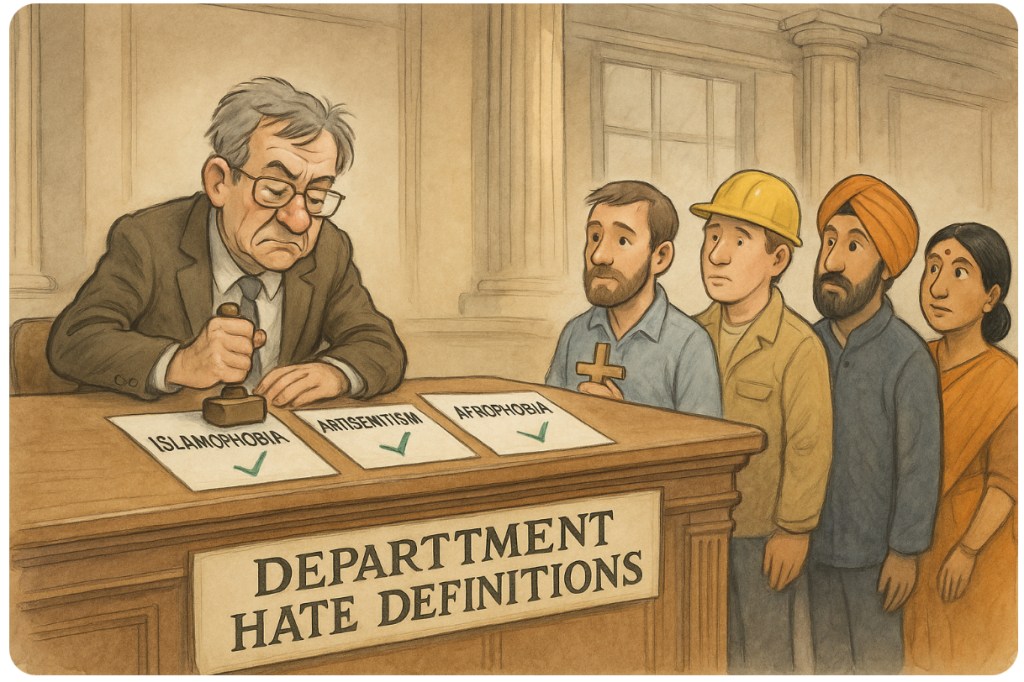
Imagine the scene. A grand government office: mahogany desks, dusty filing cabinets, and a weary civil servant hunched over a stack of moral paperwork. Above his head, a brass plaque reads “Department of Hate Definitions.”
One by one, people approach the counter. The clerk stamps the forms with the efficiency of a saint gone cynical.
- “Islamophobia?” ✅ Approved.
- “Antisemitism?” ✅ Naturally.
- “Afrophobia?” ✅ Of course.
Then comes a Christian with a small cross, a white builder with calloused hands, a Sikh, a Hindu. They shuffle forward, clutching forms of their own.
The clerk glances up, squints, and sighs: “Sorry — we’re out of definitions for this quarter.”
Equality, it seems, has a stock limit.
This is Britain’s moral admin machine in 2025 — endlessly categorising, endlessly dividing, endlessly congratulating itself for caring selectively. Because in this strange new ecosystem, outrage isn’t about justice; it’s about fashion. And right now, some forms of hate are trending — while others are quietly unfunded.
The tragic irony? Every time we gatekeep empathy, we prove we’ve forgotten its meaning. 💔
💬 Challenges 💬
Why does equality feel like a membership club with a waiting list? When did empathy become rationed by politics?
Drop your thoughts in the blog comments — not just social media rants. Let’s have the real debate, the one polite society keeps ducking. 🗣️🔥
👇 Comment. Like. Share. Challenge the moral maths.
The sharpest takes and boldest burns will be featured in our next magazine issue. 💥📝


 Chameleon Magazine
Leave a comment