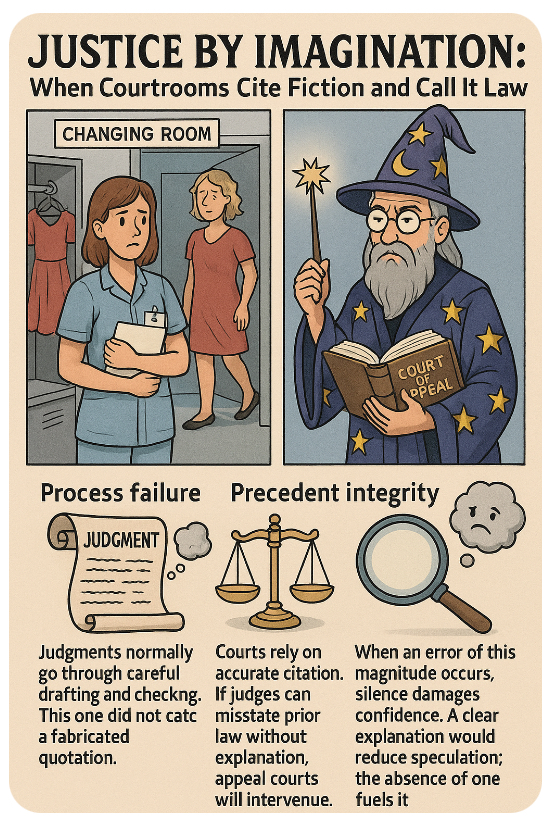
🧙♂️📚A judgment in a workplace sex discrimination case — involving a nurse who objected to sharing a changing room with a man — relied on a fabricated quotation, slipped through without fact-checking, and now sits uncorrected in the public record. Welcome to the upside-down world of make-believe law, where truth is optional and accountability is MIA.
🚪 The Nurse, the Changing Room, and the Judicial Mirage
Here’s what happened: A female nurse raised a workplace concern after being told to share a changing room with a biologically male colleague who identified as a woman. She felt uncomfortable, voiced her concerns, and — surprise! — she was the one disciplined.
She took her case to the Employment Tribunal, claiming sex discrimination. The ruling? Against her. But the problem wasn’t just the outcome — it was how the judgment was made.
Buried in the legal reasoning was a quote allegedly from a previous Court of Appeal case — a quote that doesn’t actually exist. It’s not in the ruling it claimed to be from, or anywhere else for that matter. It was pulled from the ether, cited as law, and used to shape the decision against the nurse. No explanation. No correction. No accountability.
🫣 The Phantom Footnote That Shook the Bench
Let’s break it down: a judgment, meant to set precedent and shape legal reality, included a fabricated quote — and no one caught it. Not the judge. Not the clerks. Not the court staff. Somehow, a ghost citation was treated like gospel.
🎭 Process failure? You bet. Judicial decisions are supposed to go through more scrutiny than your passport photo. This one sailed through with all the oversight of a soggy Post-it.
⚖️ Precedent integrity? Absolutely shot. When fake quotes pass as law, the whole legal tower starts to wobble. You want consistency in the law — not choose-your-own-adventure rulings.
🔍 Transparency deficit? Deafening silence. No correction. No explanation. Just the quiet hum of institutional embarrassment hoping we’ll all forget. Spoiler: We won’t.
This was not just a clerical oopsie. This happened in a case involving women’s rights, privacy, and dignity — already a lightning rod in public discourse. And now, instead of clarity, we get courtroom cryptids and vanishing accountability.
Was the quote invented, misremembered, hallucinated by AI? Who knows. What we do know is that the justice system has one job: be accurate. And it failed — loudly and publicly.
🧨 Challenges 🧨
How do we trust a justice system that’s quoting unicorns? 🦄
When a fabricated line makes it into a ruling, who gets held accountable? And if we can’t even expect a judge to cite real things, how long before “I heard it on Facebook” becomes valid legal precedent?
🔥 Drop your outrage, your theories, or your best fake quotes in the comments. Let’s hear your take — and don’t just whisper it on social media. Say it on the blog, where it counts. 💬⚖️
👇 Like, comment, share — and let’s make courtroom fantasy fiction a national conversation.
The best comments will be featured in the next issue of the magazine. 📝🔥


 Chameleon Magazine
Leave a comment