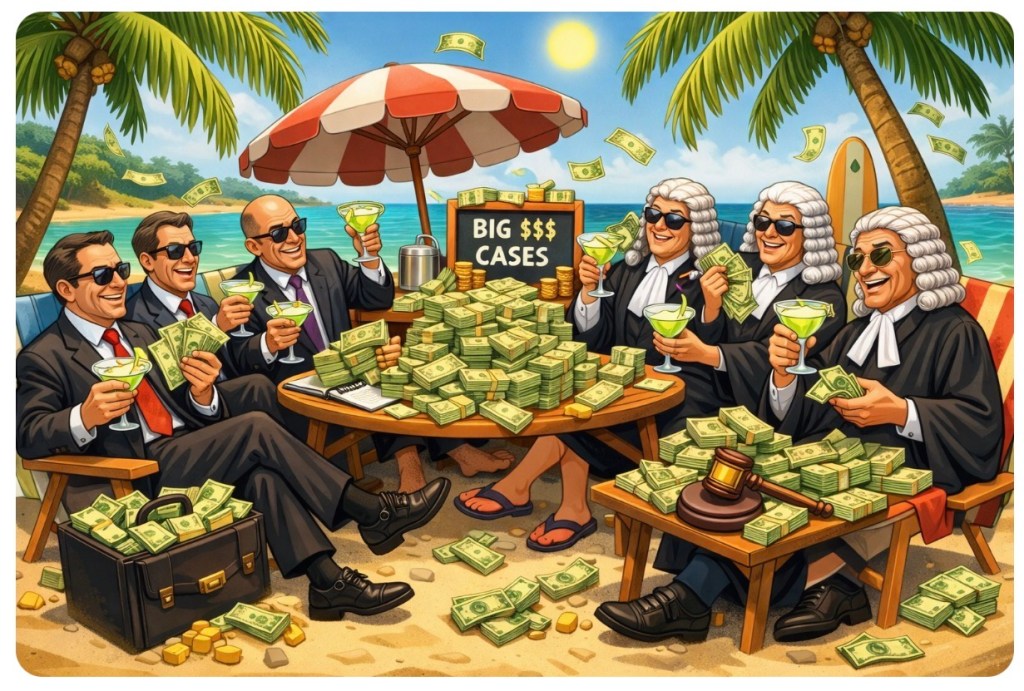
💼💰⚖️When £6–8 billion is floating around in theoretical tariff purgatory, you can practically hear the photocopiers of America revving up. That’s not “loose change down the back of the Treasury sofa” money — that’s generational-wealth-with-a-side-of-litigation money.
And now the question echoing through every pub, courtroom, and mildly unhinged WhatsApp group:
Will the lawyers make more than everyone else? 🤔
⚖️ The Refund Riddle Nobody Explained
Let’s be clear. A Supreme Court ruling that invalidates tariff authority doesn’t automatically mean cheques rain from the sky like confetti at a royal wedding. 🎉
Refunds usually depend on:
- Whether duties were actually paid under the invalid authority
- Whether importers filed protective claims in time
- Contract terms (who actually bore the cost?)
- Whether the government sets up an administrative repayment process
If no repayment mechanism is clearly spelled out, what happens?
Enter: The Legal Olympics. 🏅
Class actions. Individual claims. Contingency fee arrangements. Years of procedural fencing. Motions about motions about motions.
And yes — historically, in large-scale financial disputes, lawyers often secure a structured, guaranteed slice of recoveries before anyone else sees a penny. That’s not conspiracy; it’s how litigation economics works. Complex statutory disputes require armies of specialists, and armies do not bill modestly.
Does that mean judges are “looking after their own”?
Not necessarily. Judges rule on legality, not distribution logistics. If the ruling focused narrowly on statutory authority, refund mechanisms might fall to:
- Lower courts
- The Treasury or Customs authority
- Congress (if legislation is needed)
Courts aren’t refund-processing centers. They decide whether something was lawful. The mess after that? That’s for the political and administrative machinery to untangle — and yes, lawyers thrive in untangling. 🧵✂️
🧾 Who Actually Gets the Money?
If refunds happen, the likely primary claimants are:
- Importing companies that paid the duties
- Possibly businesses that can prove they bore the cost
Consumers? Probably not directly. The price increases you paid for goods aren’t individually traceable in a neat little “Tariff Refund Envelope.” Economics doesn’t reverse-charge your shopping basket.
And if claims must be litigated? Legal fees can indeed absorb a meaningful percentage — sometimes 20–40% in contingency structures. That’s not unusual in high-stakes commercial disputes.
So is it likely lawyers make substantial sums?
Yes.
Is it guaranteed they’ll get more than claimants?
No — but they rarely walk away empty-handed in billion-pound uncertainty. 💸
🔍 Why Didn’t the Court Spell It Out?
Because courts answer the legal question presented. If the issue was: Was the tariff authority valid? — they answer that. They don’t automatically draft refund frameworks unless the case squarely requires it.
That silence can feel suspicious. But more often, it reflects institutional limits rather than professional back-scratching.
Courts interpret. Legislatures allocate. Agencies administer.
When those lines blur, the chaos begins — and billable hours bloom like spring daffodils.
🔥 Challenges 🔥
If billions hang in legal limbo, who should get priority — businesses, consumers, or the Treasury?
Should courts be required to outline refund mechanisms when invalidating revenue measures?
Or is this just capitalism doing its usual interpretive dance? 💃⚖️
Drop your take below. Not just a shrug — a real position.
Because when billions are in question, silence is the most expensive opinion of all.
👇 Comment. Share. Stir the pot.
The sharpest arguments will be featured in the next issue of the magazine. 📝🎯


 Chameleon Magazine
Leave a comment