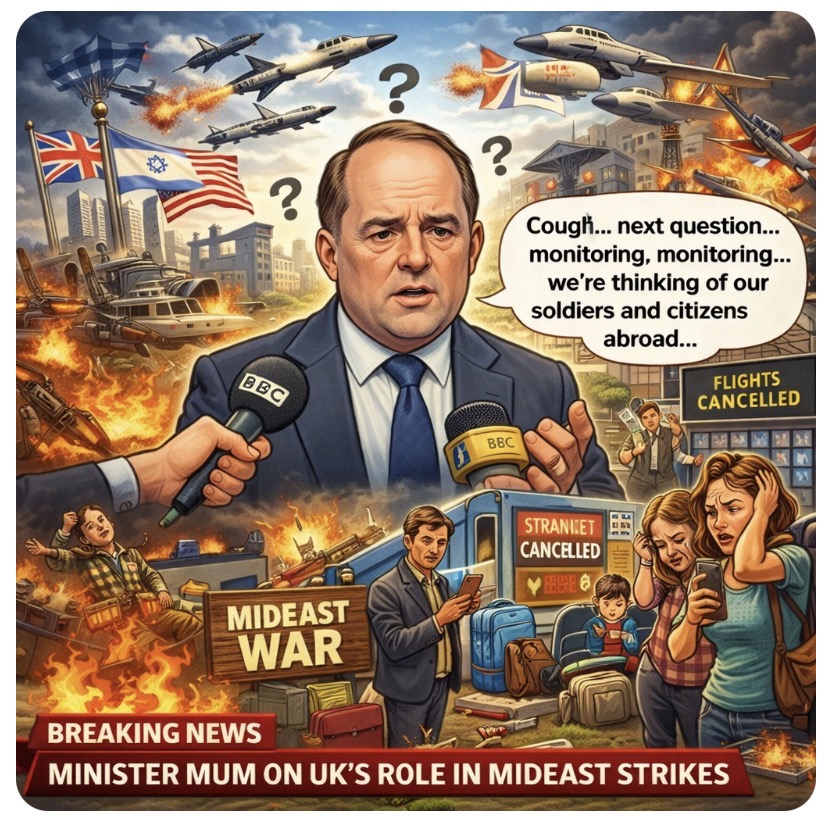
🎙️💣🇬🇧When asked live on BBC television whether the British government supported Israeli and American strikes on Iran, the Defence Secretary performed a masterclass in the ancient political art of Saying Absolutely Nothing While Using Many Words.
Did Britain back the action?
Did it oppose it?
Did it know about it?
Cue the diplomatic fog machine. 🌫️
Instead, we were treated to solemn tones about “monitoring the situation” and “thoughts being with British personnel and citizens abroad.” Admirable sentiments, of course. But not quite the same as answering the actual question.
🤐 Strategic Silence or Convenient Amnesia?
Now, let’s be fair. When missiles are flying and tensions are tightening faster than airport security, governments tread carefully. No one wants to inflame an already combustible situation with a stray syllable.
But here’s the awkward bit: if close allies are launching strikes in one of the most volatile regions on Earth, and Britain either knew—or didn’t know—that’s a story either way.
If they knew and supported it, say so.
If they knew and didn’t support it, say that.
If they genuinely had no clue… well, that’s a different kind of headline entirely. 😬
Meanwhile, British citizens find themselves stranded across airports and continents as airspace closes and routes reroute. Holidays cut short. Work trips extended indefinitely. Families refreshing departure boards like they’re waiting for exam results.
It’s hard not to wonder: if major military action is about to unfold, might a courtesy heads-up to allies be useful? Perhaps before thousands of your citizens are mid-connection somewhere over Europe.
🌍 Collateral Confusion
The official line centres on protecting British troops and nationals abroad. Sensible. Necessary. Responsible.
But what the public often hears is something else:
“We’re not saying whether we support it.”
“We’re not saying whether we were informed.”
“We’re not saying much at all.”
In moments of crisis, silence can feel less like strength and more like evasion.
Diplomacy may thrive on ambiguity. Voters, however, tend to prefer clarity—especially when global conflict is trending.
🔥 Challenges 🔥
Should governments speak plainly during military escalations—or is strategic vagueness the only responsible move? 🧐
Do you see caution… or calculated sidestepping?
We want your take in the blog comments—not just a passing remark on social media. Bring your analysis, your outrage, or your defence of diplomatic double-speak. 💬🔥
👇 Comment. Like. Share. Let’s debate it properly.
The sharpest insights and boldest opinions will be featured in the next issue of the magazine. 📰🏆


 Chameleon Magazine
Leave a comment