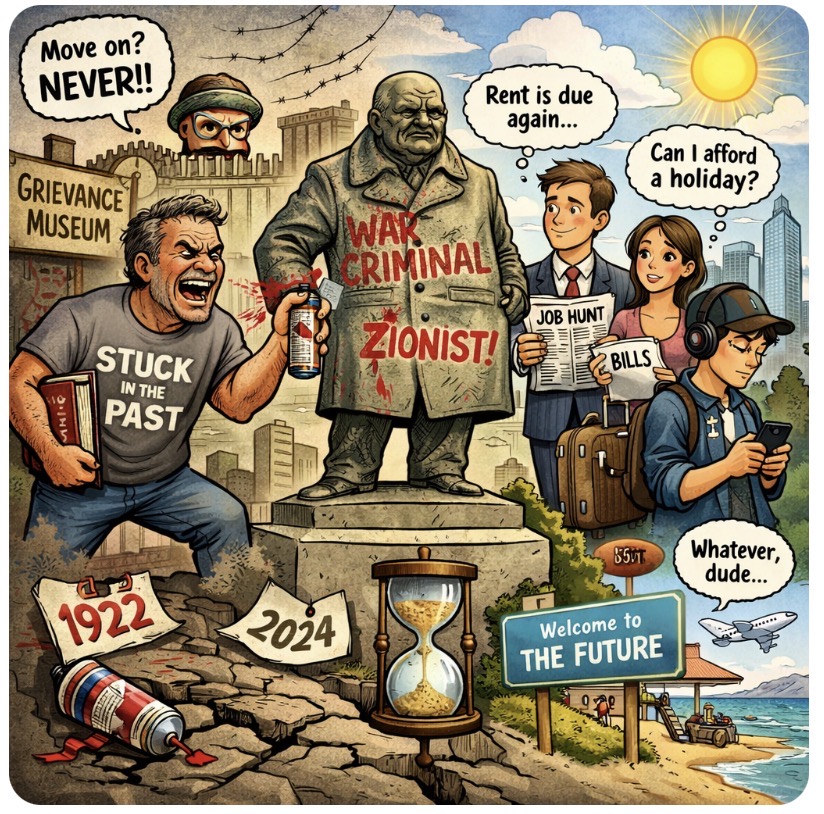
🎨⏳He died in 1965. The world moved on. Empires fell. Borders shifted. Generations changed.
And yet here we are — arguing with a statue of Winston Churchill like he’s personally drafting foreign policy from beyond the grave. 👻
There’s a serious conversation to be had about Britain’s imperial legacy and the roots of the Israel-Palestine conflict. Absolutely. But at some point, we have to ask: are we confronting history — or camping out in it?
Because living in the past isn’t the same as learning from it.
🧱 Frozen in Time While the World Moves On
Some people build a future. Others build a grievance museum.
One of the hardest things in life is moving on. Change is uncomfortable. It means accepting that the world doesn’t revolve around your anger, your nostalgia, or your unfinished argument with history.
Most people today? They’re not plotting imperial revenge maps. They’re trying to:
• Get a job.
• Pay rent.
• Afford a holiday once in a while.
• Keep their heads above the economic chaos. 💸🌍
The average twenty-something isn’t waking up thinking about 1920s colonial policy. They’re thinking about student loans, energy bills, and whether they can afford a weekend away in Spain.
That doesn’t mean history doesn’t matter. It means daily survival has a way of dominating the mental bandwidth.
So when someone sprays “war criminal” across a monument, what message is actually landing?
Not nuanced historical critique.
Not a thoughtful debate about Zionism.
Not a lecture on imperial strategy.
Just paint. And damage.
Let’s call it what it is: vandalism.
You can argue about Churchill’s record — and people have, for decades. You can debate British policy in Palestine. You can criticise empire, Zionism, modern geopolitics — all of it.
But a spray can isn’t scholarship. It’s therapy with property damage.
And here’s the uncomfortable truth: sometimes activism isn’t about changing the world. It’s about not being ready to move on from your own anger.
The world moves forward whether we like it or not. Economies shift. Generations evolve. Political landscapes transform. The message Churchill believed he was sending in his time — about empire, about strategy, about Britain’s global role — is barely legible to many young people today.
Not because they’re ignorant.
But because their battles are different.
They’re fighting cost-of-living crises, job insecurity, housing shortages. Their “empire” is a rental contract. Their “conflict” is inflation.
Smearing a statue doesn’t solve any of that.
It just proves one man hasn’t figured out how to leave 1922 behind. 🎭
🔥 Challenges 🔥
Is this righteous historical reckoning — or just one person refusing to let go?
At what point does remembering become reliving?
And when does protest tip into pointless destruction?
Don’t keep it to yourself — take it to the blog comments, not just a quick social media rant. 💬
👇 Comment. Like. Share. Agree. Disagree. Argue it properly.
The sharpest responses — whether you roast us or back us — will be featured in the next issue of the magazine. 📰🔥


 Chameleon Magazine
Leave a comment