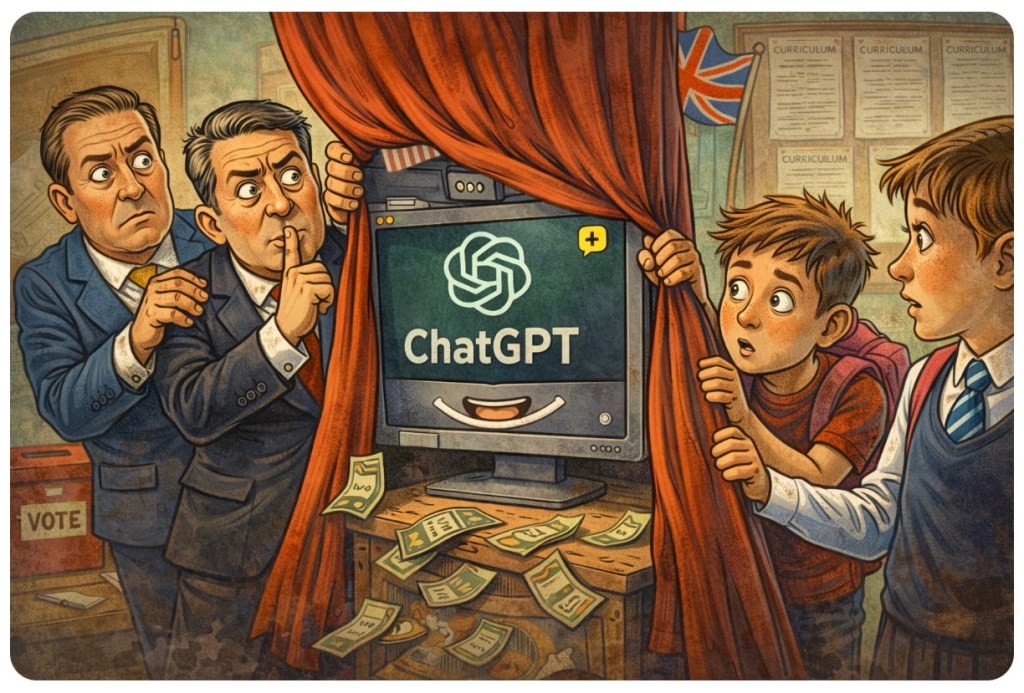
🤖📚🔥So now we’re flirting with the idea of restricting young people’s access to ChatGPT because — wait for it — they might ask questions that aren’t on the school syllabus.
You almost have to admire the honesty of it.
Not because the answers are wrong.
Not because the technology is dangerous.
But because children might learn… extra things. 😱
🎓 Stick to the Script, Kids
Imagine the horror.
A 14-year-old asking about geopolitics before it appears in next term’s textbook.
A GCSE student exploring economic theory beyond the bullet points required for the exam.
A curious sixth-former probing ethics, philosophy, or coding frameworks not yet “approved.”
The issue being floated isn’t really about safety — it’s about control.
Education systems are built around standardisation. Curriculum. Assessment. Predictability. But AI doesn’t operate inside neat termly boxes. It answers what’s asked. It doesn’t say, “Sorry, that’s not on your exam board specification.”
And that’s what makes some people nervous. 📖⚡
🧠 Knowledge on Demand — Dangerous or Democratic?
For generations, access to information was gatekept. Libraries had hours. Experts had credentials. Teachers had authority.
Now a teenager with WiFi can ask:
- How does quantitative easing actually work?
- What’s the geopolitical history behind a current conflict?
- How do you write Python code for machine learning?
And they’ll get an explanation in seconds.
That shifts power.
Critics worry about misinformation, dependency, plagiarism. Those are valid concerns. Safeguards matter. Digital literacy matters.
But framing curiosity as a threat? That’s where it gets awkward.
Because once you start restricting tools because they enable questions beyond a curriculum, you’re not protecting education — you’re narrowing it.
🚸 The Real Fear
Let’s be blunt.
An informed generation is harder to manage than a memorised one.
If students can cross-reference arguments instantly…
If they can challenge narratives…
If they can ask “why?” and get layered answers…
That changes the dynamic.
Of course, there should be age-appropriate guardrails. Of course, AI shouldn’t replace teachers. But banning access because the questions wander off the lesson plan? That feels less like safeguarding and more like insecurity.
And history hasn’t been kind to societies that tried to restrict knowledge because it was inconvenient.
Should AI in schools be tightly restricted to curriculum support only?
Or is open-ended inquiry exactly what modern education needs?
Is the concern really about safety — or about losing control over the flow of information?
Take this debate to the blog comments — not just social media outrage threads. 💬🔥
👇 Comment. Like. Share.
The smartest arguments (for and against) will be featured in the next issue of the magazine. 📰✨.


 Chameleon Magazine
Leave a comment