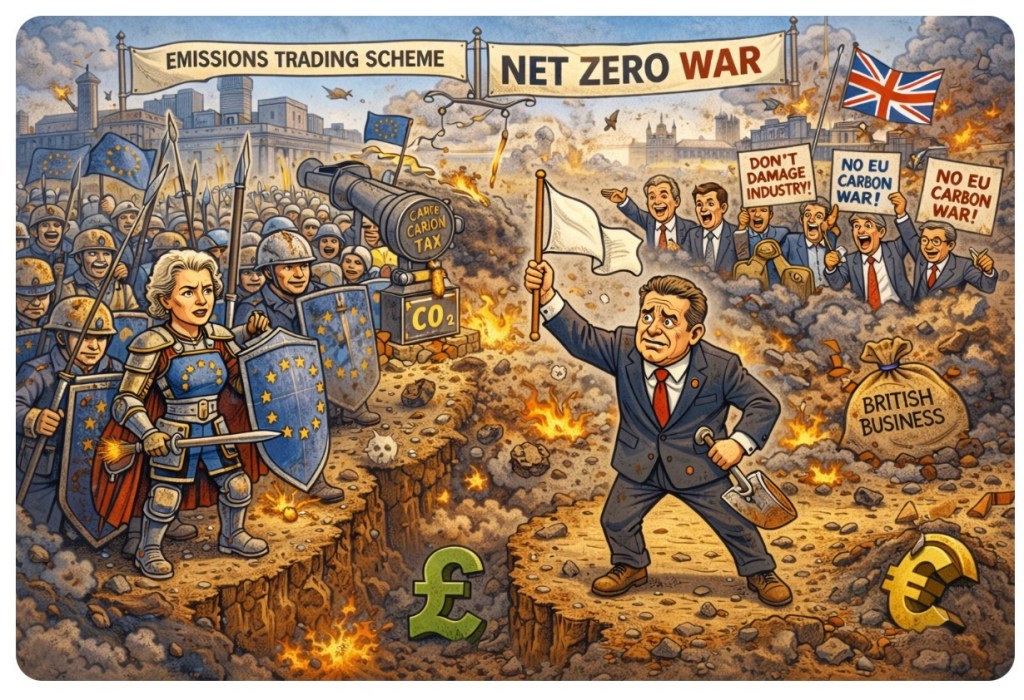
⚔️🌍🔥They call it “rejoining the EU Emissions Trading Scheme.”
Critics are calling it something else entirely: the opening move in a political war over sovereignty, business, and trust.
Because let’s be honest — this doesn’t feel like paperwork. It feels like positioning.
⚔️ From “No War” to Policy War
Opponents argue this follows a pattern. First it’s “we’re not going to war.” Then it becomes “we’re supporting.” Then it becomes “we’re aligned.”
Now the battle isn’t on foreign soil — it’s economic.
Re-entering Europe’s carbon market, critics say, risks tying British industry back into EU mechanisms just as the country fought to untangle itself. For them, this isn’t climate cooperation — it’s regulatory re-engagement by stealth.
They frame it as a slow-burning war over control:
• Who sets the rules?
• Who prices British carbon?
• Who ultimately holds leverage over British business?
Supporters argue the opposite — that linking systems avoids trade barriers and carbon border taxes, protecting exporters. But in politics, perception often wins over technical detail.
And right now, perception is that this is another front opening up.
Not a shooting war — a policy war.
Not missiles — mandates.
Not troops — trading schemes.
But wars over sovereignty can feel just as explosive. 💥
The deeper issue isn’t just net zero. It’s trust. If voters believe a leader pivots too easily, then every negotiation looks like retreat. And once that narrative sticks, every compromise is labelled surrender.
🔥 Challenges 🔥
Is this a necessary economic move in a changing climate world — or the start of a regulatory war Britain thought it had already fought?
Is linking carbon markets strategic defence — or creeping capitulation?
Take the battle of ideas to the blog comments — not just the social media trenches. 💬🔥
👇 Comment. Like. Share.
The strongest arguments from both sides will be featured in the next issue of the magazine. 📰✨


 Chameleon Magazine
Leave a comment