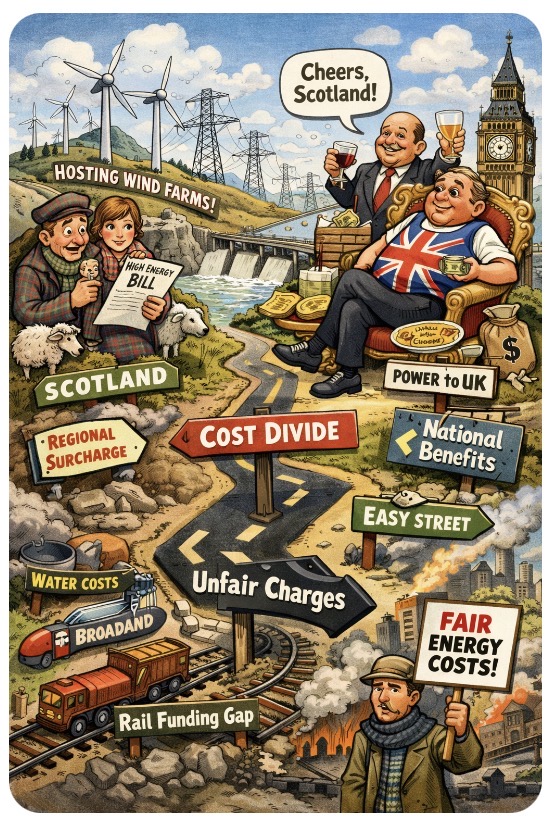
Scotland exports electricity. Scotland hosts the wind farms. Scotland carries the transmission lines marching across hills and glens.
Yet Scottish households can still face some of the highest standing charges in the UK.
If we’re serious about being one United Kingdom, then the cost — and the impact — of powering that kingdom should be shared.
Because this isn’t just about wires anymore.
It’s about landscape. Identity. And fairness.
⚡ The Postcode Premium: United Grid, Divided Bills
Let’s spell it out.
Electricity wholesale prices? National.
Net zero targets? National.
Energy security strategy? National.
But standing charges? Regional.
Infrastructure burdens? Local.
Landscape impact? Hyper-local.
So we’ve engineered a system where the benefits flow nationwide — but the physical and financial weight settles in specific postcodes.
That’s not market efficiency.
That’s political convenience with a side of rural resentment. 🔥
When the hills hum and the pylons rise, it’s “for Britain.”
When the bill lands on the mat, it’s “your regional tariff.”
Curious how unity always feels more expensive in the Highlands. 🏔️
🌬️ Turbines, Trenches, and the Scenic Surcharge
Let’s say the quiet part out loud.
As Britain accelerates toward net zero, more onshore wind capacity lands in Scotland than almost anywhere else in the UK.
Ridges once defined by heather and stone now spin steel silhouettes against the skyline. Access roads carve through peat. Grid reinforcement works snake across farmland.
Support wind? Fine.
Oppose wind? Also fine.
But one fact stands taller than the turbines:
Scotland hosts a disproportionate share of the onshore infrastructure powering Britain’s green ambition.
So here’s the awkward arithmetic:
If a region is expected to provide land, host pylons, accept visual transformation, endure construction disruption, and reinforce the national grid —
Should it then pay higher fixed charges for the privilege?
Because nothing says “thank you for powering the nation” like a premium line item on your standing charge. 🌫️
🏗️ Infrastructure Is National — So Fund It Nationally
We already socialise the big stuff.
Defence? National.
National debt? Shared.
The NHS? Collective responsibility.
Major rail and road systems? Distributed cost.
No one sends Cornwall an invoice for naval bases.
No one tells Manchester to crowdfund aircraft carriers.
Yet energy infrastructure — the literal backbone of modern life — gets sliced into regional pricing zones like a supermarket loyalty scheme.
If net zero is a national mission, then the financial model should reflect national solidarity.
Otherwise, we’re not building unity.
We’re pricing it by postcode.
💥 This Isn’t Just About Electricity
Today it’s standing charges.
Tomorrow it’s water infrastructure gaps.
Broadband rollout delays.
Rail investment disparities.
Grid balancing costs.
Renewable subsidies flowing unevenly.
The bigger question looms:
Is infrastructure a market commodity?
Or is it a shared national foundation?
Because once you admit it’s foundational, fairness begins to outweigh spreadsheet purity.
And fairness, unlike transmission loss, is something voters actually notice. 👀
🔥 Challenges 🔥
If your landscape changes to power the country, should your household costs rise too?
If a region hosts national infrastructure, should it also shoulder higher standing charges?
Should turbine-heavy regions receive structural relief — or should Britain move toward a fully nationalised infrastructure cost model?
Take it to the blog comments — not just social media. Bring your economics. Bring your environmental logic. Bring your fairness test. 💬🔥
👇 Comment. Like. Share.
The strongest arguments will be featured in the next issue of the magazine. 📰🎯


Leave a comment