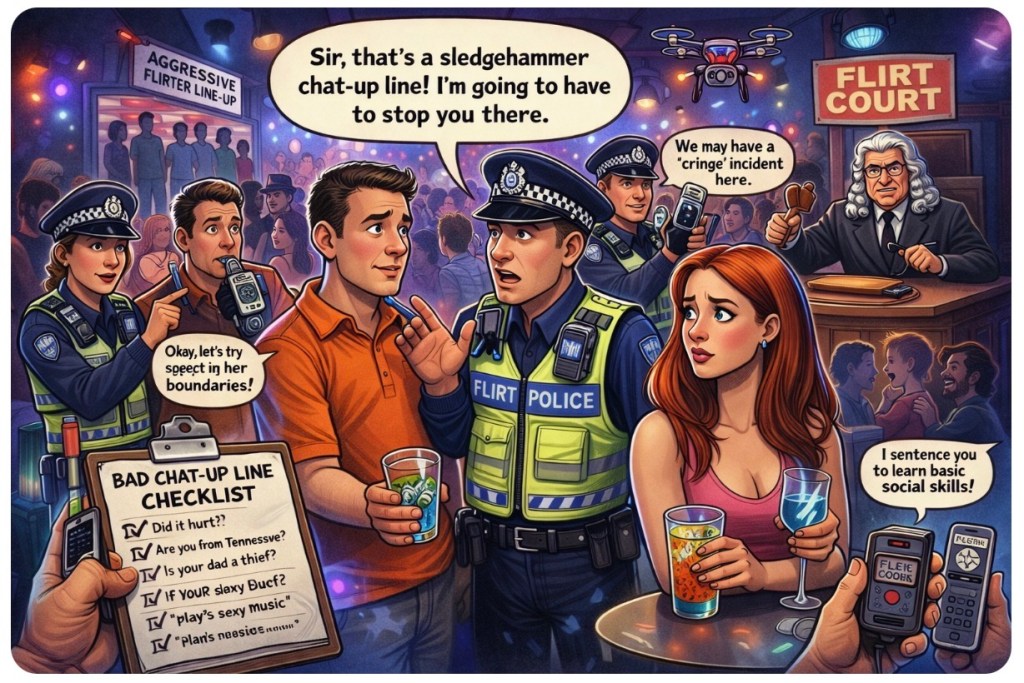
🍸🚨Just when you thought British nightlife had already been regulated to death by queues, wristbands, and bouncers with the personality of airport security, along comes the next frontier of public safety: government-backed nightclub vigilance against bad chat-up lines.
Yes, the dance floor may soon feature an entirely new species of official — the romance regulator. Their mission? To identify dodgy flirting, cringe-worthy pick-up attempts, and men who appear “too forward” while attempting the ancient ritual known as trying to meet someone in a nightclub.
Some might call it safeguarding.
Others might call it the world’s first Ministry of Flirting.
Somewhere between the sticky floor and the smoke machine, Britain’s nightlife now risks turning into a romantic traffic stop.
“Excuse me sir… do you realise that opening with ‘Did it hurt when you fell from heaven?’ constitutes Level-Two Cringe under the Nightclub Interaction Code?” 💬🚔
💃 When Flirting Requires a Permit
The stated aim, of course, is to prevent aggressive or uncomfortable behaviour in nightlife spaces. Few reasonable people would disagree with stopping genuinely pushy or predatory conduct.
But here’s where things get deliciously complicated.
Flirting is messy.
Dating is awkward.
Nightclubs are chaotic ecosystems powered by loud music, questionable decisions, and liquid confidence.
Trying to regulate that with official oversight may prove about as precise as controlling British weather with a clipboard.
Because what exactly qualifies as a crime against flirting?
Is it:
- Asking someone to dance twice?
- Attempting conversation while the DJ is playing drum & bass at aircraft-engine volume?
- Delivering a catastrophically bad chat-up line that should probably be illegal on taste grounds alone?
Or is it something more serious — persistent, uncomfortable behaviour that crosses a line?
The problem is that drawing that line in the middle of a nightclub might be harder than policymakers imagine.
⚖️ The Judicial Dance Floor
And then there’s the next stage of the process: the courts.
Because if this kind of initiative leads to actual legal cases, the final judgement may land in front of judges whose most recent nightclub experience was likely sometime around 1997 and a copy of Ministry of Sound Annual on CD.
It raises a wonderfully awkward image:
A courtroom attempting to dissect nightclub etiquette.
“Your honour, the defendant opened with the phrase ‘Fancy a drink?’ while leaning slightly to the left of the disco ball.”
One imagines entire legal arguments built around tone, eye contact, and whether a compliment about someone’s trainers counts as harassment or simply poor flirting strategy.
🕺 The Ancient Ritual of Awkward Romance
For generations, nightclubs have served as the chaotic arena where humans attempt to perform the most unpredictable activity known to science:
meeting someone they might like.
It has always involved:
- clumsy introductions
- questionable lines
- misread signals
- the occasional spectacular social disaster.
It’s part of the strange theatre of human interaction.
The real challenge isn’t stopping genuinely bad behaviour — most people support that.
The challenge is doing it without turning every awkward conversation into a potential police report.
Because if flirting becomes something that requires official approval, the dance floor might soon become the quietest place in Britain.
And that would truly be a national tragedy. 🎶
🔥 Challenges 🔥
Here’s the question for readers:
Should governments step into nightlife to regulate how people approach each other — or is this something that should remain part of the messy, awkward, human business of dating?
Where’s the line between protecting people from harassment and policing normal social interaction?
Drop your thoughts in the blog comments — not just on Facebook. We want the honest takes, the terrible chat-up lines, and the brutal truths. 💬
👇 Like it. Share it. Comment with your best or worst nightclub experience.
The sharpest comments will be featured in the next issue of the magazine. 🎯📝


 Chameleon Magazine
Leave a comment