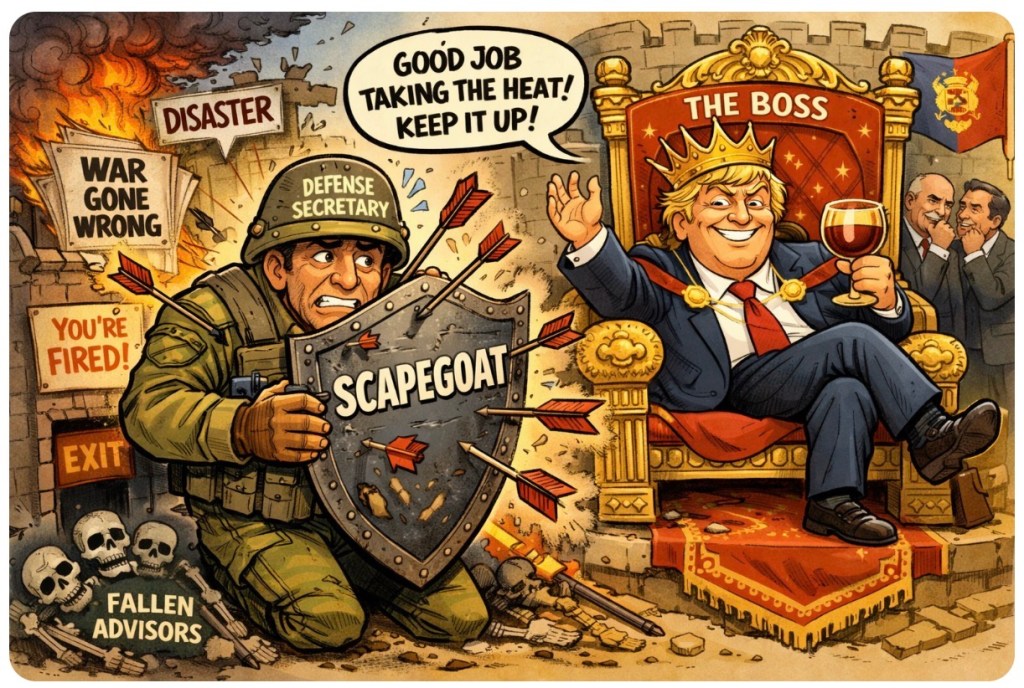
🛡️👑In politics, loyalty often flows upward while responsibility flows downward. When powerful figures surround themselves with devoted allies, those allies can quickly become expendable the moment things go wrong. The recent suggestion that a defence secretary might serve as a political “human shield” for a president is a perfect example of a very old game: commit yourself to the powerful, and you may end up carrying the blame when their plans implode.
🎭 Loyalty to Power: The Fastest Route to Becoming the Scapegoat
There is a strange career strategy that appears again and again in politics: intelligent people willingly tether their reputation to someone whose power seems unstoppable. The logic feels irresistible at the time. Align with the king, ride the wave, enjoy influence, prestige, and proximity to the throne.
But there is a catch—one as old as politics itself.
When things go well, the leader takes the glory.
When things collapse, someone else takes the fall.
That someone is almost always the loyal lieutenant who stood closest when the storm arrived.
History is littered with these political crash dummies. Advisors who carried out bold policies suddenly discover they were merely “following orders.” Cabinet members who championed strategies find themselves quietly escorted out the door once public opinion turns toxic.
The pattern rarely changes:
- A powerful leader pursues a risky policy.
- Loyal allies defend it loudly and repeatedly.
- The public backlash begins.
- The leader survives.
- The loyalist becomes the sacrificial goat.
The tragedy isn’t just the fall—it’s the naivety. Anyone who studies political history knows the rule: proximity to power is rarely protection. More often, it’s the blast radius.
Yet people still step forward, eager to pledge loyalty like knights volunteering to hold a shield over a king who never plans to stand in the arrows himself.
Because power is intoxicating.
And proximity to it can make otherwise rational people behave like extras in someone else’s survival strategy.
🧠 The Ancient Political Trick: Sacrifice the General, Save the Emperor
The “human shield” concept isn’t new. Governments have used versions of it for centuries.
When wars go badly, leaders almost never admit the strategy was flawed. Instead, a narrative appears: the policy was correct, but someone executed it poorly.
Enter the sacrificial official.
A defence secretary, general, minister, or advisor becomes the convenient explanation for failure. Remove them, reshuffle the cabinet, promise “new leadership,” and suddenly the same policy can continue with a fresh face.
The system resets.
The leader remains.
And the person who thought loyalty guaranteed protection discovers they were never inside the armour.
They were the armour.
🔥 Challenges 🔥
Here’s the uncomfortable question nobody likes to ask:
Why do intelligent people keep volunteering to be shields for powerful leaders who will abandon them the moment the arrows start flying?
Is it ambition? Ego? Blind loyalty? Or the dangerous belief that this time the powerful figure will protect them?
Drop your thoughts in the blog comments, not just on social media. We want the sharp takes, the brutal honesty, and the historical examples people rarely talk about. 💬🔥
👇 Comment, like, and share this post.
The boldest, funniest, and most insightful replies will be featured in the next issue of the magazine. 📝


 Chameleon Magazine
Leave a comment