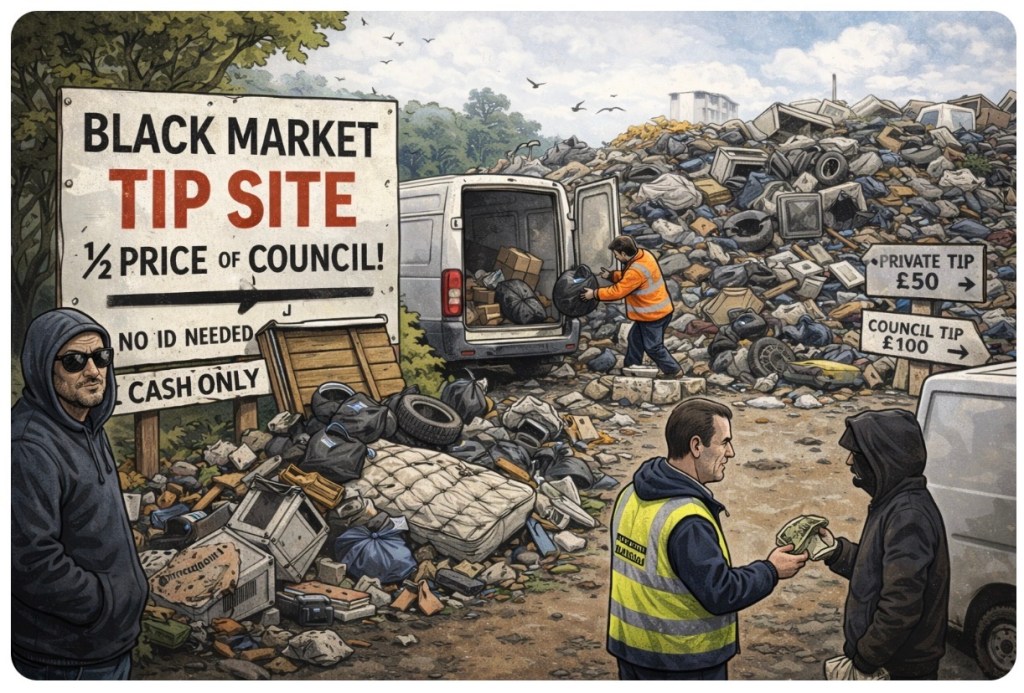
🗑️💸Councils: “Let’s charge people more to dispose of waste properly.”
Also councils: “Why is there a mountain of sofas behind Dave’s garden shed?” 🤔
It’s the kind of logic that feels like trying to stop shoplifting by charging people to enter the shop.
🚧 The Policy That Accidentally Built a Black Market
Here’s the uncomfortable reality—when councils slap fees on vans, restrict tip access, or make disposal a bureaucratic obstacle course, they don’t eliminate waste… they just redirect it.
And where does it go?
➡️ Into lay-bys
➡️ Down country lanes
➡️ Behind your house while you’re asleep
Congratulations—you’ve just created a thriving underground rubbish economy. 🕵️♂️
Because if someone’s clearing a house, running a small business, or just trying to get rid of bulky waste, they’ve got two options:
- Pay increasing fees, deal with restrictions, and jump through hoops
- Hand £50 cash to “a guy with a van” who promises to “sort it”
Spoiler alert: that van isn’t heading to the recycling centre—it’s heading to the nearest quiet street.
And just like that, councils have unintentionally outsourced waste management to the black market.
💥 Penny Wise, Pound Foolish (With Extra Rubbish)
Here’s where it gets almost poetic.
Councils try to:
- Raise revenue 💰
- Reduce tip congestion 🚛
- Regulate commercial dumping 📋
But instead, they end up:
- Paying huge clean-up costs
- Dealing with environmental hazards ☣️
- Sending crews out after the mess is made
- Getting publicly roasted when it hits the news 📺
So the money they tried to make?
They spend it—and more—cleaning up the consequences.
It’s like charging people to use a toilet… and then acting shocked when the streets smell.
🧠 The Bit No One Wants to Admit
This isn’t about MPs “not understanding.” They do understand—at least in theory. But policy gets shaped by:
- Budget pressures
- Targets and regulations
- Short-term accounting over long-term reality
And fly-tipping? It’s the classic externalised cost—easy to ignore until it piles up (literally).
The real fix isn’t glamorous:
- Cheaper or free disposal for households
- Easier access (longer hours, fewer restrictions)
- Crackdown on illegal carriers
- Better enforcement and better convenience
Because people don’t wake up thinking, “I’d love to commit environmental crime today.”
They think, “I just need this rubbish gone without it costing a fortune or taking all day.”
Are councils solving the problem—or quietly fuelling it? 🤨
Should waste disposal be treated like a public service… or a revenue stream?
Got a story about fly-tipping in your area? Seen the “man with a van” economy in action? Drop it in the blog comments—not just social media. 💬🔥
👇 Comment, like, and share if you think making it harder to do the right thing is the fastest way to get the wrong result.
The sharpest takes will be featured in the next magazine issue. 🎯📝


 Chameleon Magazine
Leave a comment