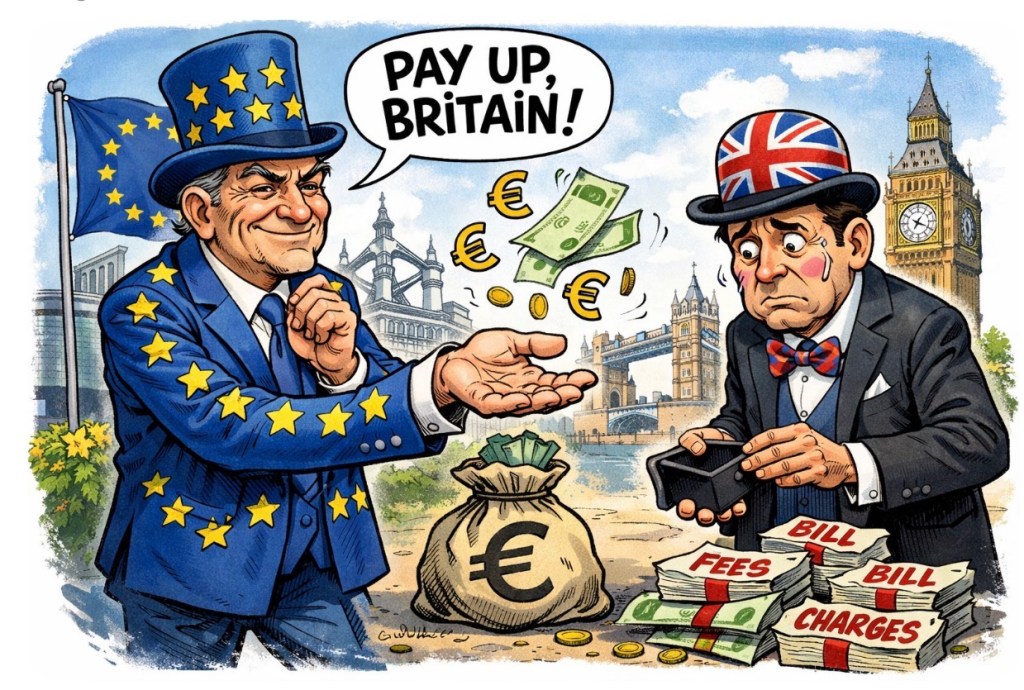
Just when you thought the relationship was over—bags packed, door slammed, dramatic exit complete—the EU slides back into the conversation like an ex who still has your Netflix password… and now wants a subscription fee. 🎭
“Want cheaper electricity?”
“Fancy a bit of Erasmus?”
“Great—just sign here, here, and… oh yes, pay up.” ✍️
⚡ Pay-to-Play Politics
So here we are: years after Brexit, and suddenly access to cheaper European electricity comes with a price tag. Not exactly the “take back control” bargain-bin deal that was sold, is it?
Because the reality is far less cinematic:
- Interconnected energy markets don’t disappear 🚧
- Geography doesn’t negotiate 🗺️
- And access? Well… access comes with terms
But instead of calling it negotiation, it’s being framed as something far more dramatic—blackmail. If it’s not blackmail, what is it exactly? They’re going to share our electricity too—so why do they need paying?
Awkward. 😬
🔄 Brexit: The Never-Ending Story
Here’s the uncomfortable bit—Brexit was never a clean break. It was always going to be a series of ongoing negotiations, trade-offs, and awkward compromises.
Because when you leave a system you were deeply integrated into, you don’t just walk away—you renegotiate your way back in, piece by piece.
- Want trade? Negotiate
- Want energy access? Negotiate
- Want student exchange? Negotiate
And yes… sometimes pay—but only if we get something in return.
Shocking behaviour from a bloc of countries acting in their own interest. Who could have predicted that? 🙃
🔌 Energy Independence… or Energy Illusion?
Here’s where it gets even more interesting.
We’re constantly told the UK is ramping up renewables, generating more electricity, becoming greener, more self-sufficient. Wind farms spinning, solar panels soaking up rays—Britain, the energy powerhouse of the North Sea. 🌬️☀️
So if that’s true… why are we still negotiating to access European electricity?
Are we:
- Energy independent?
- Or just energy optimistic?
Because the reality is a bit less headline-friendly:
- We still import oil and gas 🛢️
- Our electricity supply still leans on gas pricing 🔥
- And when supply dips or demand spikes… we look to Europe ⚡
So the question isn’t just “why are we paying?”—it’s:
Have we built a system that actually stands on its own… or one that still quietly depends on imports while claiming independence?
Because if we truly had plenty of our own, we wouldn’t be negotiating access—we’d be exporting it.
Instead, we’re stuck in the middle:
Not fully dependent…
Not fully independent…
Just… interconnected, whether we like it or not. 🔄
💶 European Prices… or Premium Membership?
Now here’s the part nobody seems keen to spell out clearly.
If we “sign up” to access European electricity… do we actually get European prices?
Because let’s be honest—energy prices across parts of Europe are often significantly cheaper than what UK consumers are paying. So naturally, you’d assume joining the system means benefiting from those lower costs.
But here’s the catch.
Access doesn’t automatically mean equality.
Instead, we could be looking at:
- Paying to access the market 💳
- Paying for the infrastructure and interconnectors 🔌
- Paying policy and regulatory costs on top 📑
Which raises a slightly uncomfortable possibility…
Are we actually buying cheaper electricity—
or just adding another layer of costs to an already expensive system?
Because if the end result is:
- European wholesale prices ➕
- UK-specific charges ➕
- Access fees ➕
Then what exactly are we saving?
Or are we just paying for the privilege of participating?
If we plug back into Europe’s energy system, do we get the benefit of cheaper prices—or just a more complicated bill?
Are we accessing value… or subscribing to yet another costly layer?
Drop your take in the blog comments—does this sound like smart economics or expensive optics? 💬⚡
👇 Like, share, and challenge the narrative—because this is where the fine print matters.
The sharpest, boldest takes will be featured in the next issue of the magazine. 📝🔥


Leave a Reply