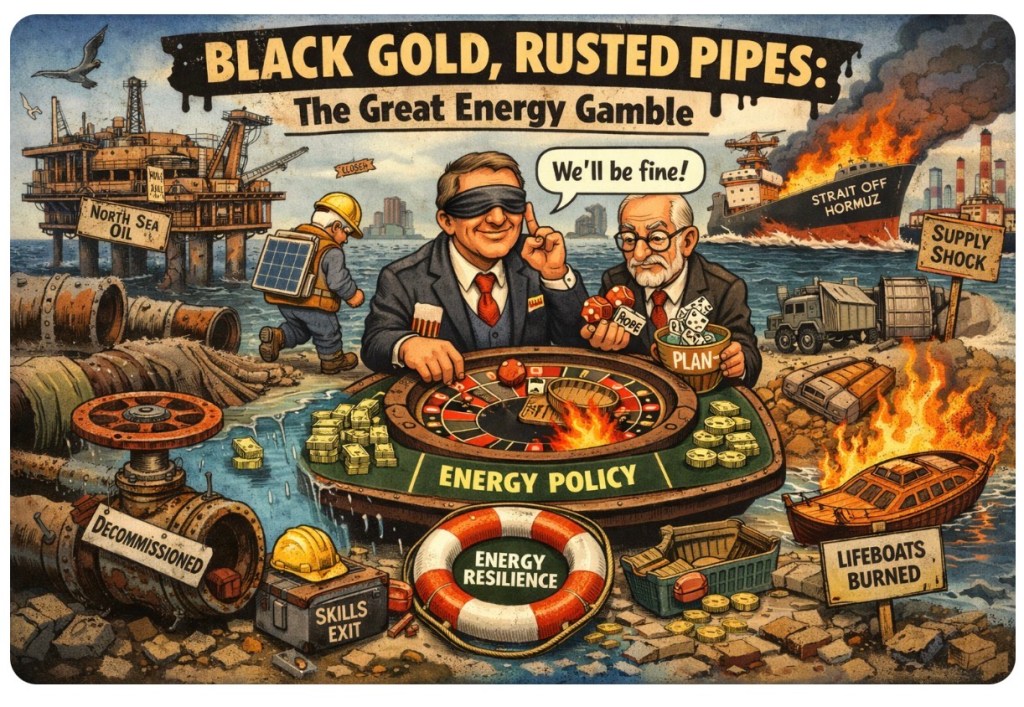
🛢️⚠️The oil isn’t gone. Not even close. What’s slipping through our fingers isn’t the resource—it’s the ability to touch it, move it, use it. While politicians celebrate “transition,” the scaffolding that once made energy security possible is quietly being dismantled like a theme park after closing time.
🔧 The Vanishing Skillset: Britain’s Accidental Energy Amnesia
Let’s be clear: oil fields don’t evaporate. But the people who know how to run them? The supply chains that keep them alive? The infrastructure that makes extraction possible?
Gone. Poof. Like your last bit of patience at a delayed train announcement. 🚆💨
We’re talking about:
- Engineers swapping rigs for renewables (or leaving entirely)
- Maintenance ecosystems collapsing from lack of demand
- Platforms and pipelines aging into expensive scrap metal
And here’s the punchline: restarting this isn’t like rebooting a laptop. It’s more like rebuilding a cathedral… underwater… during a storm… with half the blueprints missing. ⛪🌊
Multi-year. Multi-billion. Politically inconvenient.
🎲 The Government’s High-Stakes Bet
The official logic goes something like this:
“The North Sea is declining, new oil is slow and expensive, and by the time we need it… we won’t.”
Ah yes, the classic strategy:
Assume the future behaves itself.
It’s a bit like canceling your home insurance because you’re planning not to have a fire. 🔥❌
This isn’t certainty—it’s a gamble dressed up in policy language.
🌍 When Reality Refuses to Cooperate
Your argument hits like a brick when the world gets messy (which, historically, it enjoys doing):
- Geopolitical tension near chokepoints like the Strait of Hormuz
- Supply manipulation from OPEC
- Renewable rollout hitting real-world limits (storage, grids, cost overruns)
- Industries stubbornly refusing to run on “good intentions” instead of fuel
If even two of those collide, suddenly “we’ll be fine later” starts sounding like famous last words. 😬
⚖️ The Uncomfortable Truth Nobody Likes
Even if Britain drilled like it was 1975 again:
- Prices would still be global
- Imports would still be necessary
- Shocks would still hit
So no—this isn’t energy independence.
It’s something far less sexy, but far more important:
Resilience. A buffer. Breathing room.
Not a shield—but at least a helmet. 🪖
🧠 The Sensible Middle Ground (Yes, It Exists)
Here’s where the shouting usually dies down and actual strategy begins:
- Keep critical infrastructure alive where viable
- Retain core expertise (don’t let the brain drain become permanent)
- Preserve the option to ramp up production if needed
- Avoid irreversible decisions made on overly optimistic timelines
This isn’t denial of transition.
It’s refusing to burn the lifeboats while still at sea. 🚢🔥
🔥 Challenges 🔥
So here’s the uncomfortable question:
Are we building a cleaner future… or sleepwalking into strategic fragility?
Is this bold leadership—or just hoping the world behaves long enough for the plan to work?
Drop your take directly on the blog—don’t just shout into the algorithm void. We want sharp takes, hot anger, cold logic, or full-blown sarcasm. 💬🔥
👇 Hit comment, like, and share—drag this debate into the daylight.
The best comments will be featured in the next issue of the magazine. 🎯📝


Leave a comment