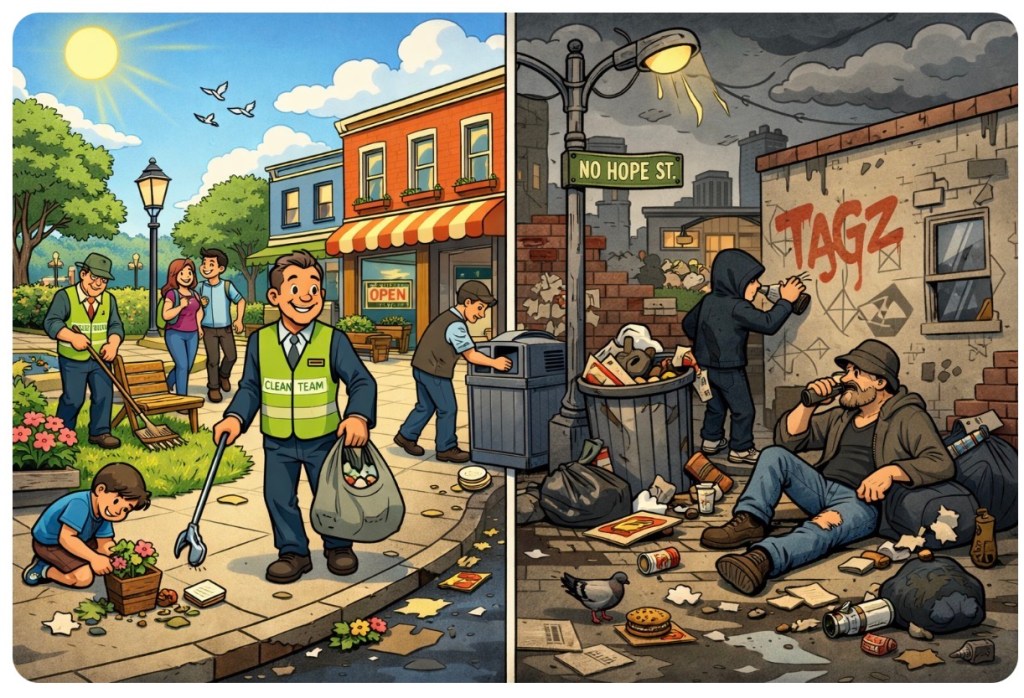
☕🏙️A single piece of litter doesn’t just dirty a street—it whispers. It tells every passerby, “No one’s watching… no one cares.” And just like that, standards begin to unravel. Not dramatically. Not overnight. But steadily, like a slow leak in the social fabric.
Welcome to the quietly powerful world shaped by James Q. Wilson and George L. Kelling—where the smallest signals shape the biggest behaviours.
🧠 The Pavement Psychology You Pretend Not to Notice
Let’s not kid ourselves—we’ve all done it.
You see a spotless street? You hold onto your rubbish just a little longer.
You see one lonely coffee cup rolling in the gutter? Suddenly, dropping yours feels… less criminal, more communal.
That’s not laziness. That’s behavioural contagion.
The genius (and slight terror) of the Broken Windows insight is this: people don’t just respond to rules—they respond to cues. And those cues are everywhere.
A clean space doesn’t just look nice—it asserts dominance. It says: “Standards live here.”
A neglected one? It shrugs and says: “Do what you want, mate.”
And guess which message spreads faster? 😏
🧹 Order Isn’t About Control—It’s About Signals
Here’s where things get deliciously ironic.
We love to frame cleanliness as cosmetic—some aesthetic luxury for city brochures and Instagram reels. But in reality, it’s doing the heavy lifting of social order.
A freshly cleaned street communicates:
- Someone gives a damn
- This place has eyes on it
- You are part of something maintained
A graffitied, bin-overflowing chaos zone?
That’s basically the urban equivalent of “abandon hope, all ye who enter.” 🗑️
And people behave accordingly—not because they’re bad, but because the environment rewrites the script.
🤝 The Myth of “It’s Someone Else’s Job”
Ah yes—the classic: “The council will sort it.”
Will they? Maybe. Eventually. Possibly after three forms, a complaint, and a small existential crisis.
But here’s the uncomfortable truth:
Environments don’t improve through responsibility—they improve through participation.
The most effective version of this idea isn’t heavy policing—it’s cultural momentum:
- Councils that fix things fast
- Communities that refuse to normalise neglect
- Individuals who think, “Not here. Not today.”
Because once care becomes visible, it becomes… contagious. Just like neglect once was.
📈 The Domino Effect Nobody Talks About
Here’s the part that should make you sit up slightly straighter:
Small improvements don’t stay small.
One clean street → raises expectations
One maintained park → shifts perception
One fixed “broken window” → resets behaviour
Before you know it, you’re not just cleaning—you’re rewiring how people experience their environment.
It’s subtle. It’s quiet. But it’s powerful.
Neglect compounds.
But so does pride. 💥
🔥 Challenges 🔥
So here’s the uncomfortable question:
Are you walking past the “coffee cup moment”… or are you part of it?
Because every ignored bit of mess, every “not my problem” shrug, is a tiny vote for decline.
And every small act of care? A vote for standards.
Tell us—where do you draw the line? What’s the moment a place loses (or earns) your respect? Drop your take in the blog comments and don’t hold back. 💬🔥
👇 Smash that comment button. Like it. Share it. Tag someone who “accidentally” litters.
The sharpest takes, hottest rants, and most brutally honest truths will be featured in the next issue of the magazine. 🎯📝


 Chameleon Magazine
Leave a comment