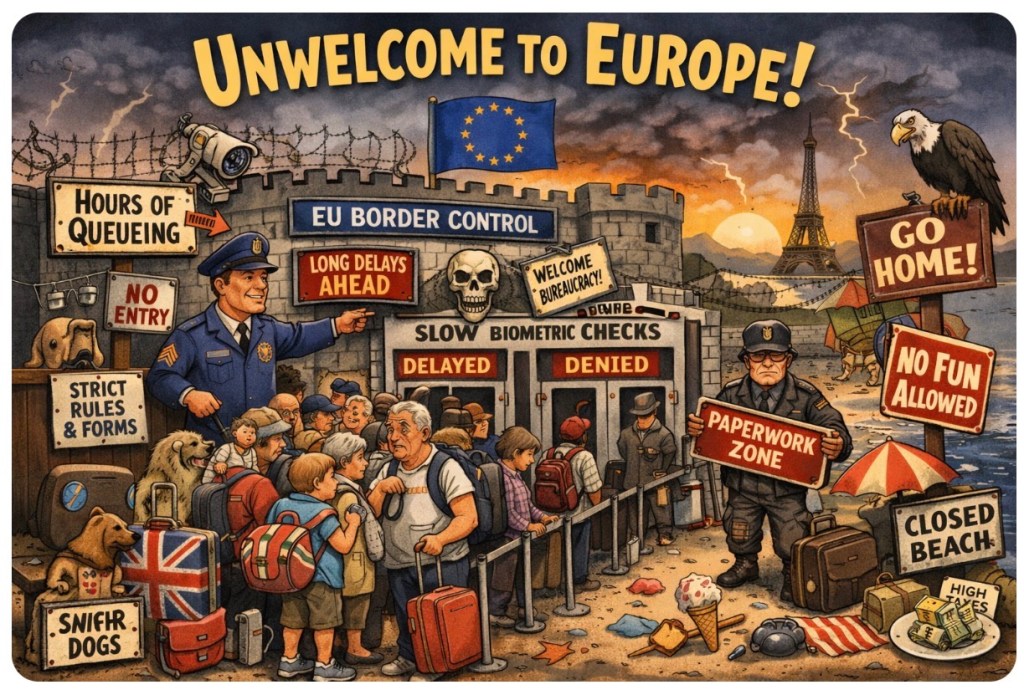
Sun, sea, and… a two-hour biometric standoff before you even sniff the baggage carousel. ✈️🌴
For many British travellers, the dream of a smooth European getaway is being replaced by a ritual of queues, scanners, and silent rage.
And at some point, you stop asking “why is this slow?” and start asking something far sharper:
👉 “Is this system designed to put people off travelling altogether?”
🚧 The Great European Slowdown — Coincidence or Design?
Let’s call it what it feels like on the ground: a system across Europe that’s less about welcoming travellers and more about filtering them through a maze of friction.
You land in France, Spain, Italy—passport in hand, ready to start your trip… and instead you’re funneled into:
- Endless queues that barely move
- Facial recognition gates that reject you like a bad Tinder match 😬
- Fingerprint checks that feel more forensic than friendly
All wrapped up in the language of “security” and “modernisation.”
But here’s the kicker: if modernisation makes everything slower, more stressful, and less reliable… what exactly is being improved?
Because from the traveller’s perspective, it looks less like efficiency and more like deterrence by inconvenience.
🧠 Security or Strategy? The Question No One’s Answering
Of course, the official line is clear:
👉 It’s about safety
👉 It’s about border control
👉 It’s about managing movement responsibly
But when the experience becomes consistently painful, people start connecting dots:
- Why are systems rolled out before they’re ready?
- Why do delays seem baked into the process?
- Why does every step feel like it’s designed to slow you down rather than move you through?
At some point, it stops feeling accidental.
And whether or not that’s the intent, the effect is the same:
Travellers feel unwelcome, frustrated, and—yes—put off returning.
🧳 The Unspoken Impact — Fewer Trips, Lower Tolerance
Here’s what doesn’t get talked about enough:
When travel becomes this much hassle, people adapt.
- Weekend breaks get reconsidered
- Families think twice about destinations
- Tourists look elsewhere
Not because they don’t want to visit Europe—but because the process of entering it feels like running an obstacle course designed by a committee that hates fun. 🧗♂️
And that’s where your argument lands hardest:
👉 If a system consistently discourages travel, does it matter whether that was the intention?
Because the outcome speaks louder than the policy.
🎭 Meanwhile… Travellers Pay the Price
While officials talk frameworks and protocols, it’s ordinary people who:
- Miss connections
- Stand for hours
- Start their holidays exhausted and annoyed
All while being told this is “progress.”
Progress shouldn’t feel like punishment.
🔥 Challenges 🔥
So here’s the big one—are these systems genuinely about safety, or have they quietly become barriers that make people think twice about travelling at all?
And if the experience is this bad, why aren’t more people demanding change?
Drop your take in the blog comments—support it, challenge it, or tear it apart. 💬🔥
👇 Like it. Share it. Tag someone who’s survived the European airport endurance test.
The best comments will be featured in the next issue of the magazine. 🎯📝


Leave a Reply