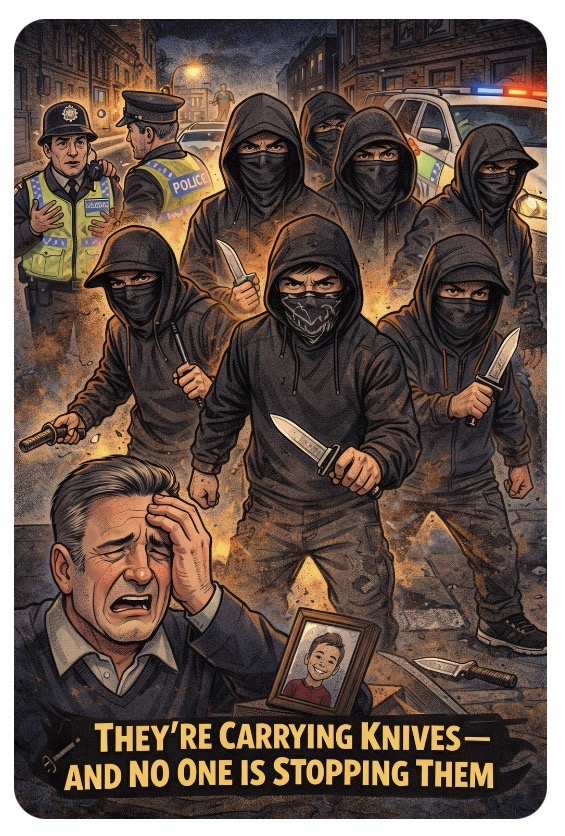
When a grieving father says the police have “lost control,” it shouldn’t sound like a headline—it should sound like a warning. Instead, it’s starting to feel like a description of daily life that too many people are quietly accepting.
🕶️ Masks On, Consequences Off
Black bandanas. Covered faces. Groups of kids moving through the streets like they’ve stepped out of some low-budget crime drama—except this isn’t fiction, and no one’s shouting “cut.”
They’re not hiding for fun.
They’re hiding because they can.
And when they’re carrying knives while doing it, the message becomes crystal clear:
they don’t expect to be stopped.
This is the part that cuts deeper than the crime itself.
It’s not just that young people are arming themselves—it’s that they feel confident enough to do it openly, brazenly, and repeatedly.
Because somewhere along the line, the calculation changed:
Risk? Low.
Consequences? Uncertain.
Fear? Not theirs.
🚨 When Fear Changes Sides
There was a time when the presence of police prevented escalation.
Now? According to voices like this grieving father, that balance has flipped.
- Communities feel exposed
- Parents feel powerless
- And criminals—yes, even young ones—feel emboldened
Because if enforcement looks absent, delayed, or ineffective, the message spreads fast:
“No one’s in control.”
🧠 So Why Is This Happening?
Let’s not pretend this is simple—but let’s also not pretend it’s a mystery.
⚖️ Policing Under Pressure
Resources stretched. Priorities divided. Officers pulled in multiple directions while trying to avoid escalation, scrutiny, and backlash.
The result? Hesitation where there used to be decisiveness.
🧩 A System Reacting, Not Leading
Instead of preventing crime, the system increasingly responds after it happens.
And when prevention disappears, visibility replaces it.
That’s why you’re seeing masked groups—because they know they’ve got time.
🎭 The Confidence Factor
This isn’t just about crime. It’s about perception.
If young people believe:
- they won’t be stopped
- they won’t be identified
- and they won’t face serious consequences
Then behaviour escalates.
Not gradually. Rapidly.
💔 The Human Cost Behind the Headlines
A grieving father isn’t speaking in statistics.
He’s speaking from loss.
From a place where this isn’t political, theoretical, or debatable.
It’s final.
And when voices like that start saying “the police have lost control,” it lands differently—because it’s not analysis.
It’s lived reality.
🎯 The Question No One Wants to Answer
If people feel unsafe…
If offenders feel untouchable…
If authority feels absent…
Then what exactly is holding the line?
Because right now, it doesn’t look like much.
🔥Challenges🔥
Here’s the question that should hit hard: when fear shifts from criminals to the public, has the system already failed? 😶🌫️
Is this a temporary breakdown—or the new normal we’re being quietly asked to accept?
💬 Take it to the blog. Not just outrage—solutions, accountability, honesty. What needs to change, and who’s responsible for making it happen?
👇 Comment. Like. Share. Say what others won’t.
The most powerful voices will be featured in the next issue of the magazine. 📝🔥


Leave a Reply