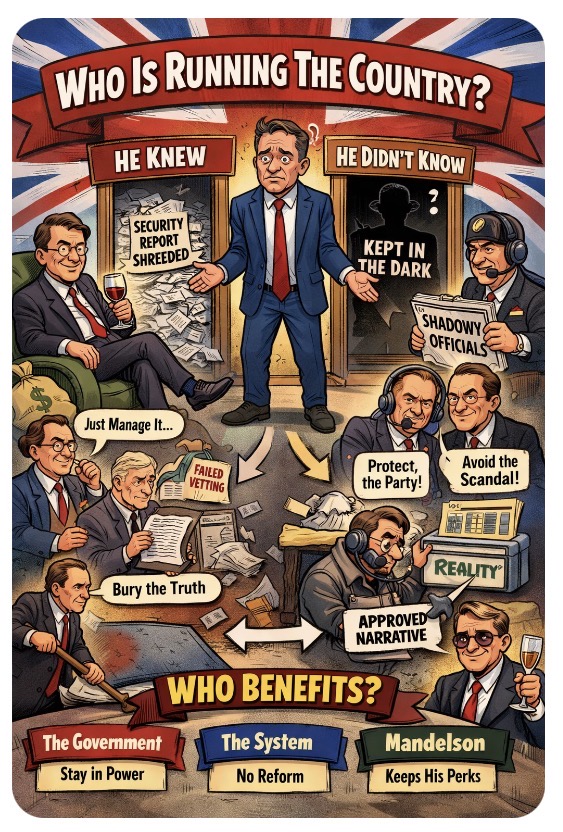
A simple question—almost naive in its phrasing. And yet, the deeper you dig, the more it starts to feel like the one question no one in power is eager to answer directly.
Because if everything is functioning as it should, the answer is obvious.
So why doesn’t it feel that way?
🎭 The System That Edits Reality
On paper, the country is led by Keir Starmer—visible, accountable, front and centre. The face of authority. The voice at the dispatch box.
But paper has always been very forgiving.
Because when a decision like the appointment of Peter Mandelson proceeds despite clear vetted reports indicating he failed, we’re no longer talking about oversight.
We’re talking about intent.
⸻
So let’s stop circling the issue and ask the question that actually matters:
Why would this happen?
Not by accident. Not by bureaucratic drift.
But deliberately.
⸻
🧠 Because Reversing Course Is Politically Toxic
Once a high-profile decision is announced, it becomes more than a decision—it becomes a statement of judgment.
To suddenly halt it because of vetting failures would mean admitting:
- The wrong call was made
- The wrong person was trusted
- The system didn’t catch it early enough
That’s not just embarrassing—it’s destabilising.
So instead of pulling the brakes, the system hits a different lever:
containment.
The problem isn’t solved.
It’s absorbed.
⸻
💼 Because Institutions Protect Themselves First
Here’s the uncomfortable truth: systems like this are not designed primarily to expose flaws—they’re designed to survive them.
Civil servants, advisors, senior officials—they operate within an ecosystem where:
- Stability is rewarded
- Disruption is punished
- “Keeping things on track” often outweighs “stopping things outright”
So when faced with a damaging truth, the calculation quietly shifts:
“Is the risk of exposure greater than the risk of proceeding?”
If the answer leans toward exposure being worse… the truth gets managed.
⸻
🧩 Because Diffused Responsibility Means No One Owns It
No single person has to stand up and say, “Ignore the report.”
That’s the beauty—and the danger—of complex systems.
One person softens the language.
Another reframes the conclusion.
Someone else decides what gets escalated.
By the time it reaches Keir Starmer, it’s no longer a clear failure.
It’s a “balanced assessment.”
And just like that, accountability evaporates into process.
⸻
💰 So… Who Benefits?
Not the public. Let’s get that out of the way immediately.
The benefits flow elsewhere—and they’re far more predictable than anyone would like to admit.
🏛️ The Government
Avoids immediate political damage.
Keeps its narrative intact.
Prevents a public climbdown that would invite scrutiny.
Short-term stability wins over long-term trust.
⸻
🧑💼 The System Itself
By not exposing its own internal failures, the machine protects its credibility.
No scandal = no investigation.
No investigation = no reform.
The cycle continues, undisturbed.
⸻
🎯 The Individual at the Centre
In this case, Peter Mandelson benefits from momentum.
Once a decision reaches a certain stage, it becomes harder to reverse than to justify.
And justification, as we’ve seen, is always easier to manufacture than accountability.
⸻
🤐 And Yes—Even Leadership
If Keir Starmer wasn’t fully informed, he benefits from plausible deniability.
If he was, he benefits from controlled language that avoids direct contradiction.
Either way, the political damage is managed—not eliminated, but contained.
⸻
⚠️ The Real Cost
This is where the satire stops being funny.
Because every time the truth is filtered, softened, or withheld, something deeper erodes:
trust.
Not instantly. Not dramatically.
But gradually—like a crack spreading through glass.
And once people start asking, “Who is really running the country?”…
…it’s already too late to answer with confidence.
⸻
🔥 Challenges 🔥
Here’s the question that should stick in your throat: if the system decides when truth is “too inconvenient,” what chance does accountability actually have? 😶🌫️
Are we being governed—or carefully managed? And more importantly, does anyone inside that system still prioritise truth over damage control?
💬 Take it to the blog comments—no safe takes, no recycled outrage. Who benefits from silence? Who pays for it?
👇 Comment. Like. Share. Say what others won’t.
The sharpest, boldest responses will be featured in the next issue of the magazine. 📝🔥


Leave a Reply