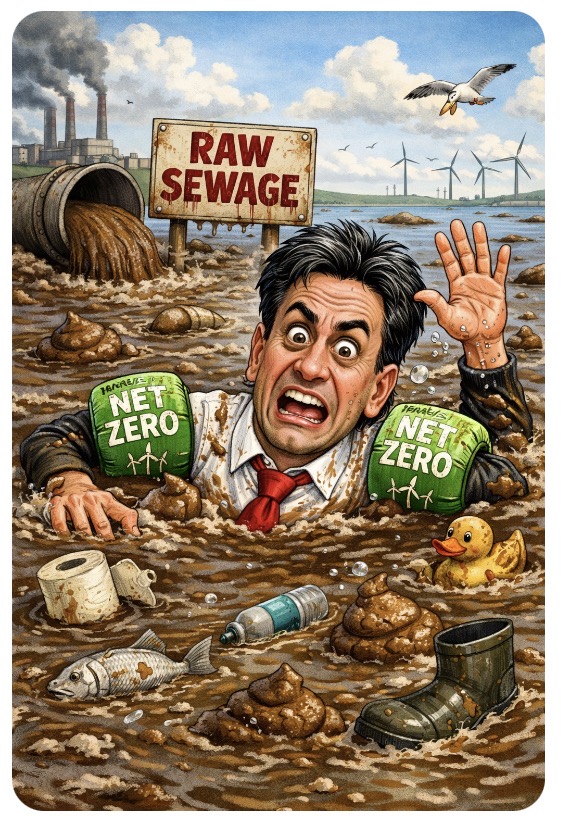
You’re told to ditch fossil fuels, abandon drilling, and embrace the green revolution—or risk frying the planet like a cheap sausage. Fair enough. But while citizens are nudged (or shoved) toward eco-purity, something smells off… and it’s not just the sea breeze. Because at the very same time, water companies seem to be getting away with turning rivers into murky confession booths for industrial sins.
So the question hangs in the air like a suspicious odour: why is one form of environmental harm treated like a global emergency, while another gets shrugged off as “regrettable but necessary”?
🌍 One Planet, Two Rulebooks—Guess Who Pays?
Let’s break it down. Oil drilling? Public enemy number one. The narrative is clear: stop it, tax it, shame it, regulate it into oblivion. You, dear citizen, must change your lifestyle, your car, your heating, your habits. The message is relentless—this is your responsibility.
But water pollution? Ah, now that’s where things get… creatively flexible. Suddenly it’s about “infrastructure challenges,” “overflow events,” and “long-term investment plans.” Translation: we’ll get around to it eventually, maybe, if profits allow.
So here we are:
- Drill for oil = climate villain 🌡️
- Dump waste in rivers = operational hiccup 💼
- Public = expected to fund both the fix and the fallout 💸
It’s not that oil drilling isn’t a serious issue—it absolutely is. But the inconsistency is staggering. You can’t preach environmental purity on one hand while casually rinsing pollution into waterways with the other. That’s not policy—that’s performance art.
And here’s the kicker: both problems hit the same planet, the same ecosystems, the same people. Yet only one seems to trigger full-blown urgency, while the other gets a polite delay and a promise to “review procedures.”
It’s like banning smoking in the house while someone’s actively setting fire to the kitchen. 🔥
🔥Challenges🔥
Why do we accept this split-screen version of environmentalism? Why are individuals pressured to sacrifice while corporations negotiate their consequences? And how long before “green policy” starts to feel less like saving the planet—and more like selective accountability?
💬 Take it to the blog comments—bring your outrage, your wit, or your best one-liner.
👍 Like if you think clean rivers should matter as much as clean air.
🔁 Share if you’re tired of environmental double standards dressed up as leadership.
The most cutting, clever, or brutally honest comments will be featured in the next issue. 🎯📝


 Chameleon Magazine
Leave a comment