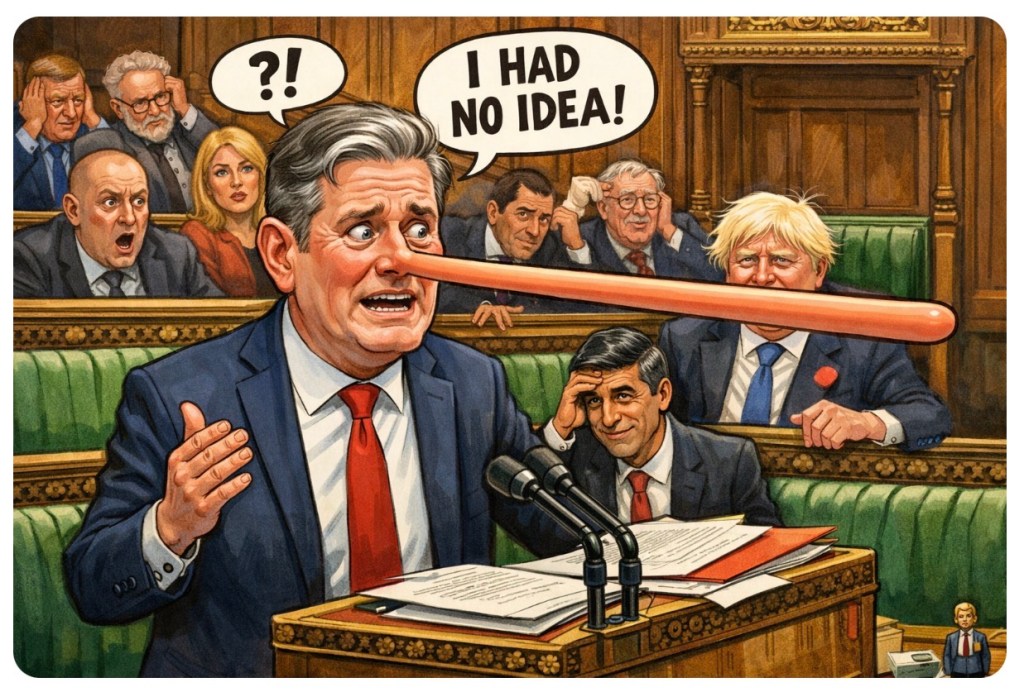
When does a steady hand at the wheel start looking more like someone steering blindfolded into oncoming traffic? The answer, apparently, is somewhere between “I wasn’t told” and “I’m not going anywhere.” Enter Keir Starmer—a man currently juggling apologies, denials, and the political equivalent of a kitchen fire… with a teaspoon.
He’s admitted a “serious judgment error.” He insists he was kept in the dark. Meanwhile, Parliament is lit up like a Christmas tree, allies are sweating, critics are circling, and someone senior has already taken the fall. Yet somehow, the captain remains firmly on deck, insisting the iceberg was… unforeseeable.
🧯 The “Nothing to See Here” School of Crisis Management
There’s a particular art form in politics: looking directly at a blazing disaster and calmly declaring it “a learning opportunity.” Starmer seems to be giving a masterclass.
Let’s break it down. A leader:
- Makes a major error (tick ✔️)
- Claims ignorance (double tick ✔️✔️)
- Sparks investigations (oh, we’re cooking now 🔥)
- Oversees a convenient resignation below him (classic 🪂)
- Faces mounting calls to step down… and doesn’t (bold strategy, Cotton)
At what point does this stop being “resilience” and start looking like denial with better tailoring?
Because here’s the uncomfortable truth: leadership isn’t just about what you knew—it’s about what you should have known. And if the answer is “not much,” that’s not a defence. That’s the problem.
The longer this drags on, the more it morphs from a contained scandal into a slow-burning question about competence, control, and credibility. Parties don’t just lose elections—they bleed trust first. And nothing hemorrhages trust faster than a leader who looks permanently surprised by their own government.
So when is a parliamentary leader a danger to their party?
Not when they make a mistake.
Not even when they make a big one.
But when they normalize the idea that accountability is optional and awareness is negotiable. That’s when colleagues start checking their own lifeboats.
🔥Challenges🔥
Here’s the real question: how many “I didn’t know” moments does it take before voters—and party members—stop believing you should be in charge at all? 🤔
Is loyalty admirable… or just politically expensive denial? Drop your verdict where it counts—on the blog, not just in your group chats. 💬
👇 Smash that comment button, share this with your politically exhausted mates, and tell us: is this leadership or slow-motion self-sabotage?
The sharpest takes (and spiciest roasts 🌶️) will be featured in the next magazine issue. 📝🔥


 Chameleon Magazine
Leave a comment