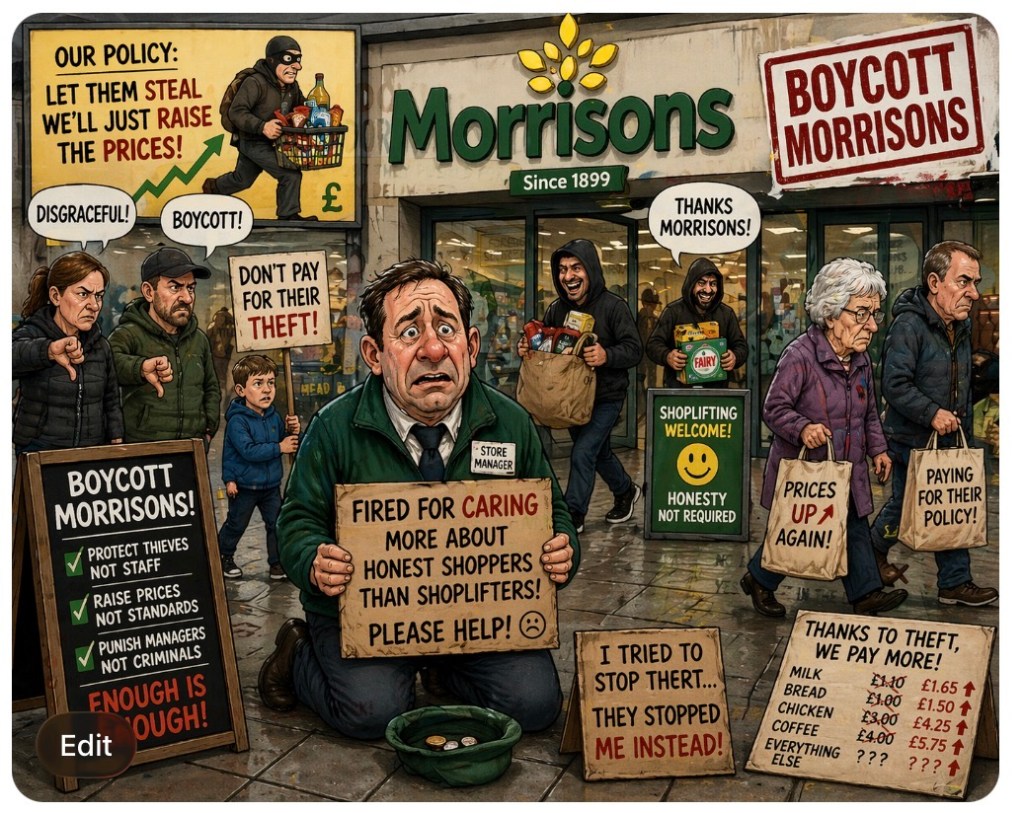
In the latest episode of “Retail Logic Gone Rogue,” Morrisons finds itself defending a decision that’s raised more eyebrows than a self-checkout asking for ID on a banana. A store manager gets the boot for not aligning with company policy… while shoplifters, apparently, get a free pass and a friendly wave on the way out.
Because why stop theft when you can just… redistribute the cost to everyone else? Efficient. Elegant. Slightly dystopian.
🕵️♂️ Catch Me If You Can… Or Don’t, Actually
The logic, as critics see it, feels like something scribbled on the back of a receipt:
- Shoplifters steal 🧃
- Prices go up 📈
- Honest customers pay the difference 😐
Voilà! Problem solved—if your goal is to turn weekly grocery runs into a mild existential crisis.
Now, to be fair, large retailers often do have policies about not confronting shoplifters—usually tied to staff safety and legal risk. No one wants a £9.50/hour employee playing Batman in aisle 7. 🦇
But here’s the rub: when enforcement disappears entirely, it can look like open season. And when prices rise at the same time? The optics write themselves.
🧾 Policy vs. Common Sense: Aisle 5 Showdown
Sacking a manager for stepping outside policy might tick the corporate compliance box. But to the average shopper watching steaks vanish into backpacks, it raises a different question:
Who exactly is the policy protecting?
- Staff safety? Fair.
- Company liability? Understandable.
- Profit margins… via your grocery bill? Ah. There it is.
The tension here isn’t new—it’s just louder now. Retailers are stuck between rising theft, stretched policing, and the risk of viral incidents if staff intervene. But passing the cost downstream while enforcing rigid internal discipline? That’s where public patience starts to wobble.
🧠 The Bigger Picture: Shrinkage, Strategy, and Spin
Retail “shrinkage” (loss from theft and errors) has been climbing, and companies are experimenting with everything from security tags on cheese to locking up laundry detergent like it’s fine jewellery.
But when messaging boils down to:
“Don’t intervene, and don’t question it,”
…people hear:
“We’ve factored theft into your bill.”
And suddenly, your weekly shop feels less like a transaction and more like a group-funded donation drive for opportunistic crime.
🔥Challenges🔥
Be honest—would you accept higher prices if it meant avoiding confrontation in stores? Or does this feel like customers are being quietly volunteered to absorb the cost of inaction?
Is this smart risk management… or a slippery slope where rules punish staff and prices punish everyone else?
Drop your take in the blog comments—sharp, sarcastic, or straight-up furious. 💬🔥
👇 Hit comment, hit like, hit share. Call out the logic or defend the policy—but don’t stay silent in the self-checkout line.
The best comments will be featured in the next issue of the magazine. 🎯📝


 Chameleon Magazine
Leave a comment