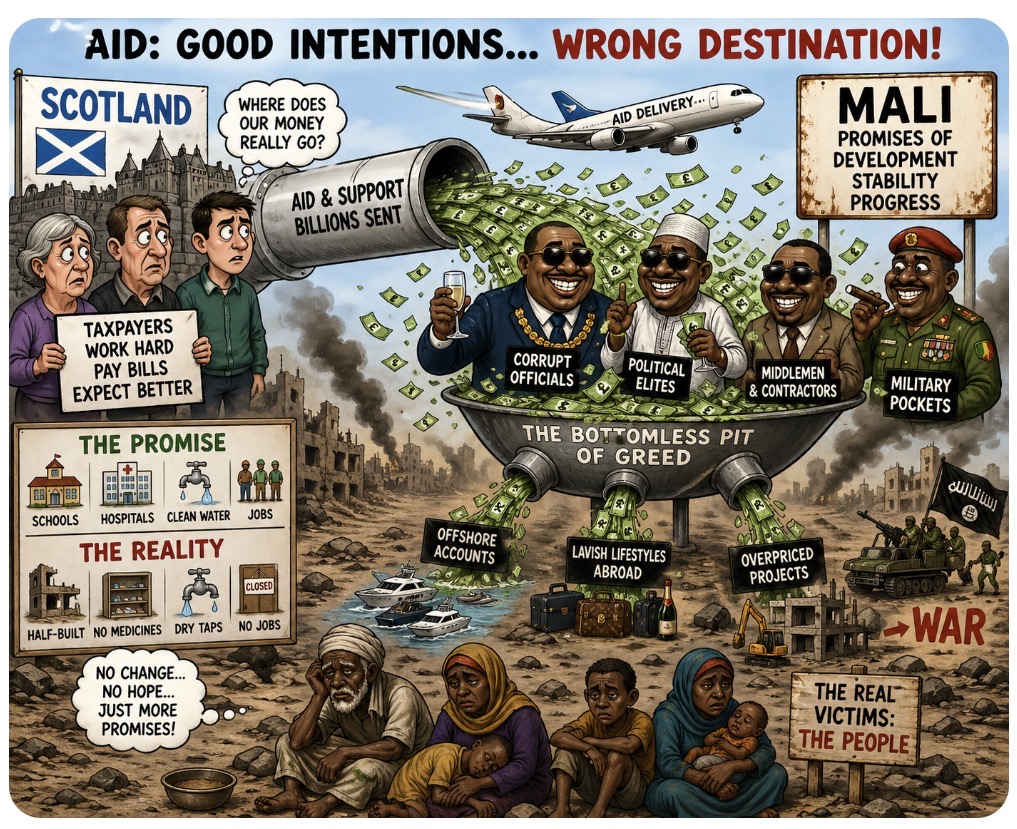
Billions flow across borders in the name of compassion, stamped with buzzwords like “development,” “support,” and “stability.” But somewhere between the donor conference and the dusty village it’s meant to help, that noble intent often mutates into something far murkier. The promise? Relief. The reality? A system that sometimes looks less like healing and more like a revolving door of dependency, corruption, and conveniently misplaced cash.
🐍 The Bottomless Pit of Good Intentions
Let’s not pretend every coin vanishes into thin air—but enough of it slips through the cracks to make you wonder who’s really being supported. In places like Mali, where instability already simmers, aid can end up orbiting the same tight circle of officials, middlemen, and “partners” who’ve mastered the art of smiling for donors while skimming off the top.
And here’s the uncomfortable bit: when money keeps coming regardless of results, what’s the incentive to fix anything? If poverty is the pitch, then progress becomes bad for business. Entire ecosystems can grow around staying just broken enough to qualify for the next funding round. It’s not always malicious—but it’s rarely accidental.
Meanwhile, taxpayers in places like Scotland are told their contributions are changing lives, while on the ground the same issues loop like a bad rerun. Schools half-built. Clinics half-stocked. Promises fully recycled.
🔄 Perpetual Crisis: The Industry That Never Closes
Aid has, in some corners, become less of a solution and more of an industry—complete with conferences, consultants, and glossy reports celebrating “ongoing challenges” like they’re quarterly targets. And just like any industry, it has stakeholders who benefit from keeping the machine running.
That doesn’t mean every project is a sham. Plenty of aid saves lives—full stop. But when oversight is weak and accountability is softer than a donor’s press release, greed finds its way in. Not just local greed, either—international contractors, NGOs, and bureaucracies can all take their slice of the pie.
So the question isn’t just “does aid work?”—it’s “who is it really working for?”
🔥Challenges🔥
If aid keeps pouring in but the problems stay put, what are we actually funding—solutions or symptoms? Is this generosity, or just a well-dressed cycle of dependency?
💬 Don’t just scroll—say it louder in the blog comments. Who’s benefiting, and who’s being played?
👍 Like, share, and tag someone who still believes every pound sent abroad lands exactly where it should.
📝 The sharpest, boldest takes will be featured in the next issue of the magazine.


 Chameleon Magazine
Leave a comment