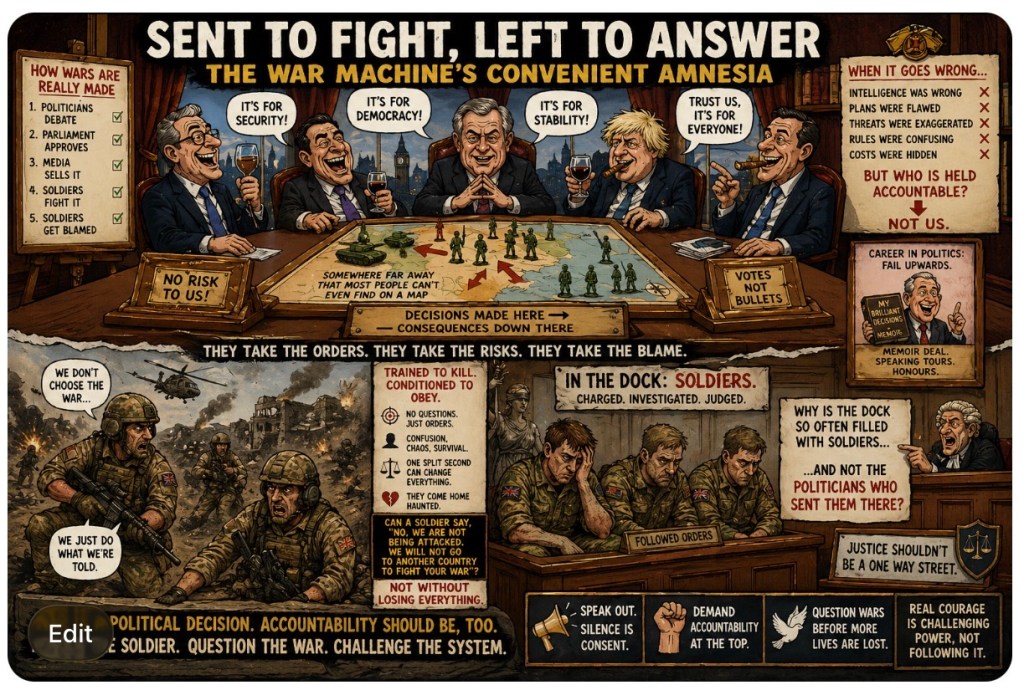
Governments beat the drum. Young men and women answer. They’re trained, conditioned, sharpened into instruments of war—taught not just how to fight, but how to override the very instincts that make us human. Then they’re dropped into conflicts most couldn’t explain on a map, let alone justify at a dinner table.
And when the dust settles? When things go wrong—as they always do in war—it’s suddenly their fault.
🪖 Trained to Kill, Then Put on Trial
Let’s not dress this up. Soldiers don’t freelance foreign policy. They don’t wake up and think, “Today I’ll invade a country.” They follow orders—orders crafted in quiet offices, far from the heat, fear, and chaos of the battlefield.
Yet when those orders collide with messy reality, accountability seems to trickle downhill at remarkable speed.
Suddenly:
- politicians talk about “isolated incidents”
- lawyers circle like it’s open season
- and the same people who demanded action demand answers
The soldier, once a “hero,” becomes a headline.
And here’s the uncomfortable truth: war is not a controlled environment. It’s confusion, split-second decisions, and survival. Expecting clean, courtroom-perfect behaviour from a battlefield is like expecting a chess match during an earthquake.
⚖️ The Starmer Paradox
Enter Keir Starmer—now the man at the top, the one who would ultimately expect British troops to deploy if conflict calls.
But rewind the tape.
Before the power, before the podium, he stood at the sharp end of the legal world that pursued cases against British soldiers. A system that—fairly or not, depending on where you stand—left many veterans feeling like targets long after the fighting stopped.
So here’s the tension that refuses to go away:
👉 The same establishment that once scrutinised soldiers now commands them.
It’s not a simple contradiction—but it is a deeply uncomfortable one.
🏛️ The Empty Dock: Where Are the Decision-Makers?
Now we hit the question that doesn’t get asked loudly enough:
Why is the dock so often filled with soldiers… and not the politicians who sent them there?
Wars don’t materialise out of thin air. They are debated, approved, justified, and launched by elected leaders, cabinets, and parliaments. Strategies are signed off. Intelligence is interpreted (or misinterpreted). Risks are weighed—sometimes disastrously.
And yet:
- when a mission goes wrong, it’s a corporal under investigation
- when conduct is questioned, it’s a patrol commander in court
- when tragedy strikes, it’s the individual who carries the charge
Meanwhile, those who made the original decision to go to war rarely face anything resembling the same scrutiny—let alone legal jeopardy.
At worst? A damaged reputation.
At best? A memoir deal and a speaking tour. 🎤
It creates a system where:
- orders flow downward
- blame flows downward faster
And accountability? That seems to evaporate somewhere near the top.
🤔 Do Soldiers Really Have a Choice?
This is where the moral tension sharpens.
Can a soldier refuse?
In theory, yes—if an order is clearly unlawful.
In reality, that line is blurred beyond recognition in modern warfare.
Conflicts are dressed in:
- “defence of interests”
- “stability operations”
- “pre-emptive security”
Not simple, black-and-white invasions.
So when a soldier asks:
“Are we under attack—or are we the ones attacking?”
There’s rarely a clean answer. And refusal? That’s not a philosophical stance—it’s insubordination, punishment, discharge, even prison.
So the system holds:
- politicians decide
- soldiers deploy
- individuals answer
And the higher up the chain you go… the quieter it gets.
If war is authorised at the top, why is justice enforced at the bottom? 👀
Should political leaders face legal consequences for the wars they start—or would that paralyse decision-making entirely?
And would you expect a soldier to risk everything by saying “no”… or is that asking the impossible?
Drop your take in the blog comments—measured, furious, or brutally honest. 💬🔥
👇 Like, share, and challenge the system in the replies.
The most powerful responses will be featured in the next issue of the magazine. 🎯📝


 Chameleon Magazine
Leave a comment