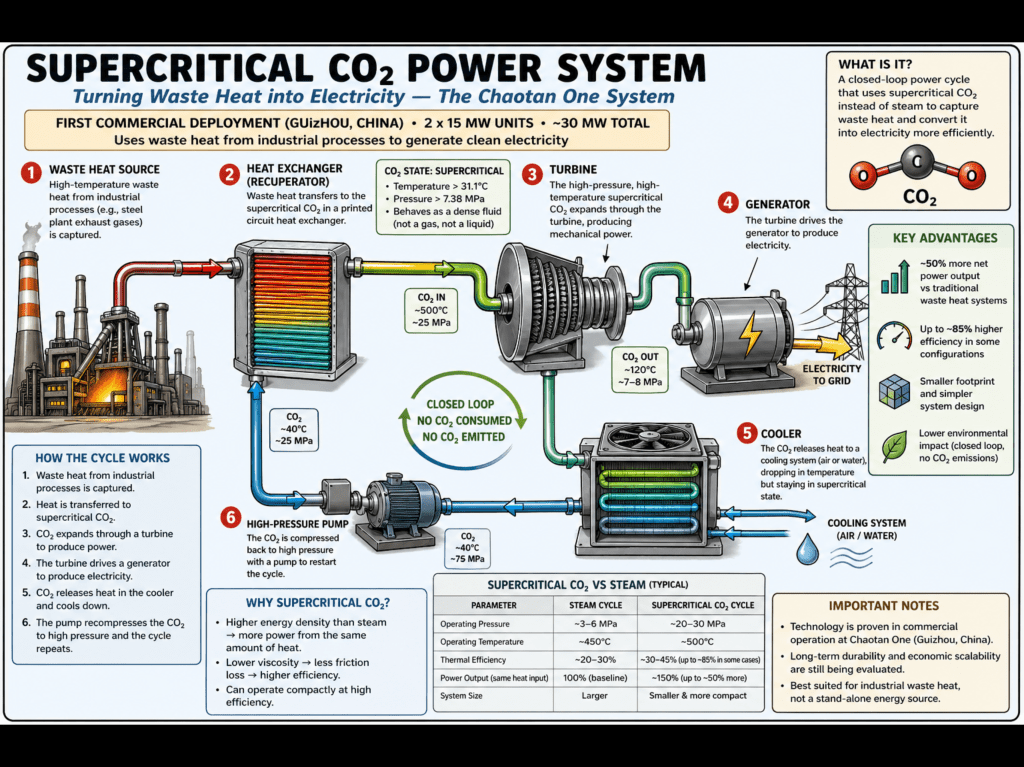
⚙️🌏China has quietly flipped the switch on something engineers have been chasing for years: a commercial-scale supercritical CO₂ power system. Not sci-fi. Not theory. Not a lab toy. Real hardware, real megawatts, real electricity—plugged into an actual steel plant in Guizhou.
Before anyone starts declaring the fossil fuel apocalypse, relax. This isn’t a miracle cure. It’s something far more dangerous to hype merchants:
A genuinely useful, but very specific, engineering upgrade.
🔧 The “Breakthrough” That Refuses to Be Sexy
Let’s translate the jargon into something less LinkedIn-inspirational and more reality-based.
This system:
- Doesn’t create energy
- Doesn’t “run on CO₂” like some kind of climate wizardry
- Doesn’t eliminate emissions
What it does do is brutally practical:
👉 It takes wasted industrial heat—the kind normally dumped into the atmosphere—and squeezes extra electricity out of it using supercritical CO₂ instead of steam.
Think of it as:
A steam turbine that went to the gym, got compact, and started working smarter instead of harder.
Closed-loop cycle. High pressure. High efficiency. Smaller footprint. Less fluff.
It’s not revolutionary—it’s evolution with teeth.
⚡ Why Everyone’s Suddenly Losing Their Minds
Because the numbers look spicy:
- ~50% more net power output vs traditional waste heat systems
- Up to ~85% efficiency gains (in ideal setups, let’s not get carried away)
- Smaller, simpler, tighter systems
In a world obsessed with “net zero,” squeezing more energy out of what you’re already burning is basically the engineering equivalent of finding cash in your winter coat. 💸
So yes—this matters.
But let’s not start building statues just yet.
🚧 Reality Check: The Engineering Hangover
Here’s the part that doesn’t trend well on social media:
- This tech runs at extreme pressures and temperatures
- Materials get stressed. Seals get tested. Things wear out
- Long-term durability? Still a question mark
- Efficiency over time? Likely to drop
- Cost at scale? TBD, and that’s doing a lot of work
Translation:
👉 It works… for now
👉 But we don’t yet know if it behaves after years of industrial abuse
And if there’s one thing factories are good at, it’s destroying anything fragile.
🧠 What This Actually Means (And Doesn’t)
Let’s kill the nonsense before it spreads:
❌ Not “energy from CO₂”
❌ Not a climate silver bullet
❌ Not replacing power grids
❌ Definitely not free energy (calm down, YouTube)
What it is:
✔ A smarter way to recover waste heat
✔ A potential upgrade for heavy industry
✔ A legit milestone in power cycle engineering
And most importantly:
✔ A test of whether clever physics survives brutal reality
🏭 Where This Could Quietly Take Over
If this tech holds up, it won’t dominate headlines—it’ll infiltrate infrastructure:
- Steel plants
- Cement factories
- Nuclear systems
- Solar thermal plants
- Anywhere heat is wasted like yesterday’s leftovers
No fireworks. No revolution. Just efficiency creeping in through the back door.
🔥Challenges🔥
Here’s the uncomfortable question nobody wants to ask:
If this does work long-term… why aren’t we already retrofitting every major industrial plant on Earth?
Is it cost? Risk? Politics? Or are we just addicted to louder, shinier “solutions” that sound better in headlines than they perform in reality?
Drop your take where it matters—in the blog comments, not just the social scroll. Let’s see who actually understands the difference between hype and hard engineering. 💬⚙️
👇 Smash comment, like, and share if you’re tired of miracle-energy nonsense and ready for real talk.
The sharpest takes will be featured in the next issue of the magazine. 🎯📝


 Chameleon Magazine
Leave a comment