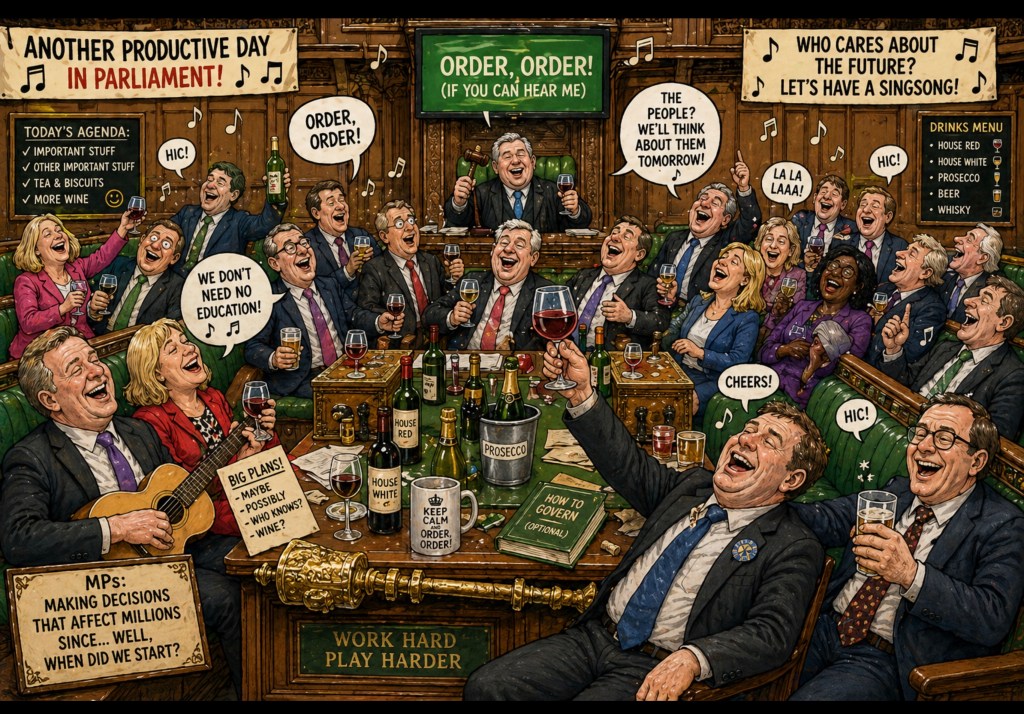
So here we are. The people steering the country—drafting laws, debating futures, shaping livelihoods—might be doing it with the subtle finesse of someone who’s just absolutely demolished a bottle of Merlot.
Meanwhile, the rest of society? Breathalysed, tested, monitored, and told in no uncertain terms: be sober or don’t bother.
🍾 One Rule for You… Another for Westminster
Let’s line it up, shall we?
- Work offshore? Breathalyser.
- Drive a car? Breathalyser.
- Fly a plane? Breathalyser (and rightly so).
- Operate machinery? Absolutely not after a drink.
But stroll into Parliament, where decisions affect millions of lives and billions in spending, and apparently the rule is… “know your limits” 🤷♂️
Ah yes, that famously reliable metric: personal judgment after alcohol. What could possibly go wrong?
Because nothing screams sound governance like a late-night debate fuelled by Pinot Grigio and questionable confidence. “I feel like this policy is solid” hits a bit differently when it’s backed by a third glass and a vague recollection of the briefing notes.
And here’s where it really starts to grate. In every other high-responsibility role, impairment is treated as a risk. A serious one. Lives, safety, and outcomes depend on clarity, focus, and accountability.
Yet in politics? It somehow drifts into the realm of tradition, culture, or—worse—shrug-worthy normality.
🧠 Liquid Confidence, Solid Consequences
The issue isn’t just optics (though, let’s be honest, they’re terrible). It’s the principle.
If you wouldn’t trust someone to safely land a plane after a few drinks, why would you trust them to vote on legislation that affects healthcare, taxes, energy, or national security?
Because unlike a dodgy landing, bad policy doesn’t just jolt a runway—it lingers. It ripples. It costs people time, money, and sometimes far more than that.
And yet the expectation remains: the public must be responsible, while those writing the rules operate on… vibes and vino. 🍷
🔥Challenges🔥
Should MPs be held to the same sobriety standards as other high-stakes professions—or is Parliament somehow exempt from basic expectations of clarity and responsibility?
Where do you draw the line between “tradition” and outright absurdity? And more importantly—why hasn’t it already been drawn?
Drop your take directly on the blog—whether it’s outrage, sarcasm, or a full-on roast. 💬🔥
👇 Comment, like, and share if you think decision-making shouldn’t come with a wine pairing.
The sharpest responses will be featured in the next issue of the magazine. 🎯📝


 Chameleon Magazine
Leave a comment