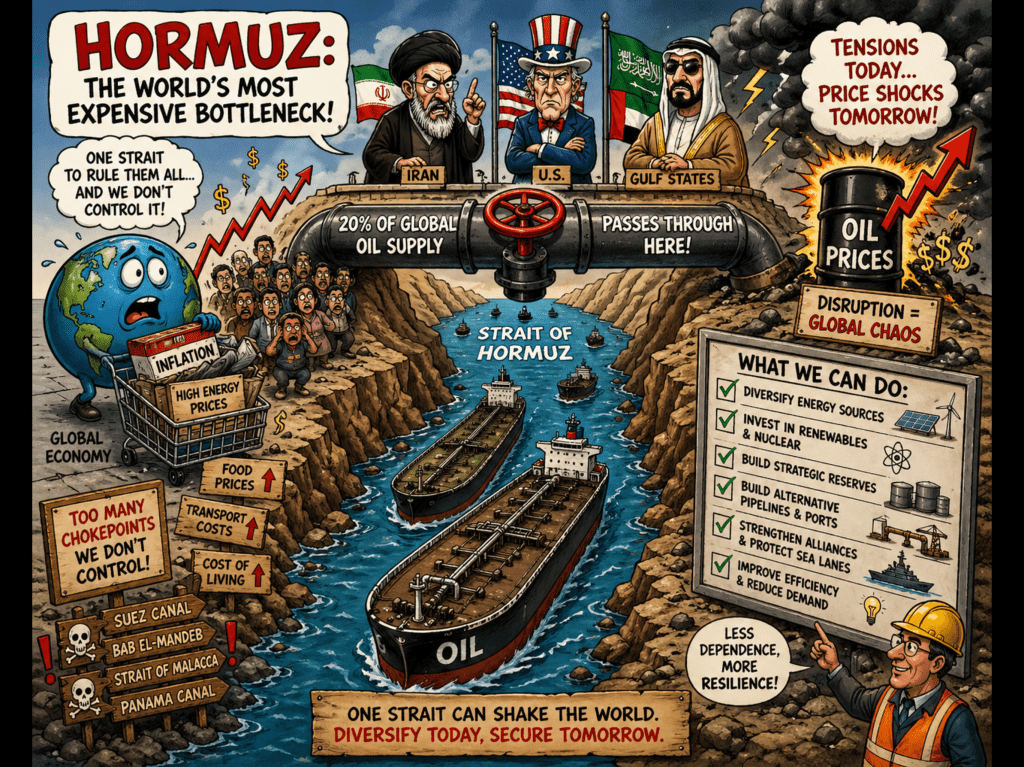
🛢️🌊Roughly 20 million barrels a day passed through the Strait of Hormuz in 2024 — about 20% of global petroleum liquids consumption — which makes this tiny sea lane a giant economic panic button. Recent reports also say shipping through Hormuz has fallen sharply amid U.S.–Iran tensions, showing just how fragile this chokepoint really is.
🚨 The World Built Its Fuel Tap in Someone Else’s Hallway
Yes — we are relying too much on waterways we do not control. Not just Hormuz, either: Suez, Bab el-Mandeb, Malacca, Panama. Modern civilisation has apparently decided that groceries, fuel, fertiliser, heating, air travel, and inflation should all depend on narrow strips of water guarded by geopolitics with a migraine.
What do we do? Not panic-buy diesel in buckets like apocalyptic garden gnomes. We diversify.
Build more energy storage. Speed up renewables and nuclear where viable. Keep strategic oil and gas reserves. Invest in alternative pipelines and ports. Protect shipping lanes through alliances. Cut demand through efficiency. Stop pretending “just-in-time” supply chains are clever when they are really “just-one-missile-away” supply chains.
Because if one strait can make global prices jump overnight, that is not efficiency. That is economic hostage-taking with a maritime view. ⚓📈
🔥Challenges🔥
Here’s the question: do we want cheap energy that collapses every time the map gets spicy, or slightly harder choices now that buy us independence later?
Drop your take in the blog comments — should we build, drill, store, diversify, go green, go nuclear, or finally admit the global economy is balanced on a wet shoelace? 💬
👇 Comment, like, and share — because energy security should not depend on one angry bottleneck with a tide schedule.
The best comments will be included in the magazine. 📝🔥


 Chameleon Magazine
Leave a comment