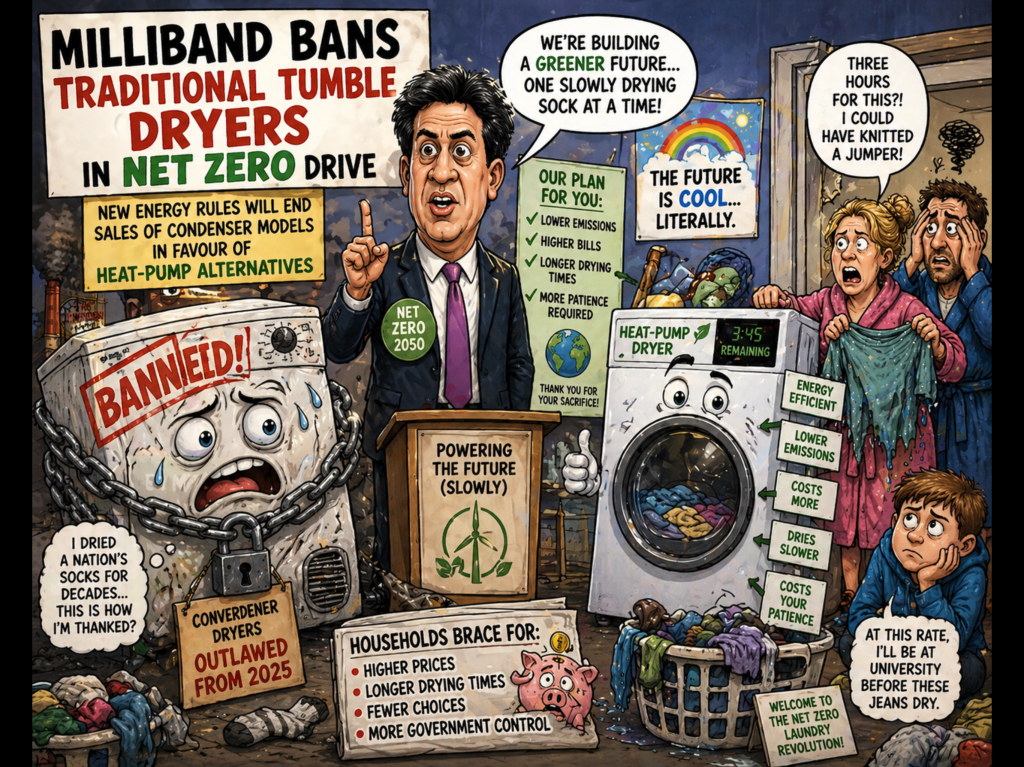
🌪️👕🔥In the latest episode of “Things You Didn’t Know Were Political Until Now,” the UK’s humble tumble dryer has been dragged into the net zero arena—kicking and screaming, presumably on a low-heat eco setting. Under new energy rules, traditional condenser dryers are being phased out, making way for heat-pump alternatives that promise efficiency… and deliver a drying time roughly equivalent to the lifespan of a houseplant.
🧺 The Great Laundry Revolution (Whether You Like It or Not)
Enter Ed Miliband, stage left, armed with ambition, climate targets, and what appears to be a vendetta against your ability to dry socks in under three business days.
The logic? Heat-pump dryers use less energy. The reality? They also use more patience, more upfront cash, and possibly more emotional resilience than the average household possesses after opening an energy bill.
So here we are:
- Your old dryer? Outlawed like it’s contraband 🚫
- Your new dryer? Slower than a Monday morning ☕
- Your electricity bill? Still suspiciously enthusiastic 📈
And while officials hail this as a bold leap toward sustainability, households are left wondering if “net zero” quietly translates to “net inconvenience.”
Because nothing says progress like standing in your kitchen at 11pm, staring at a damp hoodie, whispering: “This used to take 45 minutes…”
Meanwhile, somewhere in Westminster, policies are being applauded for saving the planet—one slightly moist bedsheet at a time. 🌍💧
🔥Challenges🔥
Is this a necessary step toward a greener future—or just another example of everyday life getting micromanaged into oblivion? Are we saving the planet… or slowly being air-dried into submission?
Drop your take in the blog comments—rage, wit, or full-on tumble-dryer grief. 💬🔥
👇 Hit comment, hit like, hit share. Tell us: are you embracing the eco-future or clinging to your fast-dry past?
The sharpest takes will be featured in the next issue of the magazine. 🎯📝


 Chameleon Magazine
Leave a comment