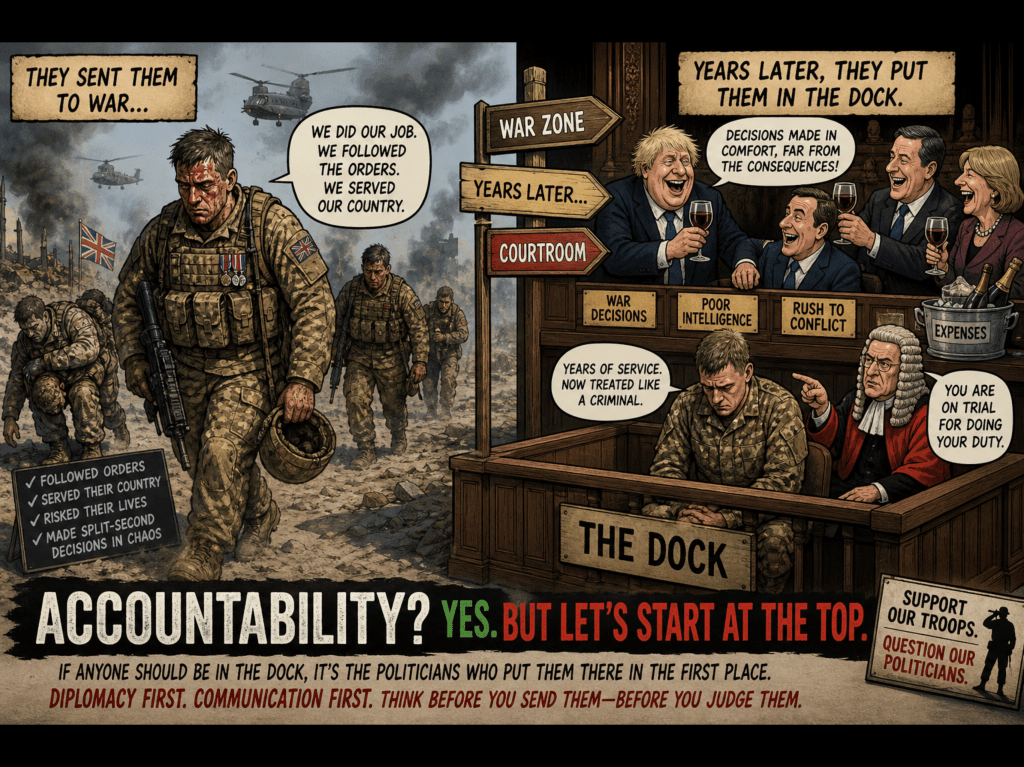
⚖️🎖️Years after the dust settles and the headlines fade, a different kind of battle begins—this time in courtrooms, not conflict zones. Soldiers who once followed orders in chaotic warzones now find themselves under legal microscopes, while the politicians who sent them there sip tea, write memoirs, and collect speaking fees. So the question isn’t just legal—it’s moral: who should really be in the dock?
From Battlefield to Defendant: The Convenient Scapegoat Strategy
Let’s not pretend this is a clean or comfortable issue. War is messy, brutal, and filled with split-second decisions that no training manual can fully prepare you for. Yet years later, with the benefit of hindsight and public pressure, governments suddenly rediscover their love of accountability—just in time to point it squarely at the boots on the ground. 👢
It’s a neat trick, really. Send troops into morally ambiguous conflicts, celebrate them when politically convenient, then quietly investigate them when the narrative turns sour. Meanwhile, the architects of those conflicts—the ones who signed the orders, ignored diplomatic alternatives, or rushed decisions under the banner of urgency—remain conspicuously absent from the witness stand. 🎭
Now, to be clear: this isn’t an argument for zero accountability. That’s a fast track to chaos. Armies without legal boundaries don’t protect democracy—they erode it. But there’s something deeply unbalanced about a system that scrutinises soldiers years later while rarely holding political decision-makers to the same standard of consequence.
Because here’s the uncomfortable truth: soldiers don’t deploy themselves. They don’t design foreign policy. They don’t choose the wars—they execute them.
And when those wars turn out to be flawed, premature, or disastrously misjudged, the blame seems to travel downward with remarkable efficiency. Gravity works wonders in politics. 🧲
🔥Challenges🔥
So who carries the real responsibility—the person pulling the trigger, or the person who created the situation where that trigger had to be pulled?
If justice only flows one way, is it justice—or damage control?
This isn’t about excusing wrongdoing. It’s about asking whether accountability is being applied fairly—or selectively.
💬 Take a stand in the comments on the blog—not just social media. Should politicians face the same legal scrutiny as soldiers? Or is that a line we’re too uncomfortable to cross?
👇 Like, share, and drop your perspective. No fence-sitting—pick a side.
The sharpest, boldest, and most thought-provoking comments will be featured in the magazine. 📝🔥


Leave a comment