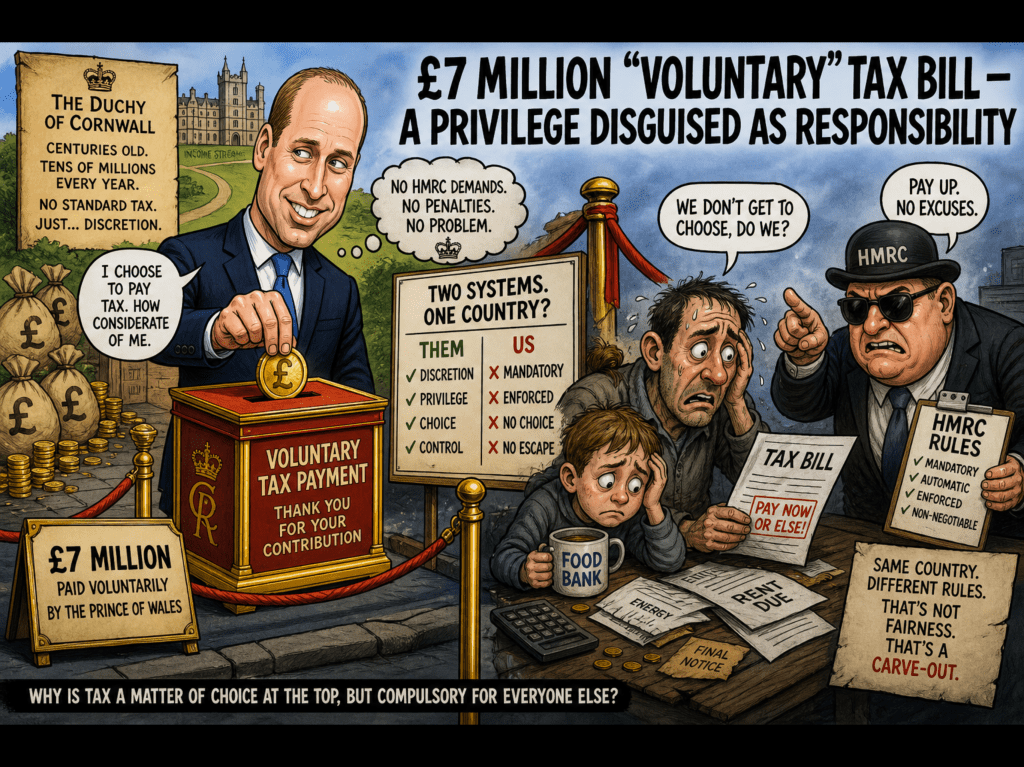
A £7 million tax payment sounds like a headline designed to calm the masses—proof that even royalty is “doing their bit.” But peel back the polished PR veneer, and the story shifts from reassuring to quietly absurd. Because when Prince William pays tax, he’s not following the same rules as everyone else—he’s opting in to them.
🎭 The Crown’s Favourite Game: Mandatory for You, Optional for Them
Let’s call this what it is: a system where the word “voluntary” does some truly heroic lifting.
For the average person, tax isn’t a lifestyle choice. You don’t wake up, stretch, and think, “You know what? I’m feeling generous today—let’s fund some public services.” HMRC doesn’t send a polite invitation. It sends a bill. You pay it, or consequences follow.
But here? Different story.
The Duchy of Cornwall—this sprawling, centuries-old money machine—funnels tens of millions into the hands of the heir to the throne. Not through hustle, innovation, or even inheritance in the usual sense, but through a constitutional setup that practically prints money with a wax seal on top.
And the tax on that income? Not enforced. Not automatic. Not even standardised.
Voluntary.
Which is a charming way of saying: entirely at their discretion.
So the £7 million isn’t just a payment—it’s a performance. A carefully measured gesture that says, “Look, I’m contributing,” while quietly preserving the system that allows contribution to remain optional in the first place. 🎬
Meanwhile, everyone else is locked into a system where “voluntary tax” sounds like the plot of a dystopian comedy.
🏰 A Private Fortune Built on Public Foundations
Here’s where it gets even more interesting.
The Duchy of Cornwall is often described as “private.” Technically true. But also deeply misleading.
Because this isn’t private wealth in the normal sense—no startup grind, no market gamble, no entrepreneurial risk. It exists because of the monarchy. Because of the state. Because of a centuries-old structure that ties land, power, and privilege into one tidy constitutional package.
So when people say, “It’s not public money,” they’re missing the point.
It may not come from taxes—but it absolutely comes from a system sustained by them.
That makes the whole arrangement feel less like independence… and more like a VIP lane built into the very system everyone else is stuck navigating.
⚖️ Fairness, But Make It Flexible
The real tension isn’t the amount. £7 million is a big number—but in context, it’s just a slice of a much larger pie.
The issue is the framework.
Fair taxation isn’t just about how much gets paid—it’s about consistency, transparency, and equality under the rules. And a system where the highest tier operates on discretion instead of obligation? That’s not consistency. That’s a carve-out.
A very polite, very traditional carve-out.
So the question isn’t whether Prince William is generous. It’s why generosity is even part of the equation.
Because taxes aren’t supposed to rely on goodwill. They’re supposed to rely on rules.
🔥Challenges🔥
If fairness is the foundation of taxation, why does it suddenly become negotiable at the top? 🤔
Does a voluntary system for the powerful undermine a mandatory one for everyone else? Or are we just expected to nod along because the number sounds big enough?
Drop your take directly on the blog—skip the safe Facebook takes. We want the sharp ones. 💬🔥
👇 Comment, like, and share if you think “optional tax” deserves a bit more scrutiny.
The best responses will be featured in the next issue of the magazine. 🎯📝


Leave a comment