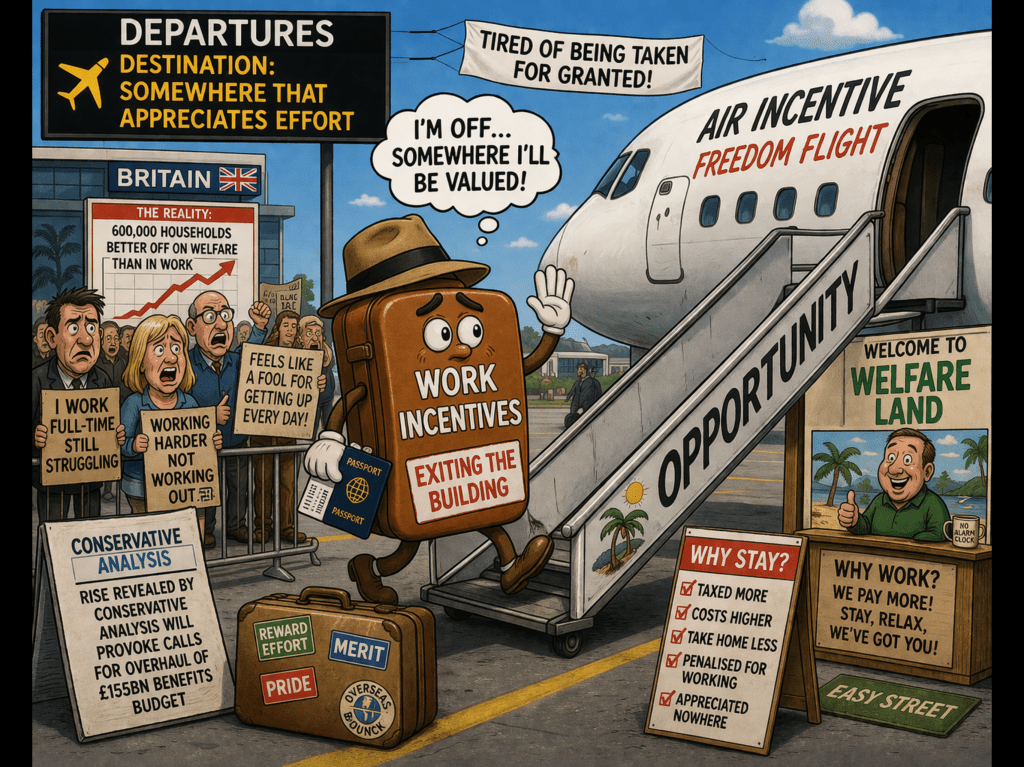
In the latest plot twist from the land of spreadsheets and spin, we’re told that around 600,000 households are now better off on welfare than in work. Yes, you read that right—clocking in might actually leave you worse off than staying home. Somewhere, the concept of “incentive” just quietly packed its bags and left the country. 🚪📉
🧮 The Great British “Why Bother?” Economy
Let’s be clear: this isn’t about demonising people who rely on support. Life happens—jobs vanish, costs explode, and sometimes the system is the only thing standing between survival and disaster. But when working full-time can lose you money compared to not working at all, something in the wiring has gone spectacularly sideways. 🔌💥
The reported figures—courtesy of Conservative analysis—have reignited the age-old political food fight: is the £155 billion benefits budget a lifeline… or a lifestyle? Cue outrage, counter-outrage, and a fresh round of policy ping-pong.
Because here’s the uncomfortable truth: if taking a job means higher costs (childcare, transport, rent adjustments) that outweigh your wages, then the system isn’t rewarding effort—it’s penalising it. And that’s not compassion—that’s chaos with paperwork. 📄🤯
Meanwhile, politicians line up to “fix” it. Some shout “cut benefits!” Others yell “raise wages!” A few whisper “maybe redesign the whole system?”—before being politely ignored. Because bold reform is hard, and headlines are easy. 📰🙄
So we’re left with a bizarre economic theatre where:
- Work doesn’t always pay 💼❌
- Support becomes a trap 🪤
- And taxpayers wonder who exactly this is all working for 🤷♂️
🔥Challenges🔥
Here’s the question nobody can dodge: if the system discourages work, who fixes it—and how? Is this a failure of wages, welfare, or political courage? 💣
Don’t just argue with your group chat—bring it to the blog. Drop your take, your frustration, or your solution in the comments. 💬🔥
👇 Like, share, and let’s hear your verdict. Is this broken Britain—or just broken policy?
The sharpest comments will be featured in the next issue of the magazine. 🎯📝


Leave a comment