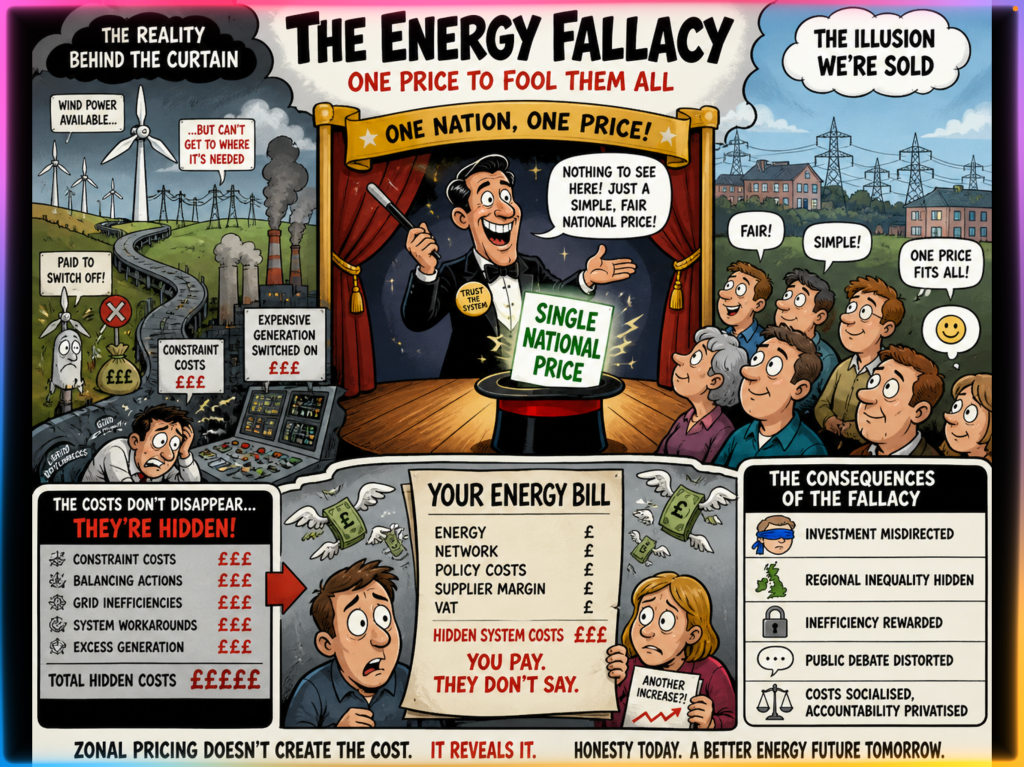
Britain loves a tidy story—especially when it fits neatly on a ministerial soundbite. “One nation, one electricity price.” Clean. Fair. Comforting. Almost poetic.
Shame it’s about as real as a £2 pint in central London.
Behind that polished slogan is a system quietly haemorrhaging complexity—where electricity isn’t just generated, but negotiated, rerouted, throttled, and occasionally paid not to exist. Wind farms get cash to switch off. Backup generators fire up at premium rates. The grid plays a never-ending game of electrical musical chairs.
And guess who’s funding the orchestra? 🎻💸
(Hint: check your energy bill.)
⚙️ The Grid’s Dirty Little Secrets Nobody Puts on the Bill
Let’s talk about the “invisible extras.” Constraint payments. Balancing mechanisms. Grid bottlenecks. Sounds technical—because it is. But the outcome is beautifully simple: you pay more, and you’re told less.
Energy is cheapest where it’s abundant. Logical, right? But instead of letting prices reflect that, the system flattens everything into one neat national figure—like blending fine wine with tap water and calling it “house red.”
Enter zonal pricing—the policy equivalent of turning the lights on at a very awkward party. Suddenly, regions rich in wind or solar would see lower prices. Areas clinging to strained infrastructure? Not so lucky.
And that’s where the political enthusiasm evaporates faster than a puddle in July. ☀️
Because once prices reflect reality, so do consequences.
Winners. Losers. Accountability. Investment shifts. Headlines.
Much easier to keep the illusion intact.
🎩 Smoke, Mirrors, and a Monthly Direct Debit
Here’s the kicker: the costs don’t disappear just because they’re hidden. They’re baked into your bills, your taxes, your “mysterious” annual increases that arrive with all the charm of a parking fine.
We’re not avoiding the cost—we’re just disguising it.
Zonal pricing doesn’t create inequality or inefficiency. It exposes it. And apparently, honesty is the one renewable resource still in short supply.
So instead, we cling to a national pricing model that treats geography like an optional extra—because admitting the truth would mean explaining it.
And explaining it would mean owning it.
Awkward. 😬
If we’re already paying the real price, why are we being sold a fake one? Who benefits from keeping the system this murky—and how long do we keep nodding along?
Drop your take directly on the blog. No fence-sitting, no polite shrugs—bring the heat. 💬🔥
👇 Comment. Like. Share. Call it out.
The sharpest takes, boldest rants, and smartest insights will be featured in the next issue of the magazine. 🎯📝


Leave a comment