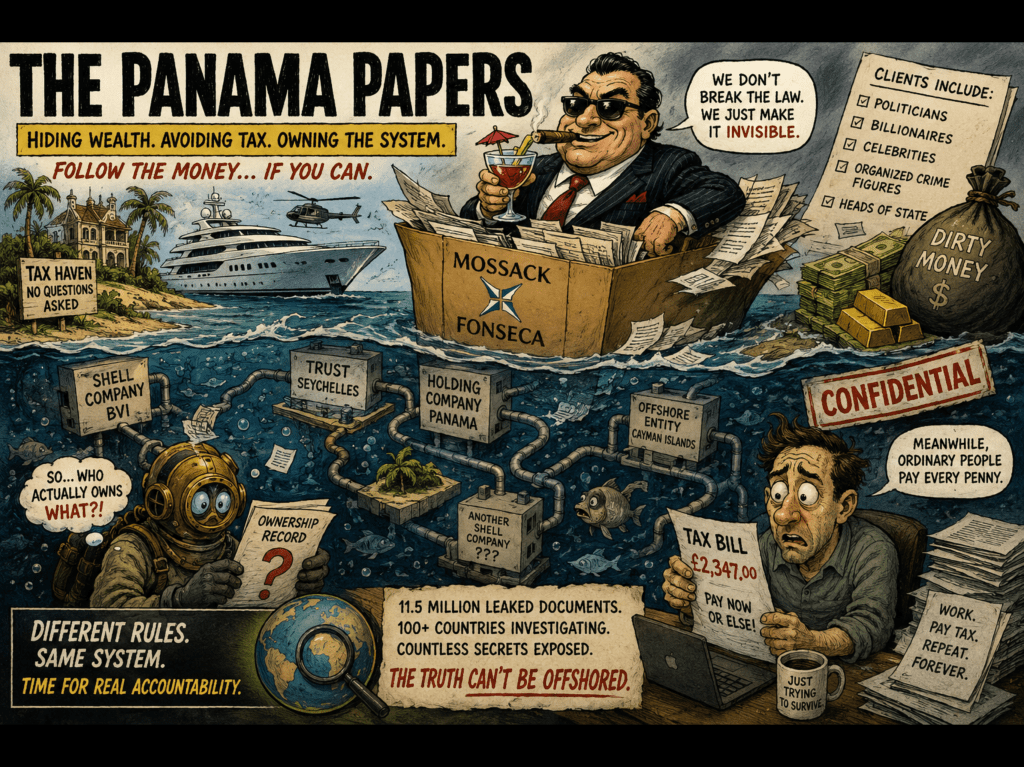
🌍💸🕵️At first glance, the Panama Papers sounded like another painfully dull tax scandal—the kind of story that makes people instinctively reach for a remote control or fake a Wi-Fi outage. Then came the plot twist. 📂🔥
In 2016, an anonymous whistleblower leaked 11.5 million documents from Panamanian law firm Mossack Fonseca, exposing how the global elite quietly shuffled fortunes through offshore shell companies like squirrels hiding radioactive acorns. Politicians, celebrities, billionaires, oligarchs, organized crime figures, and even heads of state were suddenly caught standing in the fluorescent light holding suspiciously large bags of “totally legitimate business structures.” 💼🏝️
The leak revealed a world where the rich don’t merely avoid taxes—they appear to operate in a parallel financial universe where money travels through islands with more palm trees than people. One minute a mansion belongs to a company in the British Virgin Islands owned by a trust in the Seychelles controlled by another entity in Panama. The next minute everyone involved claims they’ve “never heard of it.” 🤷♂️🌴
🏦 Offshore Finance: Because Apparently One Yacht Isn’t Enough 🚤💰
The real scandal wasn’t just hidden wealth—it was the sheer industrial scale of secrecy. The papers showed how offshore systems could be used to:
- Hide assets 💎
- Avoid taxes 🧾
- Conceal political corruption 🏛️
- Launder money 🧼
- Mask ownership of luxury property 🏠
- Move fortunes beyond public scrutiny 👀
And naturally, the people constantly lecturing ordinary citizens about “shared sacrifice” and “economic responsibility” somehow discovered magical loopholes wide enough to sail a superyacht through. Funny how that works. 😒
The leak implicated associates connected to figures like Vladimir Putin, exposed offshore dealings tied to then-Icelandic Prime Minister Sigmundur Davíð Gunnlaugsson, and embarrassed political dynasties, celebrities, and financial institutions worldwide. Iceland’s government practically melted overnight under public outrage. Meanwhile, elsewhere, some leaders responded with the universal elite defense strategy:
“This is an attack on privacy.”
Translation: “Please stop looking at where the money went.” 💀
What made the Panama Papers explosive wasn’t merely greed—it was the realization that global inequality isn’t just accidental. Entire industries exist to legally blur ownership, obscure accountability, and help fortunes disappear faster than ethics at a lobbying convention. 📉🎩
And the most absurd part? Most ordinary people can’t accidentally forget to pay a parking ticket without receiving seventeen threatening letters. Yet somehow vast offshore empires involving millions quietly drift through the global financial system like invisible pirate ships made entirely of accountants. ⚓📑
🔥Challenges🔥
If the ultra-rich can move billions through secret offshore labyrinths while ordinary workers get chased over tax codes and late fees, what does “fairness” even mean anymore? 🤔💸
Should offshore secrecy be legal? Are governments truly fighting corruption—or just protecting the VIP section of the global economy? And why does accountability always seem to arrive economy class while wealth escapes by private jet? ✈️🔥
Drop your thoughts, outrage, sarcasm, or conspiracy board diagrams in the blog comments. 💬🧠
👇 Like, share, and tag someone who still thinks billionaires keep their money in a regular savings account.
The sharpest comments and most savage takes will be featured in the next issue of the magazine. 📰🎯


Leave a comment