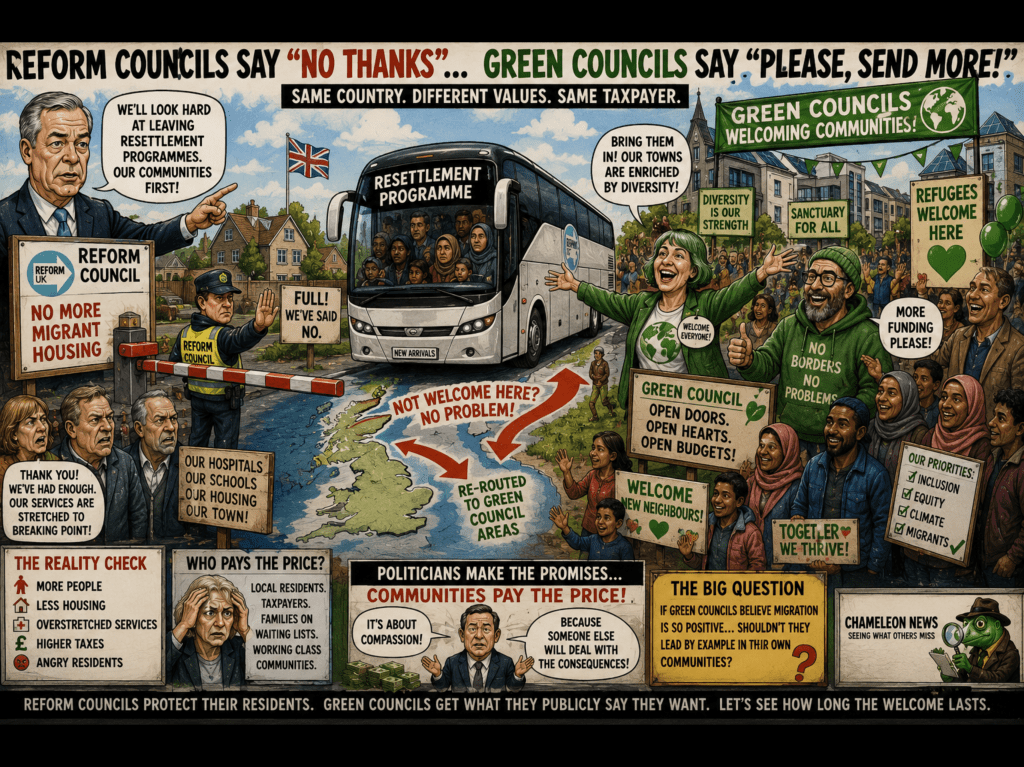
Nigel Farage says Reform-controlled councils may stop cooperating with migrant resettlement programmes — and suddenly Britain’s political map is starting to look like the world’s most awkward game of pass-the-parcel. 🎁💥
Because while Reform councils signal they want out, there’s another group of local authorities apparently warming up the tea kettles and preparing the diversity banners:
Green Party councils. 🌱🫖
And critics are already predicting exactly what happens next.
If Reform-run areas refuse accommodation schemes, pressure won’t magically disappear. It simply gets redirected elsewhere — most likely into the same progressive urban communities whose leadership endlessly lectures the country about compassion, inclusion, and moral responsibility. 📦➡️🏙️
Which raises the obvious question:
If Green councils genuinely believe mass resettlement is overwhelmingly positive, why shouldn’t they become the primary destinations?
🌱 “Compassion” Gets Very Real When It Arrives By Busload
For years, Britain’s migration debate has largely operated in abstract language:
“diversity,”
“humanitarian obligations,”
“community enrichment,”
“global responsibility.”
But abstract politics changes very quickly once accommodation, school places, GP capacity, policing pressures, housing shortages, and public services collide with local reality. 🏚️📉
And now Reform appears ready to force the issue directly onto councils that publicly support higher migration intake.
In simple terms:
if you champion the policy,
you host the consequences.
That’s the political trap quietly emerging beneath all the headlines.
Because many voters increasingly suspect Britain’s migration system works through asymmetry:
working-class towns absorb pressure,
local residents absorb costs,
while affluent political activists absorb moral satisfaction on social media. 📱🎭
Reform’s strategy flips that equation entirely.
🚚 The Great Redistribution Of “Virtue”
Imagine the scene now unfolding across Britain.
Reform councils:
“No more migrant housing here.”
Green councils:
“Well… yes… but…”
Suddenly every slogan about “welcoming communities” becomes a logistical challenge instead of a university seminar. 🎓➡️🏘️
Because it’s one thing to wave flags at a protest march.
It’s another to explain to residents why already stretched housing lists, schools, and services are about to face even greater demand.
And critics believe that’s exactly why this political collision could become explosive.
Not because migration itself is new —
but because politicians may finally be forced to align rhetoric with responsibility.
🏛️ The Real Fight Isn’t About Immigration — It’s About Accountability
This is the deeper tension boiling underneath the debate.
Who actually carries the burden of national policy decisions?
Because for years, many communities feel they’ve been told to quietly absorb massive social and economic change while elite political circles dismissed concerns as ignorance, intolerance, or “populism.” ⚠️
Now the tables may be turning.
If Green-led councils genuinely support expanded accommodation programmes, then critics argue they should become the flagship examples of how successful those policies supposedly are.
No excuses.
No outsourcing.
No hiding behind Westminster language.
Put theory into practice.
🔥Challenges🔥
If progressive councils believe migration strengthens communities, should they now lead from the front by taking the largest share of resettlement programmes? 🤔
Or will Britain once again witness politicians supporting policies publicly while quietly hoping somebody else deals with the practical consequences?
💬 Drop your verdict in the blog comments — not just on social media. We want the fury, the sarcasm, the realism, and the uncomfortable questions.
👇 Like, share, and comment if you think councils should only support policies they’re willing to implement inside their own communities.
The sharpest reader comments will feature in the next magazine issue. 📰🔥


Leave a comment