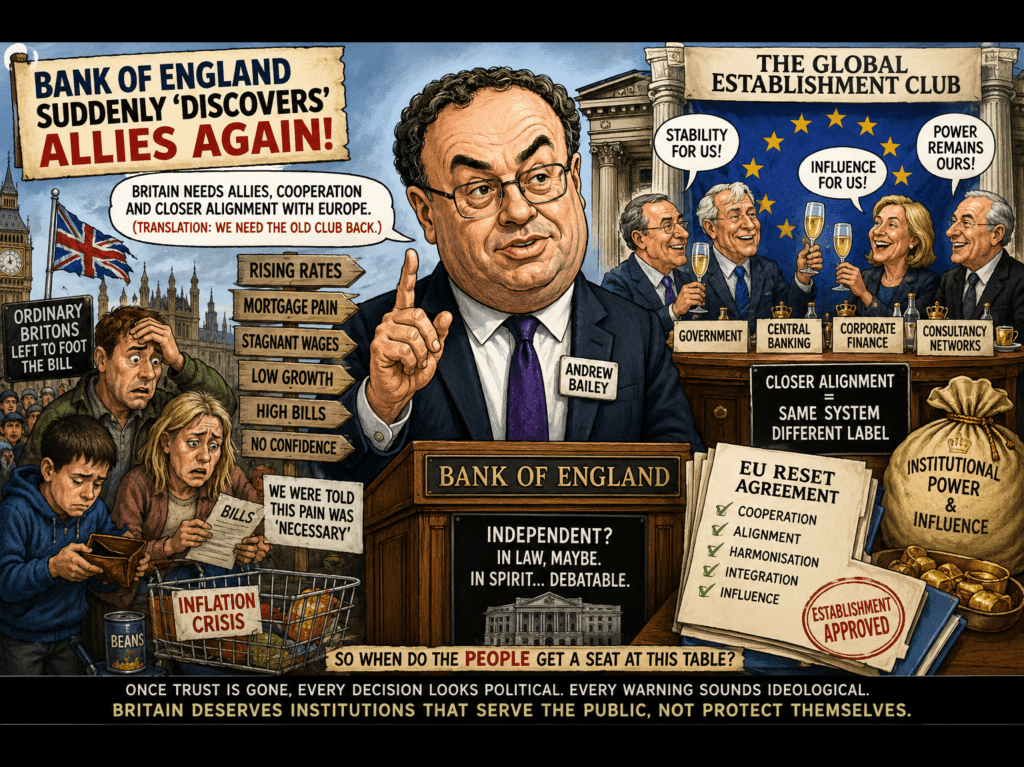
As Britain absorbs years of squeezed wages, battered confidence, mortgage pain, and economic fatigue, the nation’s unelected financial priesthood has abruptly remembered the importance of “alliances,” “cooperation,” and getting cosy with Europe again. How convenient. 🍷📉
Not when inflation exploded.
Not when households were hammered by rate hikes.
Not when businesses suffocated under uncertainty.
No — now the language changes.
And critics are asking a question Westminster hates more than a cold Pret sandwich:
Was the Bank of England ever truly neutral at all?
🎭 “Technocrats” With Political Preferences? What A Shocking Discovery
For years, the public was instructed to swallow economic pain like obedient lab rats in a Treasury experiment.
Can’t afford your mortgage anymore? Necessary.
Wages collapsing behind inflation? Unavoidable.
Businesses folding? Global conditions.
Energy costs detonating family budgets? Be realistic.
The message was always the same:
You suffer now so the experts can save stability later.
But suddenly, Andrew Bailey emerges sounding less like a central banker and more like a keynote speaker at Davos After Dark™. 🥂🌍
“Britain needs allies.”
“Closer cooperation.”
“European alignment.”
To supporters, it sounds sensible.
To critics, it sounds like the establishment quietly reopening the same door voters tried kicking shut in 2016.
And that’s where the fury begins.
Because millions increasingly believe Britain’s ruling institutions operate like an exclusive members club where politicians, central bankers, consultants, global finance executives, regulators, and corporate strategists all recycle through the same corridors while calling their collective preferences “economic reality.” 🎩🔄
The accusation isn’t subtle anymore:
When elite systems profit from globalization, it’s called “stability.”
When ordinary voters resist, it’s called “dangerous populism.”
Funny how democracy becomes “irrational” the second it threatens institutional comfort. 🤡📊
🏛️ Brexit Was Never Just About Trade — It Was About Rejection
This is the part establishment Britain still struggles to comprehend.
Brexit wasn’t simply a customs dispute or a spreadsheet disagreement over tariffs. For many voters, it was a revolt against managerial politics itself — against the feeling that every major decision had already been pre-approved by interconnected institutions pretending there was no alternative.
And now? Critics believe they’re watching those same institutions slowly attempt to rebuild the old architecture under softer language:
“Alignment.”
“Partnership.”
“Shared frameworks.”
“Cooperation.”
The wording changes.
The instinct remains identical.
That’s why Bailey’s comments landed like a political grenade. 💣
Not because one governor mentioned Europe — but because trust in institutional neutrality has already collapsed.
Once people suspect the referee secretly preferred one side all along, every future decision becomes contaminated.
Interest rates stop looking impartial.
Economic forecasts stop sounding objective.
Warnings stop feeling technical.
Everything starts resembling ideological steering from a permanent managerial class trying to guide Britain back toward the system it originally wanted.
And that perception is lethal for a central bank.
Because central banking only works when people believe the adults in the room are acting without political instinct.
The moment that belief fractures, “expert management” starts looking suspiciously like soft power dressed in spreadsheets. 📑⚡
Here’s the uncomfortable question no institution wants answered:
If the Bank of England is truly independent, why do its cultural instincts always seem to align with the same international political direction? 🤔
And if Brexit was genuinely democratic, why do so many voters feel Britain’s elite institutions spent the last decade waiting for the public to “come to its senses”?
Is this economic realism…
or establishment restoration disguised as pragmatism?
💬 Drop your verdict in the blog comments — not just social media. We want the rage, the sarcasm, the receipts, and the brutal honesty.
👇 Like, share, and comment if you think Britain’s institutions are becoming openly political while pretending to remain neutral.
The sharpest comments and best reader takedowns will be featured in the next magazine issue. 📰🔥


Leave a comment