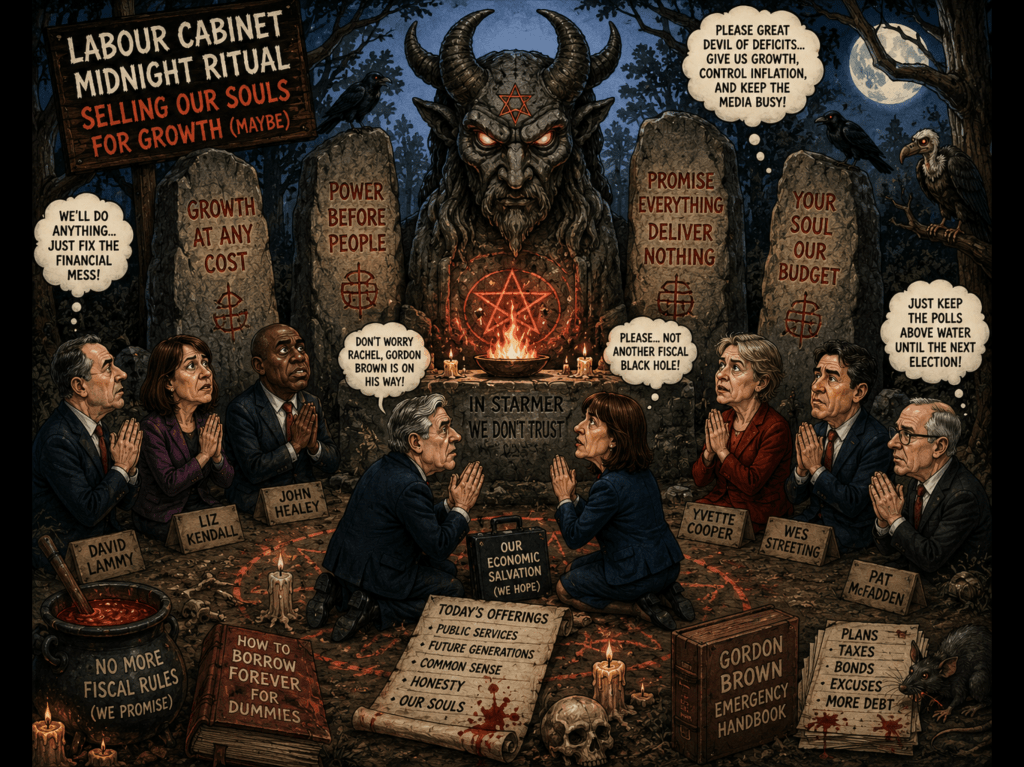
Well, Britain officially appears to have entered the “break glass in case of economic emergency” stage of government.
Because when whispers start circulating that Gordon Brown — yes, that Gordon Brown — is being dragged back into the spotlight to help Rachel Reeves untangle Labour’s growing fiscal headache, you know panic has entered the building. 🏛️📉
The Flying Scotsman has apparently left the station once more.
And somewhere deep inside Downing Street, Keir Starmer is probably clutching spreadsheets, polling data, and a ceremonial candle while desperately trying to summon economic credibility from the underworld itself. 🕯️👹
🎭 “Trust Us This Time” — The Sequel Nobody Asked For
This is where the political theatre becomes almost too absurd to parody.
Labour wants to present itself as the calm, competent, managerial alternative. The adults are back in charge. Stability. Prudence. Responsibility. The usual PowerPoint presentation. 📊😴
But now the same political machine appears to be reaching back into the New Labour vaults looking for Gordon Brown — the man permanently associated in the public imagination with financial crashes, debt explosions, and that immortal phrase:
“No more boom and bust.”
History really does have a savage sense of humour. 💥📉
And critics are already asking:
if the economy is supposedly under control, why are the old emergency mechanics being wheeled back into the garage?
Because beneath the polished language about “growth,” “investment,” and “fiscal discipline,” voters increasingly suspect Westminster is preparing another grand bargain:
Promise everything.
Borrow endlessly.
Smile confidently.
Delay consequences until later.
Modern politics in one flowchart. 🔄💰
👹 Starmer’s Midnight Pact With The Devil
At this point, some swear they’ve seen Keir Starmer wandering through Westminster after dark carrying economic forecasts and muttering incantations under a blood moon. 🌕🔥
The ritual reportedly goes something like this:
“I promise growth.”
“I promise stability.”
“I promise prosperity.”
“I promise everyone everything all at once.”
And then somewhere in the distance, a taxpayer quietly faints beside their energy bill.
Because that’s the deeper frustration bubbling underneath British politics right now:
People no longer trust promises that arrive wrapped in slogans and consultant-approved optimism.
They’ve heard it too many times before.
Every government claims salvation is around the corner.
Every leadership campaign promises renewal.
Every fiscal plan arrives as “historic.”
And somehow ordinary people still end up paying more for less while political elites rotate seats around the same collapsing carousel. 🎠📉
🪶 Beads, Trinkets, Promises… Then The Bill Arrives
The real anger here is about trust.
Critics increasingly believe modern politics operates like an elaborate sales operation:
offer shiny promises,
sell emotional hope,
package it as national renewal,
then quietly transfer the costs onto future taxpayers once the applause fades. 🎁💳
That’s why the comparisons are becoming harsher and more cynical.
To frustrated voters, the promises sound less like economic planning and more like historical bait-and-switch politics:
grand visions offered upfront,
consequences hidden in the small print.
And once public trust collapses, every promise starts sounding transactional.
Not leadership.
Marketing.
🔥Challenges🔥
Why does British politics always seem to recycle the same names, the same economic language, and the same “rescue missions” every time things go wrong? 🤔
And are voters witnessing genuine solutions…
or simply another rebrand of the same managerial system that created the mess in the first place?
💬 Drop your theories, sarcasm, outrage, and political autopsies in the blog comments.
👇 Like, share, and comment if you think Westminster increasingly resembles a travelling circus where yesterday’s “solution” becomes tomorrow’s emergency comeback tour.
The sharpest reader comments will feature in the next magazine issue. 📰🔥


Leave a comment