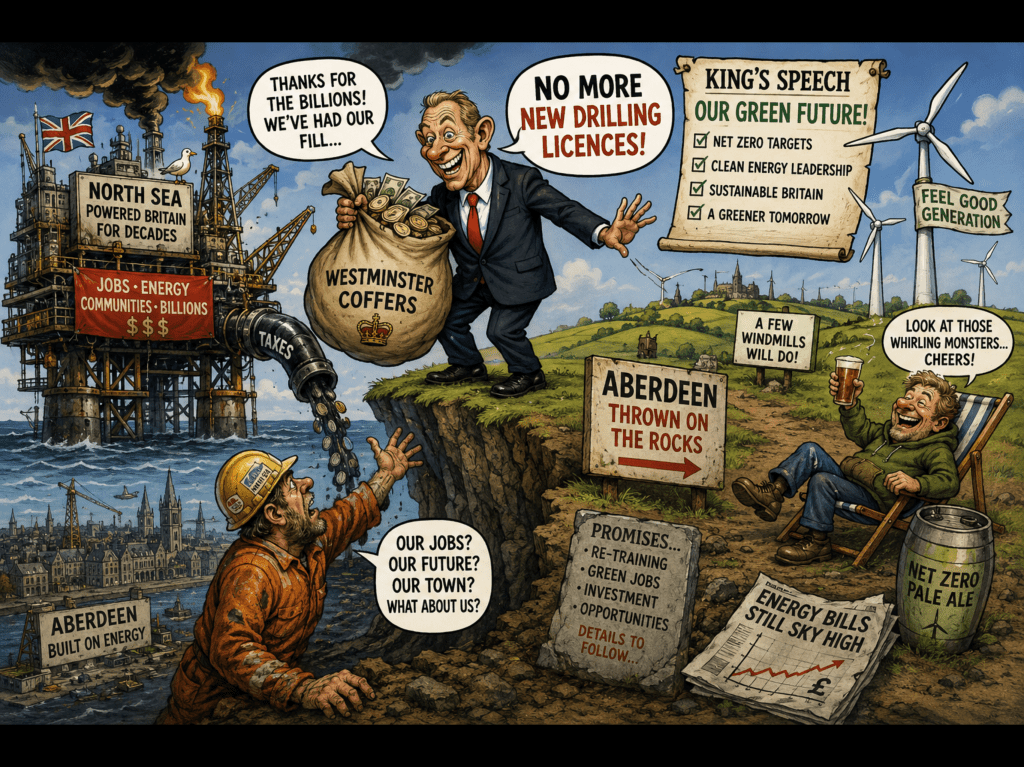
🛢️🌊💸For decades Westminster treated the North Sea like a giant offshore cash machine — sucking out billions in oil, taxing the industry into orbit, and building entire chunks of the UK economy on Aberdeen’s back.
Now suddenly the same political class has discovered environmental morality and announced:
“No more new drilling licences.” 🌱✨
Convenient timing, that.
After milking the North Sea dry for generations, the government now seems ready to toss Aberdeen onto the rocks with a leaflet about renewable optimism and a few strategically placed wind turbines. ⚡🌬️
Because apparently if you can see a windmill spinning sadly in the distance, unemployment somehow becomes “green transition.”
🏗️ Aberdeen: From Energy Capital to Political Afterthought
The fury in the north isn’t just about oil.
It’s about betrayal.
Workers who powered Britain for decades now watch politicians in Westminster lecture them about sustainability from heated London studios powered by the very industry they’re dismantling. 🏛️🔥
Entire communities were built around:
- offshore engineering,
- supply chains,
- fabrication yards,
- transport,
- logistics,
- and energy infrastructure.
This isn’t simply “turning off oil.”
It’s potentially restructuring entire regional economies with no guaranteed replacement at the same scale.
And people know it.
Because governments love announcing transitions.
They’re less enthusiastic about funding them properly.
🌬️ “Learn to Code” — But for Offshore Workers
The political messaging often sounds bizarrely detached from reality.
Workers hear:
“Don’t worry — green jobs are coming.”
But many hear something else:
“Thanks for the decades of revenue. Good luck retraining at 52.” 🛠️💀
Wind energy matters.
Renewables matter.
Climate transition matters.
But pretending those industries instantly replace the wages, scale, infrastructure, and economic ecosystem of North Sea oil is political fantasy dressed up as strategy.
You cannot build an economy entirely from press releases and turbine photo opportunities. 📸⚡
🧠 The Bigger Fear: Britain Imports Energy While Killing Its Own Industry
This is where public anger intensifies.
Critics ask:
if Britain still needs oil and gas during transition years… why import it from abroad while shutting domestic production down?
To many in Aberdeen, that feels less like environmental leadership and more like economic self-sabotage with a sustainability logo attached. 🌍💸
Because voters notice the contradiction:
- domestic jobs disappear,
- energy bills remain brutal,
- foreign imports continue,
- and politicians still fly globally to climate summits discussing “working people.”
Not exactly reassuring.
⚓ The North Sea Was Never Meant to Last Forever — But Neither Was Neglect
The hardest truth is this:
everyone knows oil has a long-term expiry date.
The real argument is over pace, planning, and fairness.
Communities that generated billions for Britain are now asking a simple question:
“Where exactly is the serious replacement plan?” 🤔
And so far, many feel the answer is:
a speech, a slogan, and a wind turbine on a hill.
🔥Challenges🔥
Is Labour making a necessary long-term climate decision — or sacrificing energy jobs without a credible economic transition plan? ⚡🛢️
Should Britain continue North Sea drilling while renewables scale up, or is it finally time to shut the chapter completely?
Drop your thoughts in the blog comments. 💬🔥
👇 Like, comment, and share if you think governments are very good at ending industries and far less skilled at replacing them.
The sharpest comments and fiercest debates may feature in the next magazine issue. 📰⚡


Leave a comment