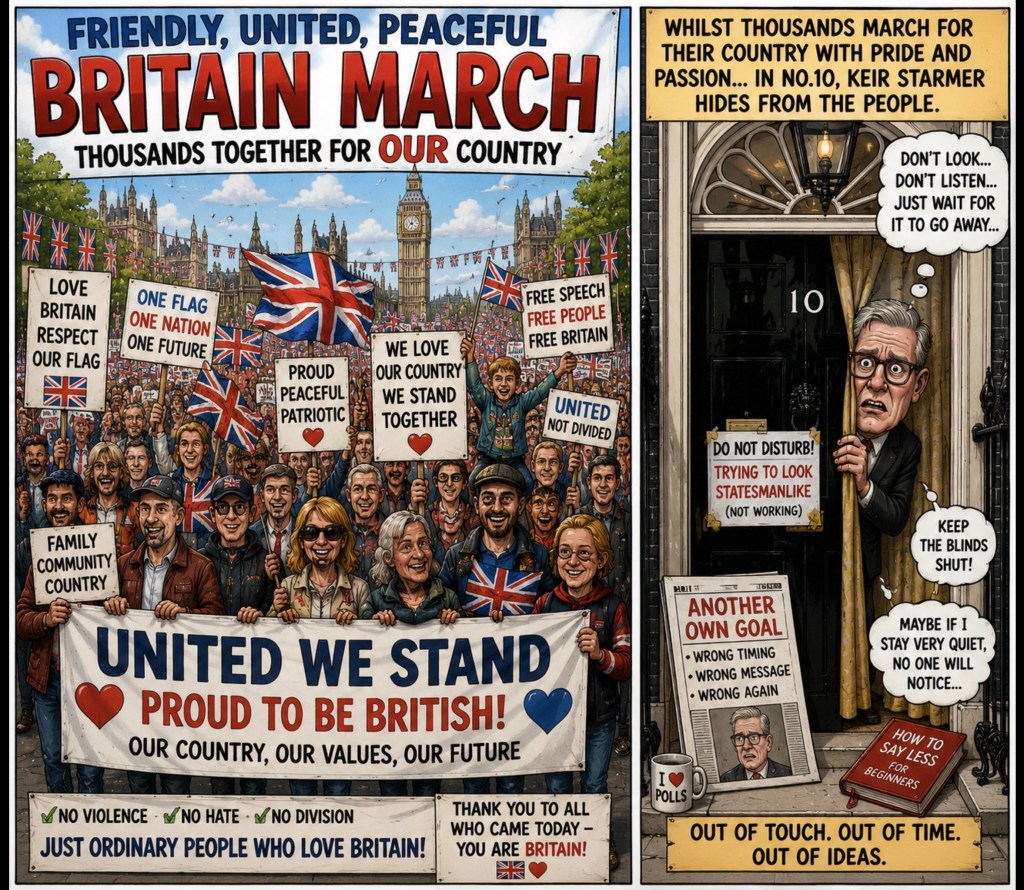
You would think after months of political own goals, awkward statements, U-turns, and public frustration, Keir Starmer might have finally discovered the ancient and mysterious art of waiting five minutes before speaking. But no — once again the microphone switched on before the facts had even finished putting their shoes on. 🎤💥
Because what many people saw wasn’t “far-right extremism,” “far-left agitation,” or some cartoon villain gathering organised by online commentators desperate for clicks.
What they saw were ordinary people who simply love Britain. 🇬🇧
Nothing more.
Nothing less.
🏴 Loving Your Country Isn’t Extremism
This is the growing frustration boiling across Britain:
the political class increasingly seems unable to distinguish between genuine extremism and ordinary patriotism.
People waving flags.
People concerned about their communities.
People worried about immigration, culture, identity, safety, economics, or national direction.
People wanting borders, stability, and accountability.
That does not automatically make them radicals. ⚖️
But Westminster often reacts as though any public display of national identity outside a football tournament must immediately be placed under investigation by a committee in London.
And every time politicians rush to smear huge groups of people before understanding who they actually are, they deepen the divide even further. 📉
🎭 The Problem With Political Labels
Modern politics has become addicted to labels because labels are easier than conversations.
“Far-right.”
“Far-left.”
“Populist.”
“Extremist.”
“Nationalist.”
Once the label lands, debate stops. The media machine spins up. Social media erupts. And ordinary people feel dismissed before they’ve even spoken. 📺⚠️
The danger is obvious:
If governments and media constantly describe ordinary patriotic citizens as dangerous, eventually people stop trusting either government or media altogether.
And once trust collapses, anger rushes in to fill the vacuum.
🏛️ Britain’s Political Class Keeps Misreading the Mood
Many people aren’t protesting because they “hate” Britain.
They’re protesting because they feel Britain is changing rapidly and nobody in Westminster listens until public frustration spills onto the streets. 🇬🇧
That doesn’t mean every crowd is perfect. It doesn’t mean there are never extremists hiding within larger movements. Every major demonstration attracts opportunists and agitators eventually.
But treating everyone as guilty by association before the facts are clear is exactly the kind of political arrogance that keeps making the situation worse.
And people are tired of being instantly caricatured simply for caring about the country they live in.
🔥Challenges🔥
Has Westminster become too quick to label ordinary patriotic concern as extremism? Are politicians genuinely listening to public frustration — or simply dismissing it with headlines and buzzwords? 🤔🇬🇧
Drop your thoughts in the blog comments — not just social media where every debate instantly becomes a digital food fight. 💬🔥
👇 Hit comment, hit like, hit share.
When does patriotism become “acceptable” again in modern Britain? 🇬🇧⚡
The strongest comments and sharpest takes will be featured in the next issue of the magazine. 📝🔥
Chameleon News


Leave a comment