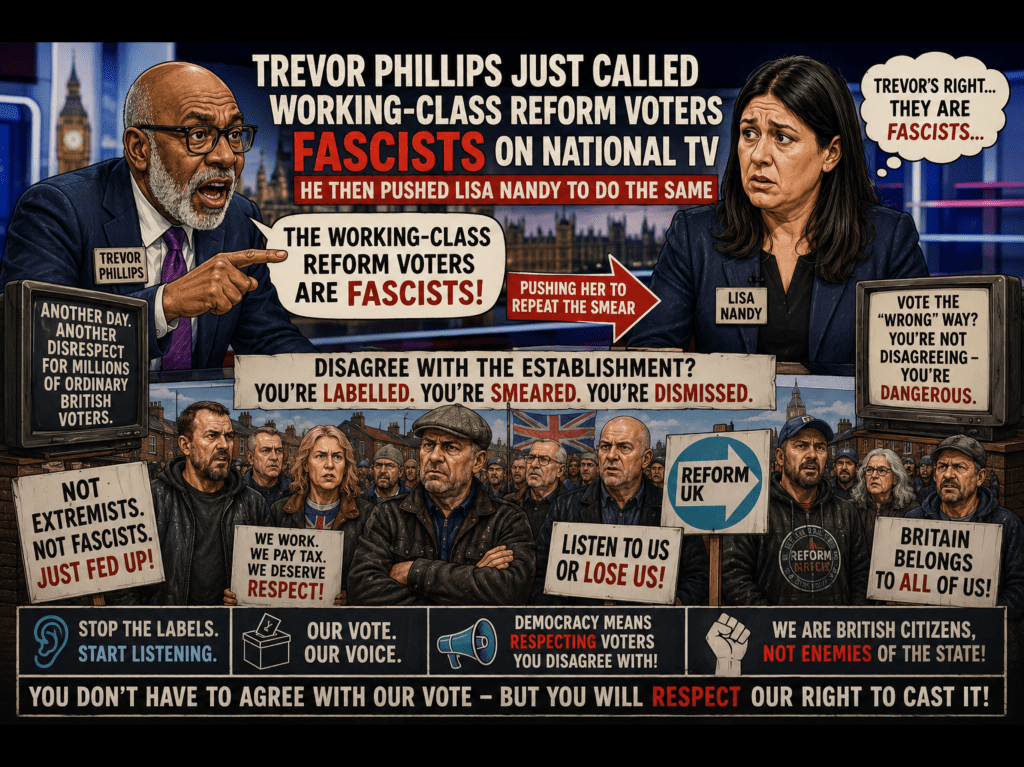
And if that wasn’t enough, he then appeared to push Lisa Nandy to join in and repeat the same accusation live on air. 📺⚠️
For millions of ordinary people watching at home — many of them working-class voters already frustrated with Westminster, the media, immigration pressures, cost of living chaos, and political arrogance — the message landed like a slap across the face.
Because increasingly in Britain, it seems voting the “wrong way” no longer means people disagree with you politically.
Now it means parts of the establishment feel comfortable portraying you as morally dangerous. 🎭
🏛️ The Working Class: Celebrated When Convenient, Smeared When Defiant
This is the contradiction many voters are now noticing loud and clear.
When working-class communities vote for establishment parties, politicians and broadcasters call them:
- “hard-working families”
- “the backbone of Britain”
- “ordinary decent people”
But when those same voters drift towards Reform out of frustration or protest?
Suddenly the language changes:
- “extremists”
- “far-right”
- “dangerous”
- “fascists”
And millions of people are now asking:
At what point did ordinary political disagreement become psychological warfare against voters themselves? ⚡
🎤 The Fastest Way to Avoid Listening? Label People
Because once words like “fascist” enter a debate, the conversation effectively ends.
Nobody asks:
- Why are Reform gaining support?
- Why are voters abandoning mainstream parties?
- Why do so many working-class communities feel ignored?
- Why is trust collapsing in politics and media?
Instead the discussion becomes:
“How do we discredit these people quickly enough to avoid confronting why they’re angry in the first place?” 🚫
That’s what infuriates many Reform voters most.
They don’t see themselves as extremists.
They see themselves as ordinary citizens concerned about:
- borders 🚧
- national identity 🇬🇧
- economic pressure 💸
- public services 🏥
- political trust 📉
- and feeling unheard by Westminster itself
Agree or disagree with those concerns, branding huge sections of the working class as fascists only pushes people further away from the institutions making the accusation.
📺 Britain’s Media Class Keeps Misreading the Mood
The real danger for broadcasters and political elites is this:
every time ordinary voters feel mocked, dismissed, or smeared, anti-establishment anger grows stronger.
People can tolerate disagreement.
What they increasingly refuse to tolerate is open contempt.
And many viewers watching that interview likely came away feeling the same thing:
that parts of Britain’s political and media class now seem more interested in condemning public frustration than understanding why it exists at all.
🔥 Challenges 🔥
Has modern political debate become too quick to label working-class frustration as extremism? And are media figures deepening division by smearing millions of ordinary voters instead of listening to why they’re angry? 🤔🇬🇧
Drop your thoughts in the blog comments — not just social media where every debate instantly turns into outrage clips and tribal warfare. 💬🔥
👇 Hit comment, hit like, hit share.
Can democracy survive if large parts of the public feel openly despised by the establishment? ⚡🏛️
The strongest comments and sharpest takes will be featured in the next issue of the magazine. 📝🔥
Chameleon News


Leave a comment