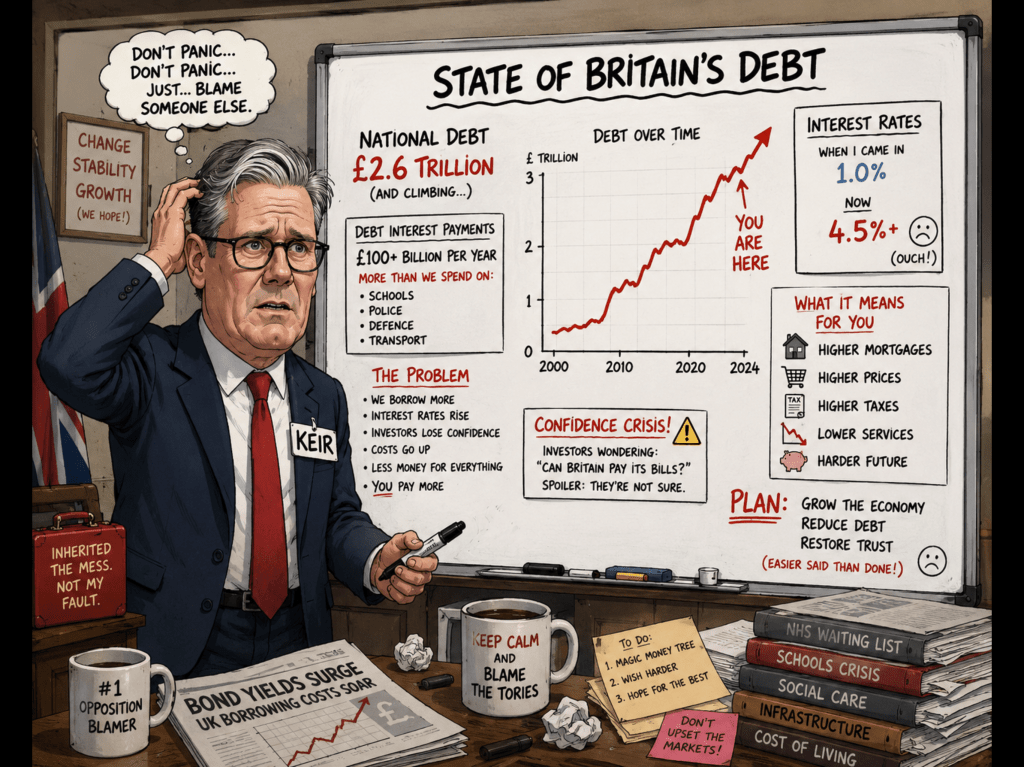
The UK bond market is flashing warning lights like a broken fruit machine in a seaside arcade, and yet Westminster keeps pretending everything’s absolutely fine. Borrowing costs are surging, investors are getting twitchier than a cat in a fireworks factory, and the government is now paying more just to service debt than it spends on entire public departments. 📉🇬🇧
Translation for normal humans? Your mortgage, your rent, your taxes, your bills, your pension, and your future are all being quietly tossed into the Treasury blender while politicians hold another press conference about “growth plans” nobody believes anymore.
And now Keir Starmer strolls into the middle of this economic bonfire carrying a clipboard and a slogan. Because apparently inheriting a collapsing confidence crisis is the new definition of “stable leadership.” 🧯😬
💸 Britain’s Debt Addiction Has Entered Its Villain Era
Here’s the problem they don’t explain properly on TV: when bond markets lose confidence in a country, they demand higher interest rates to lend money. That means Britain has to pay more just to borrow cash to keep the lights on.
More debt interest means:
- Less money for hospitals 🏥
- Less money for schools 📚
- Less money for pensions 👴
- Higher taxes for everyone who still works 💀
- More cuts disguised as “efficiency savings”
It’s basically paying off one maxed-out credit card with another while insisting you’re “fiscally responsible.”
And investors are nervous because Britain now looks politically unstable, economically sluggish, overtaxed, overborrowed, and governed by people whose greatest skill is blaming the previous lot while continuing exactly the same policies. 🎪
The bond markets aren’t emotional. They don’t care about party slogans or carefully staged factory visits in hi-vis jackets. They care whether the UK can actually grow, pay its debts, and stop behaving like a country managed via panic and PowerPoint.
Right now? The answer looks shakier than a Wetherspoons table. 🍺📉
🧱 Keir Starmer’s Incoming Concrete Shoes
Keir promised competence. Calm. Stability. Serious government. Lovely words. Unfortunately, bond traders tend to prefer maths.
And the maths is ugly.
Starmer is walking straight into:
- Rising borrowing costs
- Weak economic growth
- Massive public spending demands
- Crumbling infrastructure
- Record tax burdens
- An exhausted public that’s already been squeezed dry
Every promise now comes with a terrifying little question attached:
“Who’s paying for it?” 💷👀
Because when borrowing costs rise, governments lose room to manoeuvre. Every grand pledge suddenly costs billions more. Every crisis becomes harder to contain. Every budget becomes a hostage negotiation with the financial markets.
This is the next disaster Keir will own — whether he caused it or not.
And voters won’t care whose spreadsheet started the fire. They’ll care who was standing there when the smoke alarm exploded. 🚨
🏚️ Welcome to Austerity 2.0: Now With Better Branding
Here’s the really fun part: both major parties spent years pretending Britain could endlessly spend, borrow, subsidise, tax, and stagnate without consequences.
Now the bill’s arrived.
The country faces the grim possibility of:
- Higher mortgage repayments 🏠
- More stealth taxes 🧾
- Worse public services 🚑
- Pension pressure 💰
- Frozen wages 🥶
- More economic decline dressed up as “difficult decisions”
The elite class will still be fine, naturally. They’ll continue discussing “market confidence” over £14 cocktails in Westminster wine bars while ordinary people compare supermarket prices like Cold War ration planners. 🍞
Meanwhile the public gets told to remain “resilient.” Which is political code for:
“You’re on your own.” 👍
🔥Challenges🔥
At what point do people stop treating this as normal? How many times can Britain be told the economy is “recovering” while living standards sink like a shopping trolley in a canal?
Do you think Starmer can actually avoid this financial train wreck — or is he about to become the next manager of national decline? 💬🔥
👇 Drop your verdict in the blog comments. Like, share, and unleash your best economic rage in the replies.
The sharpest comments, funniest burns, and most brutal truths will be featured in the next issue of the magazine. 📝⚡
Chameleon News


Leave a Reply