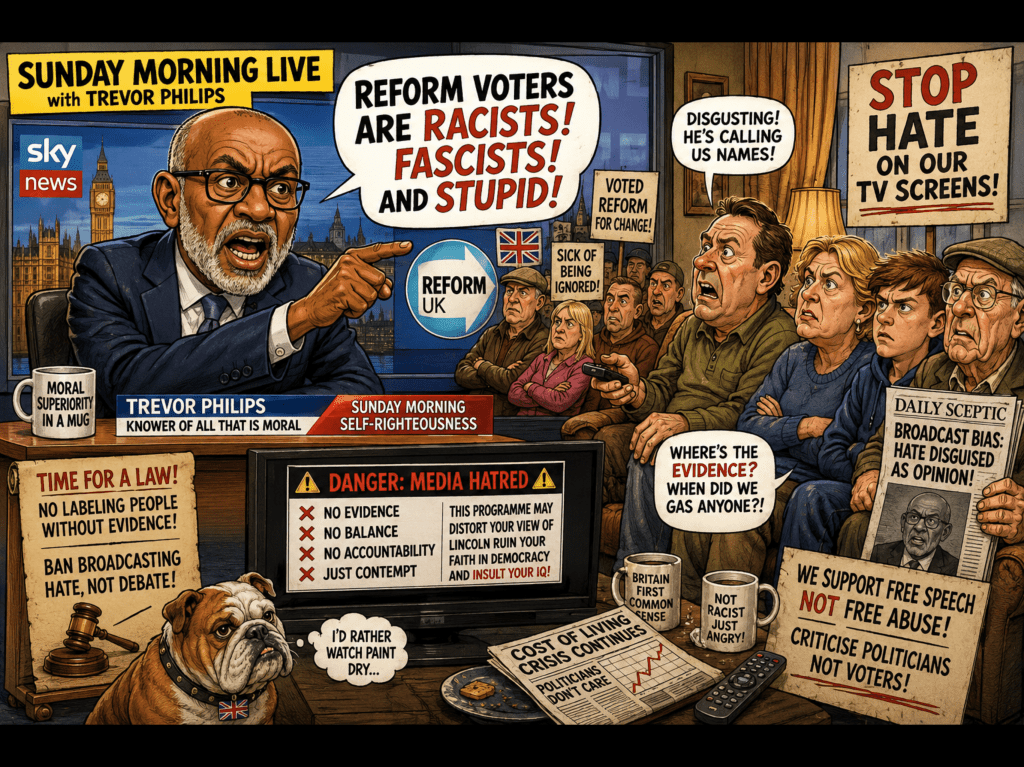
British television has once again stumbled into the gladiator pit where outrage, politics, and daytime broadcasting wrestle in a puddle of self-righteousness and bad coffee. Reports that Trevor Phillips described Reform voters as “racists, fascists and stupid” have detonated across social media like someone tossed a lit firework into a mobility scooter convention. 💥🛵
And here’s the problem: when a major TV figure starts throwing around labels usually reserved for dictatorships and goose-stepping maniacs, people stop hearing “analysis” and start hearing “contempt.” Especially millions of ordinary voters who already think parts of the media see them as backward peasants who should apologise for owning an England flag and a Facebook account. 🇬🇧📱
🎭 The Holy Priests of Television Morality
Modern political broadcasting increasingly feels less like journalism and more like a Victorian headmaster scolding the public for incorrect opinions. One minute viewers tune in for debate, the next they’re being told they’re one suspicious tweet away from reenacting 1930s Europe.
Now, let’s be clear: criticism of political parties is completely fair game in a democracy. If politicians say inflammatory things, journalists and presenters absolutely have the right to challenge them hard. But branding huge swathes of voters with loaded accusations like “fascist” is political napalm. Once that word gets casually sprayed around television studios, meaningful discussion dies instantly. 💣🗞️
Because here’s the awkward truth Westminster and media elites hate admitting: not everyone voting Reform is doing it because they secretly dream of marching through Croydon in jackboots. Some are angry about immigration. Some are furious about living costs. Some just want to launch a brick through the window of the political establishment after years of broken promises and managerial waffle. 🧱🏛️
And comparing voters to monsters without evidence? Dangerous territory. Democracies survive by arguing with people — not by declaring half the electorate morally radioactive.
That said, calls for banning speech by law are another trap entirely. Once governments start deciding which political opinions are too offensive for television, the door swings open for censorship against everybody. Today it’s one presenter. Tomorrow it’s anyone criticising the government hard enough. ⚖️🚪
The answer to speech people dislike is usually more debate, more scrutiny, and more accountability — not politicians handing themselves bigger censorship buttons like toddlers discovering the TV remote. 📡👶
🔥 Challenges 🔥
Has political debate in Britain become nothing more than elite sneering versus populist outrage? Are TV presenters crossing the line from journalism into open political activism? Or are viewers becoming too quick to label criticism as “hate”? 🤔🔥
Drop your take in the blog comments — but bring facts, fury, and sarcasm in equal measure. We want the sharpest arguments, the funniest burns, and the most brutally honest reactions. 💬⚔️
👇 Hit comment, hit like, hit share.
Call out hypocrisy wherever you see it — media, politicians, or the permanently offended online mobs. 🎯📺
The best comments and most savage replies will be featured in the next issue of the magazine. 📰🔥
Chameleon News


 Chameleon Magazine
Leave a comment